Department of Pharmacy, Pharmaceutical Biology, LMU Munich, Munich, Germany.
Institute of Pharmacy, Paracelsus Medical University, Salzburg, Austria.
Hepatology. 2019 Jan;69(1):376-393. doi: 10.1002/hep.30190. Epub 2018 Dec 22.
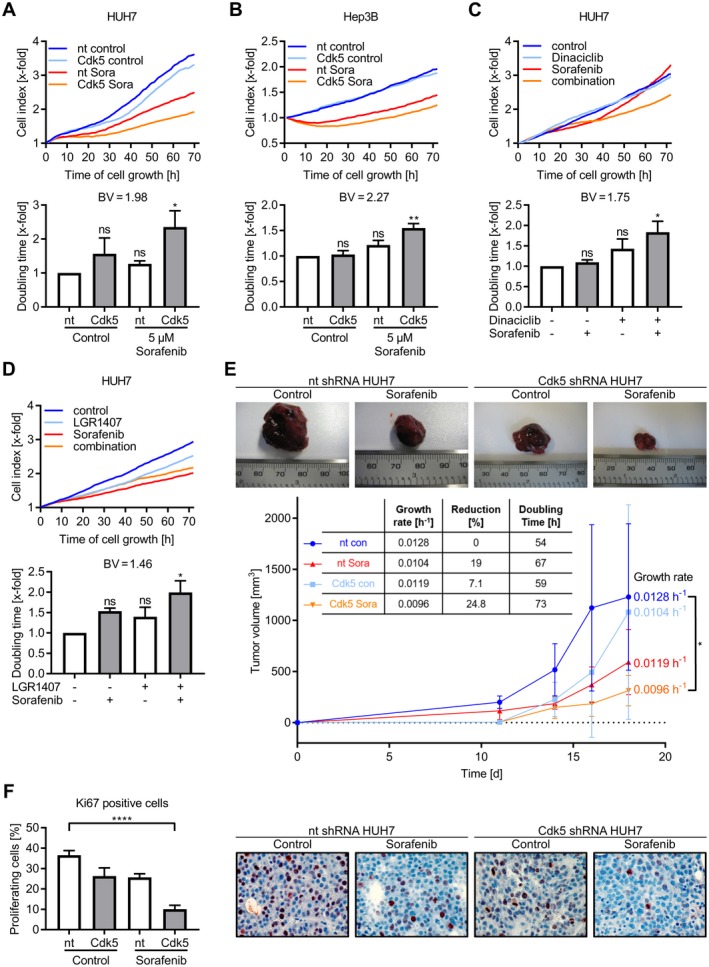
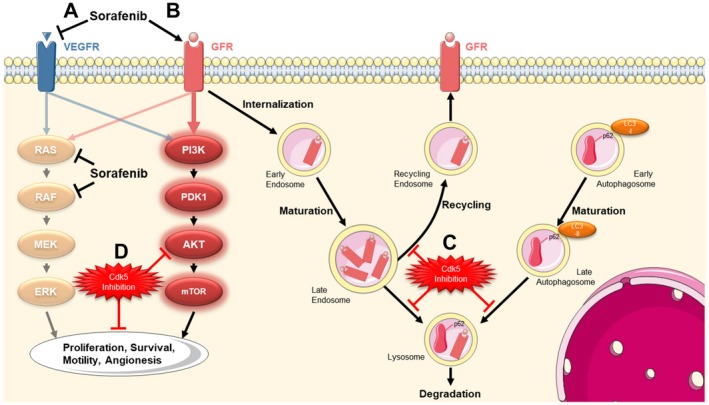
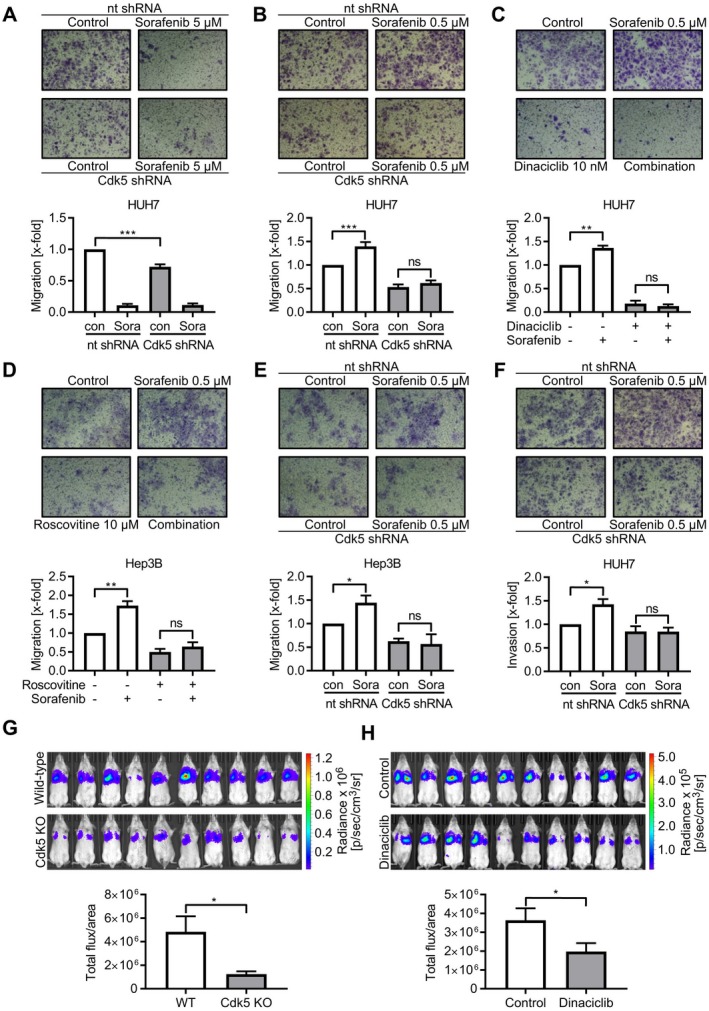
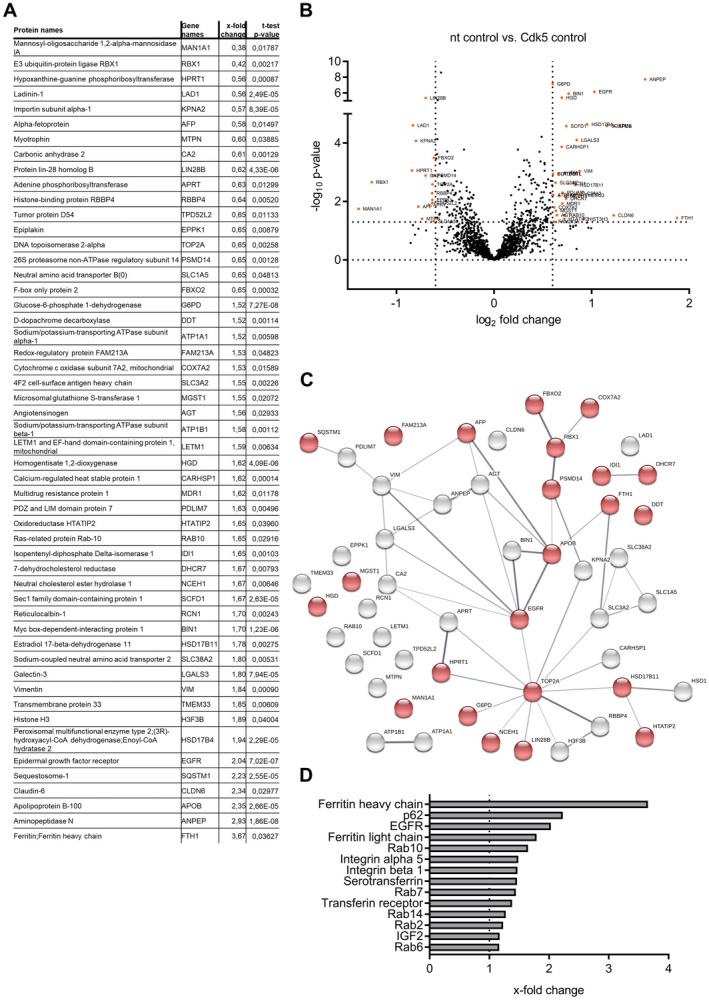
Therapeutic options for patients with advanced-stage hepatocellular carcinoma (HCC) are very limited. The only approved first-line treatment is the multi-tyrosine kinase inhibitor sorafenib, which shows low response rates and severe side effects. In particular, the compensatory activation of growth factor receptors leads to chemoresistance and limits the clinical impact of sorafenib. However, combination approaches to improve sorafenib have failed. Here we investigate the inhibition of cyclin-dependent kinase 5 (Cdk5) as a promising combination strategy to improve sorafenib response in HCC. Combination of sorafenib with Cdk5 inhibition (genetic knockdown by short hairpin RNA or CRISPR/Cas9 and pharmacologic inhibition) synergistically impaired HCC progression in vitro and in vivo by inhibiting both tumor cell proliferation and migration. Importantly, these effects were mediated by a mechanism for Cdk5: A liquid chromatography-tandem mass spectrometry-based proteomic approach revealed that Cdk5 inhibition interferes with intracellular trafficking, a process crucial for cellular homeostasis and growth factor receptor signaling. Cdk5 inhibition resulted in an accumulation of enlarged vesicles and respective cargos in the perinuclear region, considerably impairing the extent and quality of growth factor receptor signaling. Thereby, Cdk5 inhibition offers a comprehensive approach to globally disturb growth factor receptor signaling that is superior to specific inhibition of individual growth factor receptors. Conclusion: Cdk5 inhibition represents an effective approach to improve sorafenib response and to prevent sorafenib treatment escape in HCC. Notably, Cdk5 is an addressable target frequently overexpressed in HCC, and with Dinaciclib, a clinically tested Cdk5 inhibitor is readily available. Thus, our study provides evidence for clinically evaluating the combination of sorafenib and Dinaciclib to improve the therapeutic situation for patients with advanced-stage HCC.
晚期肝细胞癌 (HCC) 患者的治疗选择非常有限。唯一批准的一线治疗方法是多激酶抑制剂索拉非尼,但它的反应率低,副作用严重。特别是,生长因子受体的代偿性激活导致了化疗耐药,并限制了索拉非尼的临床影响。然而,联合治疗方法以改善索拉非尼的效果却失败了。在这里,我们研究了抑制细胞周期蛋白依赖性激酶 5 (Cdk5) 作为一种有前途的联合策略,以改善 HCC 对索拉非尼的反应。索拉非尼与 Cdk5 抑制(通过短发夹 RNA 或 CRISPR/Cas9 的基因敲低和药理学抑制)联合使用,在体外和体内协同抑制 HCC 的进展,通过抑制肿瘤细胞的增殖和迁移。重要的是,这些作用是通过 Cdk5 的一种机制介导的:一种基于液相色谱-串联质谱的蛋白质组学方法表明,Cdk5 抑制干扰了细胞内运输,这是细胞内平衡和生长因子受体信号传导的关键过程。Cdk5 抑制导致核周区域中增大的囊泡及其各自的 cargo 的积累,严重损害了生长因子受体信号的程度和质量。因此,Cdk5 抑制提供了一种全面的方法来全局扰乱生长因子受体信号,这比单独抑制个别生长因子受体更为有效。结论:Cdk5 抑制代表了一种有效改善索拉非尼反应并防止 HCC 中索拉非尼治疗逃逸的方法。值得注意的是,Cdk5 在 HCC 中经常过度表达,是一个可寻址的靶点,并且 Dinaciclib 是一种经过临床测试的 Cdk5 抑制剂,随时可用。因此,我们的研究为临床评估索拉非尼和 Dinaciclib 的联合应用以改善晚期 HCC 患者的治疗情况提供了证据。