Cole C N, Tornow J, Clark R, Tjian R
J Virol. 1986 Feb;57(2):539-46. doi: 10.1128/JVI.57.2.539-546.1986.
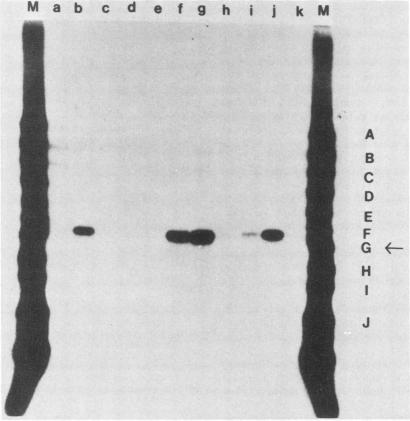
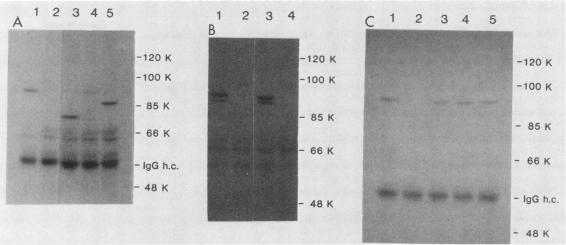
The biochemical properties of the large T antigens encoded by simian virus 40 (SV40) mutants with deletions at DdeI sites in the SV40 A gene were determined. Mutant large T antigens containing only the first 138 to 140 amino acids were unable to bind to the SV40 origin of DNA replication as were large T antigens containing at their COOH termini 96 or 97 amino acids encoded by the long open reading frame located between 0.22 and 0.165 map units (m.u.). All other mutant large T antigens were able to bind to the SV40 origin of replication. Mutants with in-phase deletions at 0.288 and 0.243 m.u. lacked ATPase activity, but ATPase activity was normal in mutants lacking origin-binding activity. The 627-amino acid large T antigen encoded by dlA2465, with a deletion at 0.219 m.u., was the smallest large T antigen displaying ATPase activity. Mutant large T antigens with the alternate 96- or 97-amino acid COOH terminus also lacked ATPase activity. All mutant large T antigens were found in the nuclei of infected cells; a small amount of large T with the alternate COOH terminus was also located in the cytoplasm. Mutant dlA2465 belonged to the same class of mutants as dlA2459. It was unable to form plaques on CV-1p cells at 37 or 32 degrees C but could form plaques on BSC-1 monolayers at 37 degrees C but not at 32 degrees C. It was positive for viral DNA replication and showed intracistronic complementation with any group A mutant whose large T antigen contained a normal carboxyl terminus. These findings and those of others suggest that both DNA binding and ATPase activity are required for the viral DNA replication function of large T antigen, that these two activities must be located on the same T antigen monomer, and that these two activities are performed by distinct domains of the polypeptide. These domains are distinct and separable from the domain affected by the mutation of dlA2465 and indicate that SV40 large T antigen is made up of at least three separate functional domains.
测定了猿猴病毒40(SV40)A基因中DdeI位点有缺失的SV40突变体所编码的大T抗原的生化特性。仅含前138至140个氨基酸的突变大T抗原不能与SV40 DNA复制起点结合,位于0.22至0.165图距单位(m.u.)之间的长开放阅读框在其COOH末端编码96或97个氨基酸的大T抗原也不能与SV40 DNA复制起点结合。所有其他突变大T抗原都能与SV40复制起点结合。在0.288和0.243 m.u.处有同相位缺失的突变体缺乏ATP酶活性,但在缺乏起点结合活性的突变体中ATP酶活性正常。由dlA2465编码的627个氨基酸的大T抗原在0.219 m.u.处有缺失,是显示ATP酶活性的最小大T抗原。具有替代的96或97个氨基酸COOH末端的突变大T抗原也缺乏ATP酶活性。所有突变大T抗原都存在于被感染细胞的细胞核中;少量具有替代COOH末端的大T也位于细胞质中。突变体dlA2465与dlA2459属于同一类突变体。它在CV-1p细胞上于37或32℃时不能形成噬斑,但在BSC-1单层细胞上于37℃时能形成噬斑,而在32℃时不能形成噬斑。它的病毒DNA复制呈阳性,并与任何大T抗原含有正常羧基末端的A组突变体表现出顺反子内互补。这些发现以及其他研究结果表明,DNA结合和ATP酶活性对于大T抗原的病毒DNA复制功能都是必需的,这两种活性必须位于同一个T抗原单体上,并且这两种活性由多肽的不同结构域执行。这些结构域与受dlA2465突变影响的结构域不同且可分离,表明SV40大T抗原至少由三个独立的功能结构域组成。