Department of Microbiology, University of Tennessee Knoxville, Knoxville, TN 37996, USA.
Viruses. 2018 Jul 20;10(7):383. doi: 10.3390/v10070383.
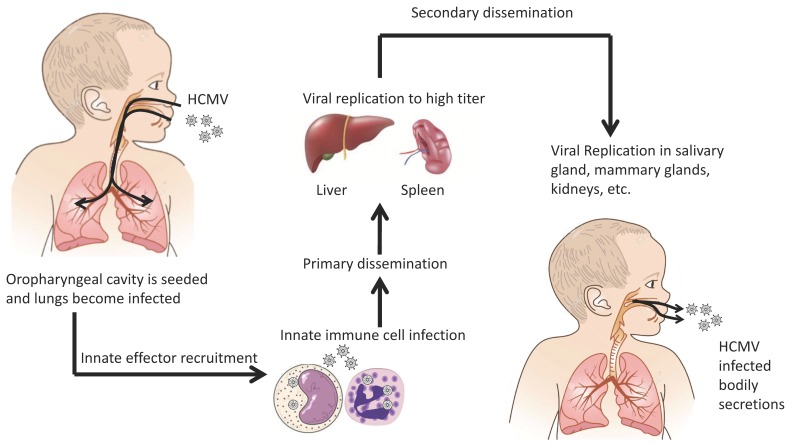
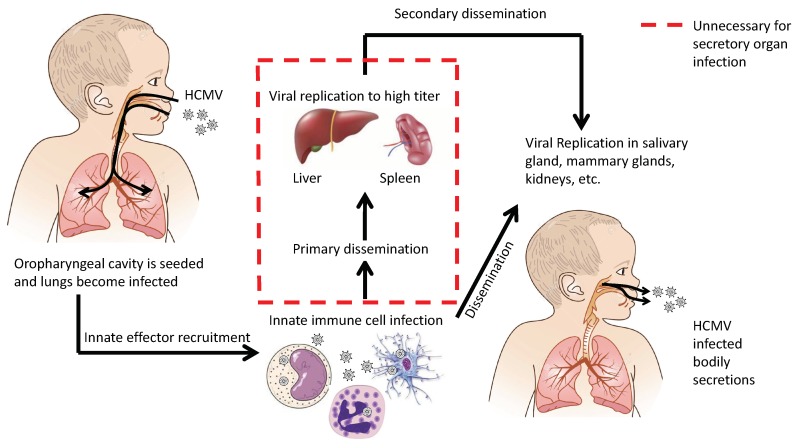
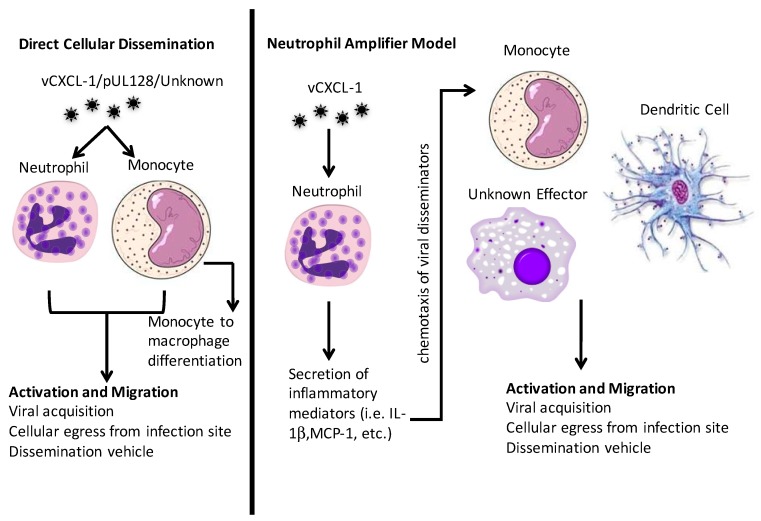
Human cytomegalovirus (HCMV) is a β-herpes virus that is a significant pathogen within immune compromised populations. HCMV morbidity is induced through viral dissemination and inflammation. Typically, viral dissemination is thought to follow Fenner's hypothesis where virus replicates at the site of infection, followed by replication in the draining lymph nodes, and eventually replicating within blood filtering organs. Although CMVs somewhat follow Fenner's hypothesis, they deviate from it by spreading primarily through innate immune cells as opposed to cell-free virus. Also, in vivo CMVs infect new cells via cell-to-cell spread and disseminate directly to secondary organs through novel mechanisms. We review the historic and recent literature pointing to CMV's direct dissemination to secondary organs and the genes that it has evolved for increasing its ability to disseminate. We also highlight aspects of CMV infection for studying viral dissemination when using in vivo animal models.
人类巨细胞病毒(HCMV)是一种β疱疹病毒,在免疫功能低下的人群中是一种重要的病原体。HCMV 的发病机制是通过病毒传播和炎症诱导的。通常,病毒传播被认为遵循 Fenner 的假说,即病毒在感染部位复制,然后在引流淋巴结中复制,最终在血液过滤器官中复制。尽管 CMV 有些遵循 Fenner 的假说,但它们通过主要通过先天免疫细胞而不是无细胞病毒传播来偏离它。此外,在体内,CMV 通过细胞间传播感染新细胞,并通过新机制直接传播到次级器官。我们回顾了指向 CMV 直接传播到次级器官的历史和最新文献,以及它为提高传播能力而进化的基因。我们还强调了在使用体内动物模型研究病毒传播时 CMV 感染的各个方面。