Department of Recreation, Sport and Tourism, University of Illinois at Urbana-Champaign, Champaign, IL 61820, USA.
Int J Environ Res Public Health. 2018 Jul 20;15(7):1541. doi: 10.3390/ijerph15071541.
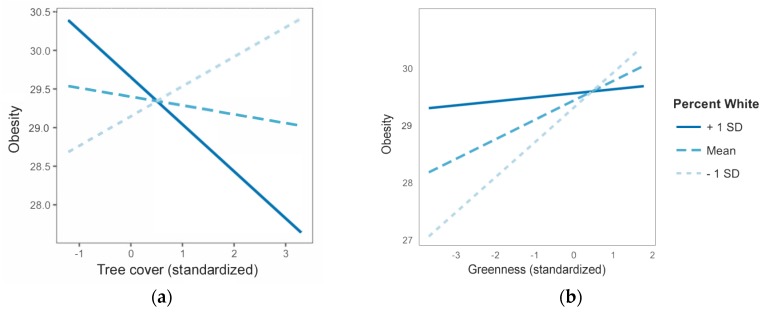
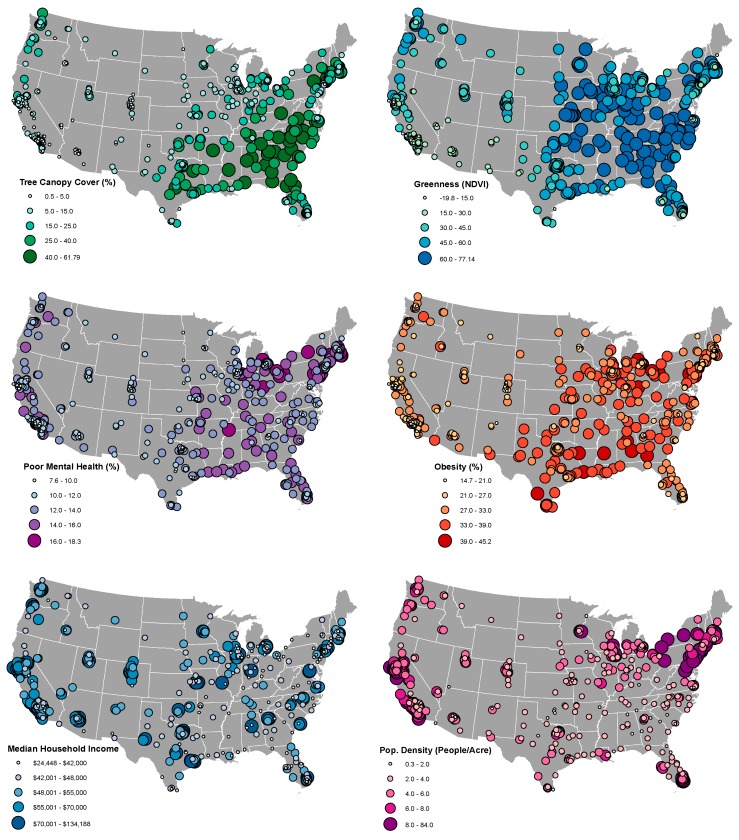
Examination of the greenspace-human health relationship operates in at least four dimensions: what is considered greenspace? which moderators and mediators are included? what outcomes are measured? and which units of analysis (e.g., individuals, cities) are studied? We examined three of these four dimensions in a cross-sectional study of 496 of the 500 most populated US cities (total population size = 97,574,613, average population per city = 197,920). Spatial average models tested the effect of two greenspace measures (Normalized Difference Vegetation Index greenness and tree cover) on two outcomes (obesity and mental health), while adjusting for income, race and ethnicity, sprawl, age, sex, physical inactivity, median age of housing, and total population. We conducted analyses at the city scale, which is an understudied unit of analysis, and compared findings to individual- and neighborhood-level studies. In two of four models, greenspace was associated with better health. We found race and ethnicity moderated this relationship with varying results. In full sample analyses, cities with greater percentages of non-Hispanic Whites showed links between higher tree cover and lower obesity but marginal relationships between higher greenness and lower obesity. In subsample analyses with majority-non-Hispanic Black cities, higher tree cover was associated with lower obesity and better mental health. These findings advance previous research by showing that race and ethnicity moderate the greenspace-health link at the city level.
什么是绿地?包括哪些调节因素和中介因素?测量哪些结果?以及研究哪些分析单位(例如个人、城市)?我们在一项对美国 500 个人口最多的城市中的 496 个城市(总人口为 97574613 人,每个城市的平均人口为 197920 人)的横断面研究中检验了这四个维度中的三个。空间平均模型测试了两种绿地指标(归一化植被指数绿化和树冠覆盖率)对两种结果(肥胖和心理健康)的影响,同时调整了收入、种族和民族、蔓延程度、年龄、性别、身体活动不足、住房中位数年龄和总人口。我们在城市层面进行了分析,城市层面是一个研究不足的分析单位,并将研究结果与个体和社区层面的研究进行了比较。在四个模型中的两个中,绿地与更好的健康相关。我们发现种族和民族调节了这种关系,结果不同。在全样本分析中,非西班牙裔白人比例较高的城市与较高的树冠覆盖率和较低的肥胖率之间存在关联,但较高的绿化与较低的肥胖率之间的关系则较为边缘。在以非西班牙裔黑人为主的城市的子样本分析中,较高的树冠覆盖率与较低的肥胖率和更好的心理健康相关。这些发现通过表明种族和民族在城市层面上调节了绿地与健康之间的联系,推进了先前的研究。