Laboratory of Immune Regulation, Institute of Pharmaceutical Sciences, Seoul National University, Seoul 08826; BK21 Plus Program, College of Pharmacy, Seoul National University, Seoul 08826, Korea.
BMB Rep. 2018 Aug;51(8):371-372. doi: 10.5483/BMBRep.2018.51.8.171.
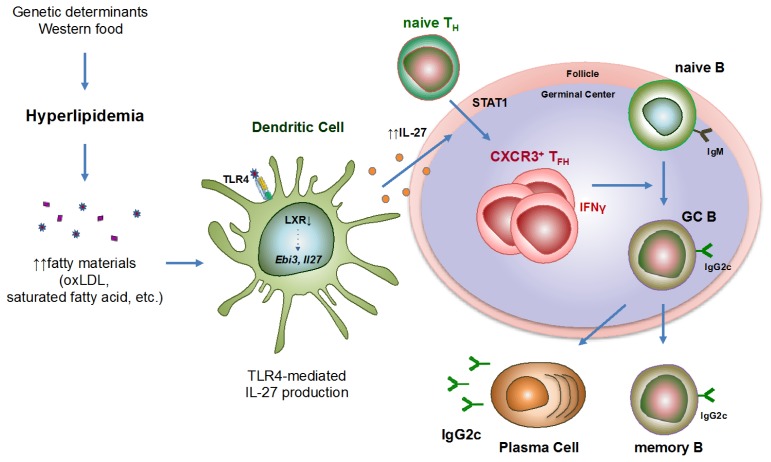
Cardiovascular disease such as atherosclerosis is caused by imbalanced lipid metabolism and represents a leading cause of death worldwide. Epidemiological studies show that patients with systemic autoimmune diseases exhibit a higher incidence of atherosclerosis. Conversely, hyperlipidemia has been known to accelerate the incidence of autoimmune diseases in humans and in animal models. However, there is a considerable gap in our understanding of how atherosclerosis impacts the development of the autoimmunity in humans, and vice versa. The atherosclerosis-related autoimmune diseases include psoriasis, rheumatoid arthritis, systemic lupus erythematosus (SLE) and diabetes mellitus. By using animal models of atherosclerosis and SLE, we have recently demonstrated that hyperlipidemia significantly accelerates the development of autoantibodies, by inducing autoimmune follicular helper T (TFH) cells. Mechanistic studies have identified that hyperlipidemia induces IL-27 production in a TLR4-dependent manner, likely via downregulating LXR expression in dendritic cells. In this case, mice lacking IL-27 do not develop enhanced antibody responses. Thus it is noted that these findings propose a mechanistic insight responsible for the tight association between cardiovascular diseases and SLE in humans. [BMB Reports 2018; 51(8): 371-372].
心血管疾病如动脉粥样硬化是由脂质代谢失衡引起的,是全球范围内主要的致死原因。流行病学研究表明,患有系统性自身免疫性疾病的患者动脉粥样硬化的发病率更高。相反,高脂血症已被证实可加速人类和动物模型中自身免疫病的发生。然而,我们对于动脉粥样硬化如何影响人类自身免疫的发展,以及反之亦然,仍存在相当大的理解差距。与动脉粥样硬化相关的自身免疫性疾病包括银屑病、类风湿关节炎、系统性红斑狼疮(SLE)和糖尿病。通过使用动脉粥样硬化和 SLE 的动物模型,我们最近证明,高脂血症通过诱导自身免疫性滤泡辅助 T(TFH)细胞,显著加速了自身抗体的产生。机制研究已经确定,高脂血症通过 TLR4 依赖性方式诱导 IL-27 的产生,可能通过下调树突状细胞中的 LXR 表达。在这种情况下,缺乏 IL-27 的小鼠不会产生增强的抗体反应。因此,这些发现表明,在人类中,心血管疾病与 SLE 之间存在紧密关联的机制见解。[BMB Reports 2018; 51(8): 371-372]。