Fundación Instituto de Investigación Sanitaria, Fundación Jiménez Díaz (FIIS-FJD), Avenida Reyes Católicos 2, 28040, Madrid, Spain.
Sci Rep. 2018 Jul 23;8(1):11089. doi: 10.1038/s41598-018-29432-4.
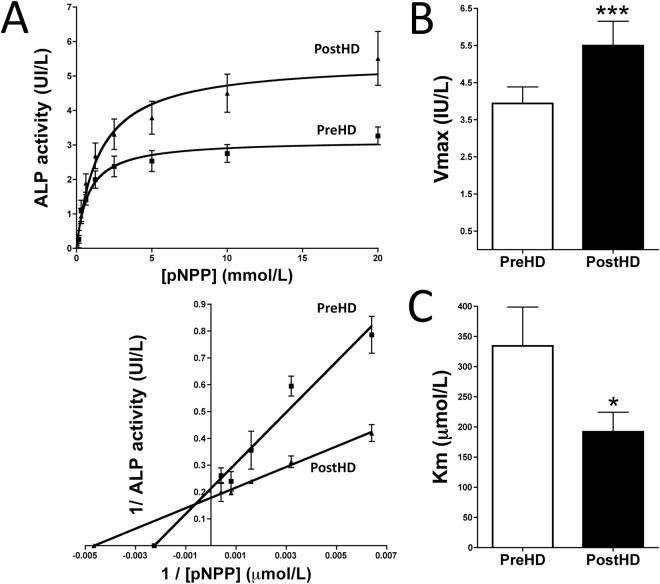
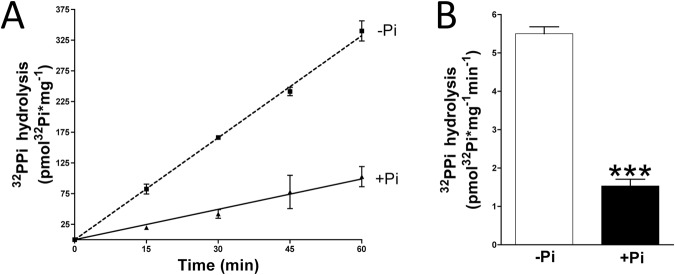
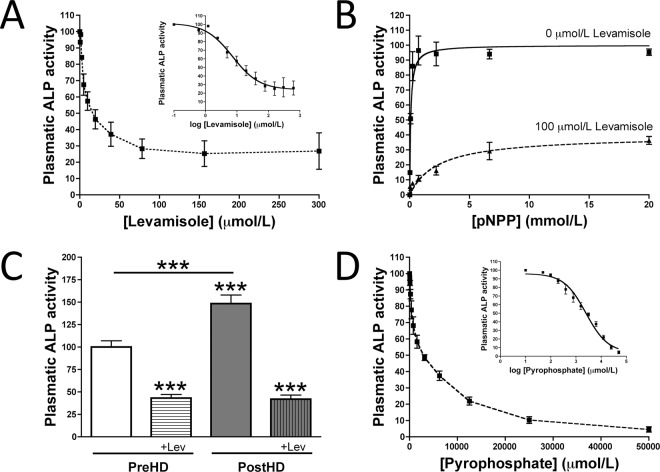
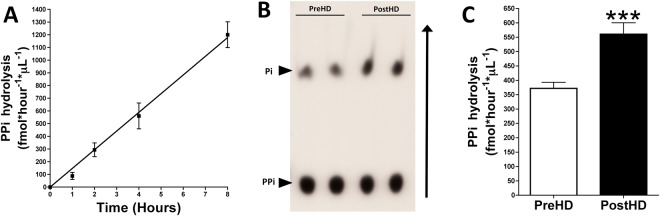
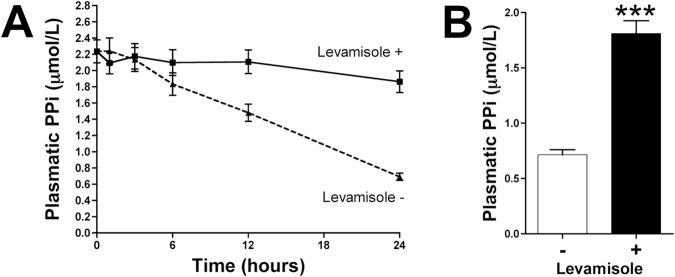
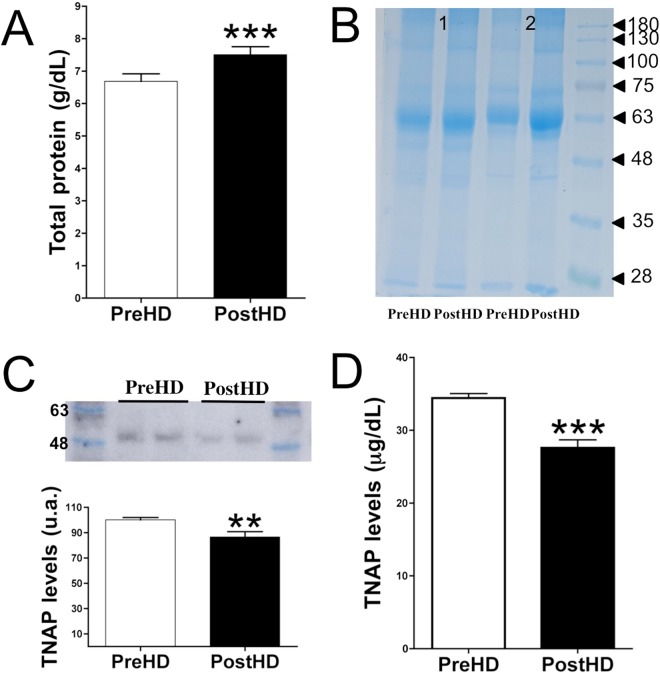
Vascular calcification (VC) is associated with significant morbidity and mortality of dialysis patients. Previous studies showed an association between loss of plasma pyrophosphate and VC. Moreover, loss of pyrophosphate occurs during dialysis in this population, suggesting that therapeutic approaches that prevent reduction of plasma pyrophosphate levels during dialysis could improve the quality of life of dialysis patients. This study found that pyrophosphate hydrolysis was 51% higher in post- than pre-dialysis plasma. Dialysis sessions modified the kinetic behavior of alkaline phosphatase, increasing its V and reducing its K, probably due to the elimination of uremic toxins during dialysis. At least 75% of alkaline phosphatase activity in human plasma was found to depend on a levamisole-sensitive enzyme probably corresponding to tissue non-specific alkaline phosphatase (TNAP). Dialysis increased total plasma protein concentration by 14% and reduced TNAP enzyme by 20%, resulting in an underestimation of pyrophosphate hydrolysis in post-dialysis plasma. Levamisole inhibited TNAP activity (IC, 7.2 µmol/L), reducing pyrophosphate hydrolysis in plasma and increasing plasma pyrophosphate availability. Alkaline phosphatase is also found in many tissues and cells types; therefore, our results in plasma may be indicative of changes in phosphatase activity in other locations that collectively could contribute significantly to pyrophosphate hydrolysis in vivo. In conclusion, these findings demonstrate that dialysis increases pyrophosphate hydrolysis, which, taken together with previously reported increases in alkalization and calcium ion levels in post-dialysis plasma, causes VC and could be prevented by adding calcification inhibitors during dialysis.
血管钙化 (VC) 与透析患者的高发病率和死亡率密切相关。既往研究表明,血浆焦磷酸盐的丢失与 VC 之间存在关联。此外,该人群在透析过程中会发生焦磷酸盐丢失,这表明在透析过程中防止血浆焦磷酸盐水平降低的治疗方法可能会改善透析患者的生活质量。本研究发现,透析后血浆中焦磷酸盐的水解率比透析前高 51%。透析过程改变了碱性磷酸酶的动力学行为,增加了其 Vmax,降低了 Km,这可能是由于透析过程中清除了尿毒症毒素。在人血浆中,至少 75%的碱性磷酸酶活性依赖于一种左旋咪唑敏感的酶,可能对应于组织非特异性碱性磷酸酶 (TNAP)。透析使总血浆蛋白浓度增加了 14%,同时使 TNAP 酶减少了 20%,导致透析后血浆中焦磷酸盐水解的低估。左旋咪唑抑制 TNAP 活性(IC50 为 7.2 μmol/L),从而减少了血浆中的焦磷酸盐水解,并增加了血浆中焦磷酸盐的含量。碱性磷酸酶也存在于许多组织和细胞类型中;因此,我们在血浆中的结果可能表明其他位置的磷酸酶活性发生了变化,这些变化共同导致体内焦磷酸盐水解增加。总之,这些发现表明,透析会增加焦磷酸盐的水解,再加上之前报道的透析后血浆中碱化和钙离子水平的升高,会导致 VC,并可通过在透析过程中添加钙化抑制剂来预防。