Associate Professor, Department of Sociology, Bowling Green State University, Bowling Green, OH.
Ph.D. Candidate, Department of Sociology, Bowling Green State University, Bowling Green, OH.
Perspect Sex Reprod Health. 2018 Sep;50(3):129-138. doi: 10.1363/psrh.12074. Epub 2018 Jul 24.
Women with an unintended birth have an elevated risk of subsequent unintended pregnancy, and multiple unintended pregnancies could exacerbate any negative consequences of such births. It is therefore important to understand whether postpartum contraceptive use differs by birth intendedness.
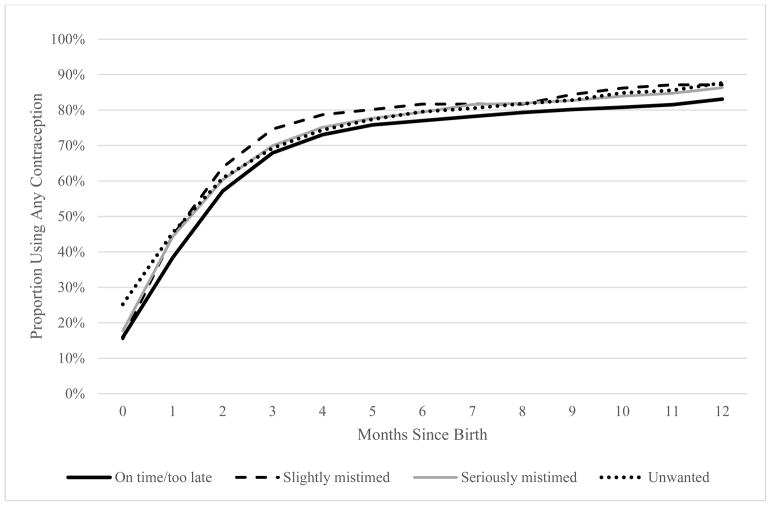
Data on 2,769 births reported in the 2011-2015 cycles of the National Survey of Family Growth were used to examine postpartum contraceptive use. Life-table estimates were employed to assess differences by birth intendedness in timing of postpartum contraceptive use, and multinomial logistic event history methods were used to model initial contraceptive uptake and efficacy by birth intendedness.
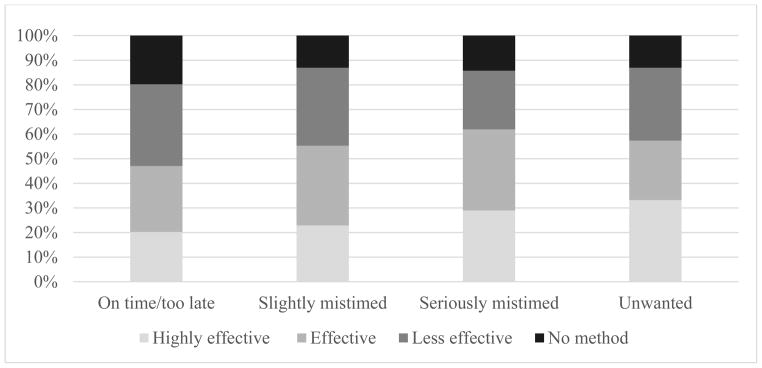
Compared with postpartum women whose births were on time or too late, those with seriously mistimed and those with unwanted births were more likely to first adopt a highly effective method (e.g., implant or IUD), rather than no method (relative risk ratios, 1.9 and 1.7, respectively); mothers with unwanted births were also more likely to first use least effective methods (e.g., condoms or withdrawal) instead of no method (1.5). Mothers with seriously mistimed births had a reduced likelihood of using either effective methods (e.g., the pill or injectable) or least effective methods, rather than highly effective ones (0.5 for each).
The elevated risk of repeat unintended fertility does not seem to be due to mothers' initial postpartum contraceptive behavior. Whether mothers with unintended births use contraceptives less consistently, discontinue use sooner or switch methods more often than those with intended births remains to be seen.
意外妊娠的女性随后再次发生意外妊娠的风险增加,多次意外妊娠可能会加剧此类分娩的任何负面后果。因此,了解产后避孕措施是否因生育意愿而有所不同非常重要。
使用 2011-2015 年全国家庭增长调查周期中报告的 2769 例分娩数据,检查产后避孕措施的使用情况。寿命表估计用于评估生育意愿不同对产后避孕措施使用时间的差异,多分类逻辑事件史方法用于根据生育意愿对初始避孕方法的采用和效果进行建模。
与分娩时间正常或过晚的产后女性相比,分娩时间严重延误和非意愿分娩的女性更有可能首先采用高效避孕方法(如植入物或宫内节育器),而不是不采用任何方法(相对风险比分别为 1.9 和 1.7);非意愿分娩的母亲也更有可能首先使用效果最差的方法(如避孕套或体外排精)而不是不采用任何方法(1.5)。分娩时间严重延误的母亲使用有效方法(如避孕药或注射剂)或效果最差的方法(每种方法的 0.5)的可能性降低。
再次意外怀孕的风险增加似乎并不是由于母亲产后最初的避孕行为所致。意外妊娠的母亲是否比有意愿生育的母亲更不规律地使用避孕药具、更早停止使用或更频繁地更换方法,还有待观察。