Institute of Ecology and Evolutionary Biology, National Taiwan University, Taipei, Taiwan.
Australian Research Council Centre of Excellence for Environmental Decisions, University of Melbourne, Melbourne, Australia.
Sci Rep. 2018 Jul 24;8(1):11130. doi: 10.1038/s41598-018-29517-0.
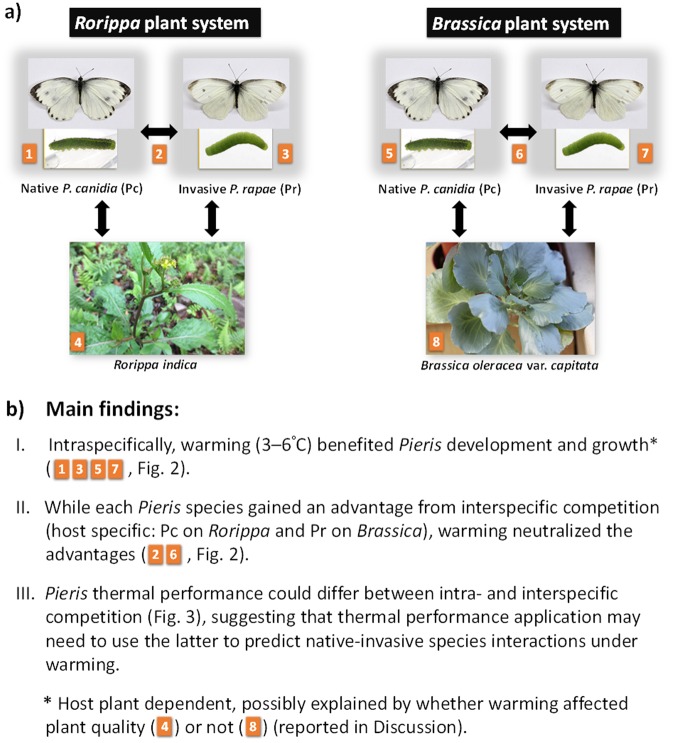
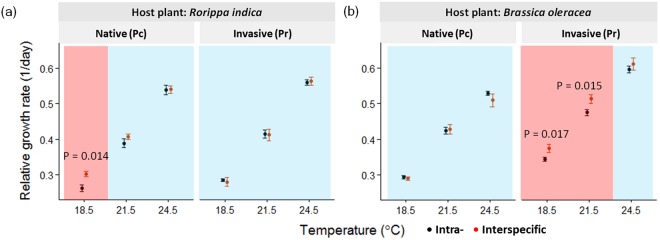
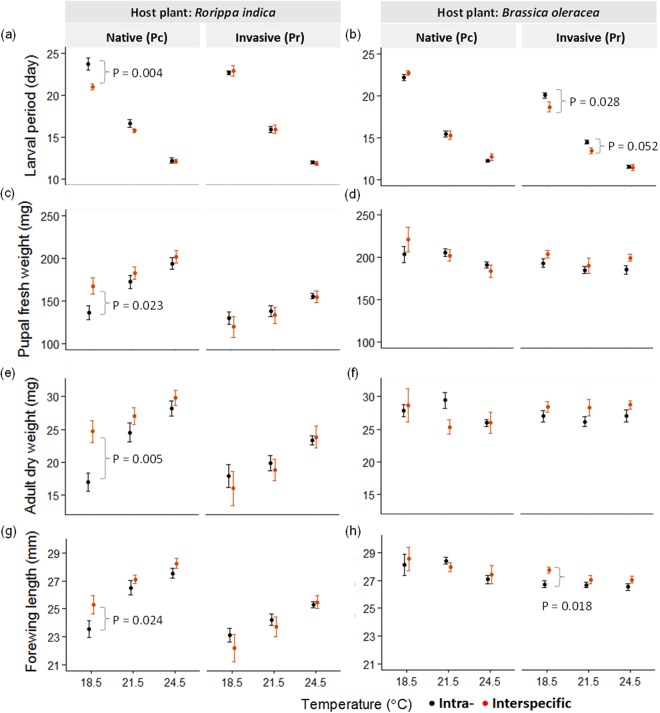
Although native-invasive species interactions have become a common mechanism shaping ecosystems, whether these interactions shift under warming remains unclear. To investigate how warming may affect native and invasive species separately and together (intraspecific and interspecific competition, respectively) and whether any warming impact is resource dependent, we examined the performance of two competing herbivores (native Pieris canidia and invasive P. rapae) on two common host plants under three temperature settings (control, 3 °C, and 6 °C warming using environmental chambers). The results revealed that warming benefited the development and growth of both Pieris under intraspecific competition, but the benefits were host-plant dependent. Notably, the native or invasive Pieris gained an advantage from interspecific competition (host-plant dependent), but warming neutralized the competitive advantages of either Pieris species. These findings raise the possibility that warming-induced shifts in competitive status may become a crucial mechanism shaping ecosystems worldwide, because most ecosystems are challenged by species invasion and warming. Moreover, this study revealed a discrepancy in species thermal performance between intra- and interspecific competition. Therefore, to predict native-invasive species competition under warming, current thermal performance applications should use species performance curves derived from interspecific rather than intraspecific competition studies (although the latter is more readily available).
虽然本土入侵物种的相互作用已成为塑造生态系统的一种常见机制,但这些相互作用在变暖下是否会发生变化尚不清楚。为了研究变暖如何分别影响本土和入侵物种(种内竞争和种间竞争)以及任何变暖影响是否依赖于资源,我们使用环境室在三种温度设置下(对照、3°C 和 6°C 变暖)检查了两种竞争的草食性昆虫(本土 Pieris canidia 和入侵 P. rapae)在两种常见寄主植物上的表现。结果表明,变暖有利于两种 Pieris 在种内竞争下的发育和生长,但这种益处取决于寄主植物。值得注意的是,本土或入侵的 Pieris 从种间竞争(寄主植物依赖)中获得了优势,但变暖削弱了任何一种 Pieris 物种的竞争优势。这些发现提出了一种可能性,即变暖引起的竞争地位变化可能成为塑造全球生态系统的关键机制,因为大多数生态系统都受到物种入侵和变暖的挑战。此外,本研究揭示了种内和种间竞争中物种热性能的差异。因此,为了预测变暖下的本土入侵物种竞争,当前的热性能应用应该使用来自种间而非种内竞争研究的物种性能曲线(尽管后者更容易获得)。