Roe Mark, Murphy John C, Gissane Conor, Blake Catherine
School of Public Health, Physiotherapy, and Sports Science, University College Dublin, Dublin, Ireland.
Medfit Proactive Health, Dublin, Ireland.
PeerJ. 2018 Jul 20;6:e4895. doi: 10.7717/peerj.4895. eCollection 2018.
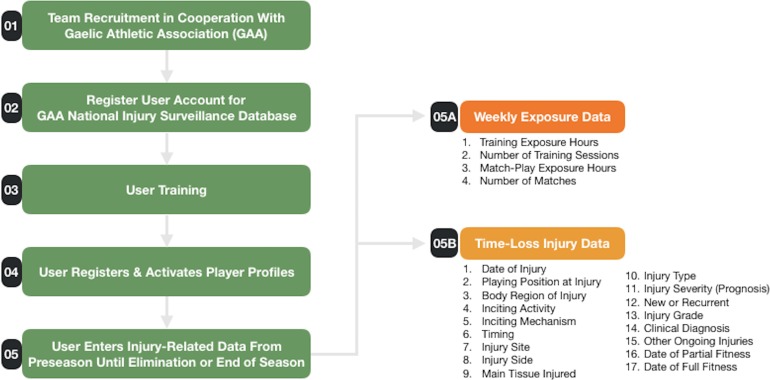
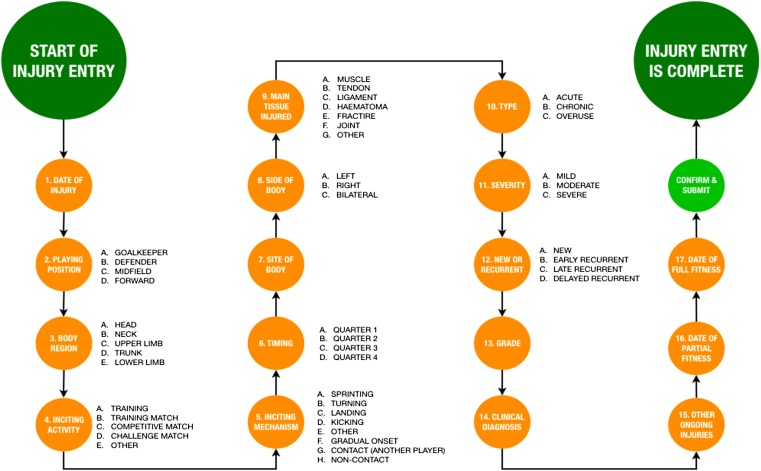
Managing injury risk requires an understanding of how and when athletes sustain certain injuries. Such information guides organisations in establishing evidence-based priorities and expectations for managing injury risk. In order to minimise the impact of sports injuries, attention should be directed towards injuries that occur frequently, induce substantial time-loss, and elevate future risk. Thus, the current study aimed to investigate the rate at which elite Gaelic football players sustain different time-loss injuries during match-play and training activities. Datasets ( = 38) from elite Gaelic football teams ( = 17) were received by the National Gaelic Athletic Association Injury Surveillance Database from 2008 to 2016. A total of 1,614 time-loss injuries were analysed. Each season teams sustained 24.0 (interquartile ranges) (IQR 16.0-32.0) and 15.0 (IQR 10.0-19.0) match-play and training injuries, respectively. When exposure was standardised to 1,000 h, greater rates of injury (12.9, 95% CI [11.7-14.3]) and time-loss days (13.4, 95% CI [12.3-14.9]) were sustained in match-play than in training. Acute injury rates were 3.1-times (95% CI [2.7-3.4]) greater than chronic/overuse injuries. Similarly, non-contact injury rates were 2.8-times (95% CI [2.5-3.2]) greater than contact injuries. A total of 71% of injuries in elite Gaelic football affected five lower limb sites. Four lower limb-related clinical entities accounted for 40% of all time-loss injuries (hamstring, 23%; ankle sprain, 7%; adductor-related, 6%; quadriceps strain, 5%). Thus, most risk management and rehabilitation strategies need to be centred around five lower limb sites-and just four clinical entities. Beyond these, it may be highly unlikely that reductions in injury susceptibility can be attributed to specific team interventions. Thus, compliance with national databases is necessary to monitor injury-related metrics and future endeavours to minimise injury risk.
管理损伤风险需要了解运动员如何以及何时遭受特定损伤。此类信息指导各组织确定基于证据的管理损伤风险的优先事项和预期目标。为了将运动损伤的影响降至最低,应关注那些频繁发生、导致大量时间损失并增加未来风险的损伤。因此,本研究旨在调查精英盖尔式足球运动员在比赛和训练活动中遭受不同时间损失损伤的发生率。2008年至2016年,国家盖尔式运动协会损伤监测数据库收到了来自17支精英盖尔式足球队的数据集(n = 38)。共分析了1614例时间损失损伤。每个赛季各球队分别遭受24.0例(四分位间距)(IQR 16.0 - 32.0)比赛损伤和15.0例(IQR 10.0 - 19.0)训练损伤。当将暴露时间标准化为1000小时时,比赛中的损伤发生率(12.9,95%CI[11.7 - 14.3])和时间损失天数(13.4,95%CI[12.3 - 14.9])高于训练。急性损伤发生率是慢性/过度使用损伤的3.1倍(95%CI[2.7 - 3.4])。同样,非接触损伤发生率是接触损伤的2.8倍(95%CI[2.5 - 3.2])。精英盖尔式足球中71%的损伤影响下肢五个部位。四个与下肢相关的临床病症占所有时间损失损伤的40%(腘绳肌损伤,23%;踝关节扭伤,7%;内收肌相关损伤,6%;股四头肌拉伤,5%)。因此,大多数风险管理和康复策略需要围绕下肢五个部位以及仅四个临床病症展开。除此之外,损伤易感性的降低极不可能归因于特定的团队干预措施。因此,遵守国家数据库对于监测损伤相关指标以及未来降低损伤风险的努力是必要的。