Department of Surgical Sciences, Section of Vascular Surgery, Uppsala University, Uppsala, Sweden.
Department of Hybrid and Interventional Surgery, Unit of Vascular Surgery, Sahlgrenska University Hospital, Gothenburg, Sweden.
Br J Surg. 2018 Dec;105(13):1753-1758. doi: 10.1002/bjs.10953. Epub 2018 Jul 24.
Popliteal artery aneurysms (PAAs) are generally complicated by thrombosis and distal embolization, whereas rupture is rare. The aim of this study was to describe the clinical characteristics and outcome in a cohort of patients who had surgery for ruptured PAA (rPAA).
Operations for rPAA were identified from the Swedish Vascular Registry, Swedvasc, 1987-2012. Medical records and imaging were reviewed. Comparison was made with patients treated for PAA without rupture.
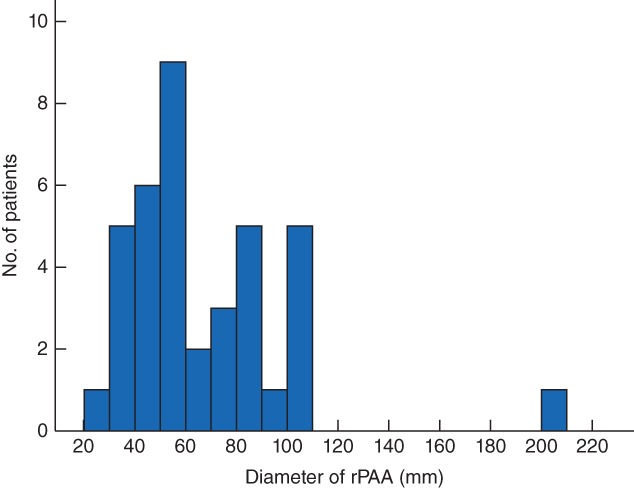
Forty-five patients with rPAA were identified. The proportion with rupture among those operated on for PAA was 2·5 per cent. Patients with rPAA were 8 years older (77·7 versus 69·7 years; P < 0·001), had more lung and heart disease (P = 0·003 and P = 0·019 respectively), and a larger mean popliteal aneurysm diameter (63·7 versus 30·9 mm; P < 0·001) than patients with PAA treated for other indications. At time of surgery, 22 of 45 patients were already receiving anticoagulants, seven for concomitant deep venous thrombosis (DVT) in the affected leg. There was extensive swelling of the whole leg in 20 patients. In 27 patients, the initial diagnosis was DVT or a Baker's cyst. All patients underwent surgery, all but three by the open method. There were four amputations, all performed within 1 week of surgery. One year after surgery, 26 of the 45 patients were alive. Among these, the reconstructions were patent in 20 of 22 patients.
The diagnosis of rPAA is difficult, and often delayed. The condition affects old patients, who often are on anticoagulation treatment and have large aneurysms. The immediate surgical results are acceptable, but the condition is associated with a high risk of death within the first year after surgery.
腘动脉动脉瘤(PAAs)通常并发血栓形成和远端栓塞,而破裂则较为罕见。本研究旨在描述一组接受破裂性腘动脉动脉瘤(rPAA)手术治疗患者的临床特征和结局。
从瑞典血管登记处 Swedvasc 中确定了 rPAA 手术病例,时间范围为 1987 年至 2012 年。回顾了病历和影像学资料,并与未破裂的 PAA 患者进行了比较。
共确定了 45 例 rPAA 患者。在接受 PAA 手术的患者中,破裂的比例为 2.5%。rPAA 患者比其他原因接受 PAA 治疗的患者年龄大 8 岁(77.7 岁比 69.7 岁;P<0.001),患有更多的肺部和心脏疾病(P=0.003 和 P=0.019),腘动脉瘤直径更大(63.7 毫米比 30.9 毫米;P<0.001)。在手术时,45 例患者中有 22 例已经接受抗凝治疗,其中 7 例在患侧下肢同时伴有深静脉血栓形成(DVT)。20 例患者整个腿部广泛肿胀。27 例患者最初诊断为 DVT 或贝克氏囊肿。所有患者均接受手术治疗,除 3 例患者外均采用开放方法。有 4 例截肢,均在手术后 1 周内进行。手术后 1 年,45 例患者中有 26 例存活。在这些患者中,22 例患者中有 20 例重建的血管通畅。
rPAA 的诊断困难,且常被延误。该疾病好发于老年患者,这些患者常接受抗凝治疗,且动脉瘤较大。即刻手术结果尚可,但该疾病在手术后 1 年内死亡风险较高。