Department of Sociology, Boston College, United States.
Department of Sociology, Boston College, United States.
Soc Sci Med. 2018 Sep;212:219-226. doi: 10.1016/j.socscimed.2018.07.025. Epub 2018 Jul 19.
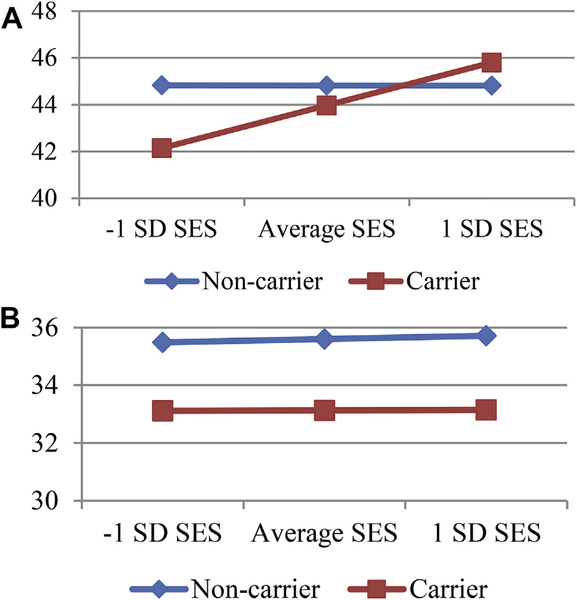
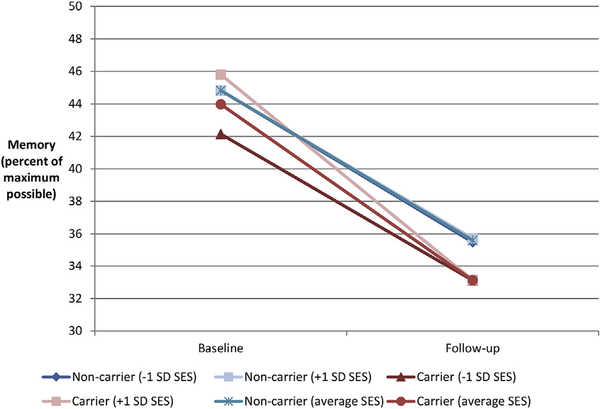
The ε4 allele of the APOE gene is associated with poorer cognition in later life. This study aimed to advance understanding of how environments potentially moderate this genetic risk by focusing on childhood socioeconomic status (SES). Previous research across diverse national contexts has found that older adults from higher-SES families in childhood demonstrate better cognitive functioning than their lower-SES counterparts. Nevertheless, few studies have examined whether higher childhood SES might also promote later life cognition by mitigating the effects of ε4 carrier status. To address this gap, we used data from 3017 participants in the Wisconsin Longitudinal Study, which has followed a random sample of people who graduated from Wisconsin high schools in 1957. Childhood SES included parents' educational attainment, father's occupational status, and household income in adolescence. We constructed measures of memory and of language/executive functioning using scores from neurocognitive tests administered when participants were approximately ages 65 and 72. APOE ε4 status was measured through saliva samples. Results from cross-controlled multilevel models indicated that APOE ε4 status-and not childhood SES-independently predicted memory, whereas childhood SES-and not APOE ε4 status-independently predicted language/executive functioning. Moreover, a statistical interaction between APOE ε4 status and childhood SES for memory indicated that at baseline, higher childhood SES protected against the risk of APOE ε4 status, whereas lower childhood SES exacerbated the risk of APOE ε4 status. However, by follow-up, these moderating effects dissipated, and APOE ε4 status alone was associated with memory. We interpret these results in light of theorizing on differential susceptibility for poorer cognition across the life course.
载脂蛋白 E 基因的 ε4 等位基因与晚年认知能力较差有关。本研究旨在通过关注儿童社会经济地位(SES),深入了解环境如何潜在地调节这种遗传风险。在不同的国家背景下,先前的研究发现,童年时期来自高 SES 家庭的老年人在认知功能方面表现优于 SES 较低的同龄人。然而,很少有研究探讨较高的儿童 SES 是否也可以通过减轻 ε4 携带状态的影响来促进晚年认知。为了解决这一差距,我们使用了来自威斯康星纵向研究的 3017 名参与者的数据,该研究跟踪了 1957 年毕业于威斯康星州高中的随机人群。童年 SES 包括父母的教育程度、父亲的职业地位和青少年时期的家庭收入。我们使用参与者大约 65 岁和 72 岁时进行的神经认知测试的分数来构建记忆和语言/执行功能的测量。APOE ε4 状态通过唾液样本测量。交叉控制多层次模型的结果表明,APOE ε4 状态——而不是儿童 SES——独立预测记忆,而儿童 SES——而不是 APOE ε4 状态——独立预测语言/执行功能。此外,APOE ε4 状态和儿童 SES 对记忆的统计交互表明,在基线时,较高的儿童 SES 可以保护免受 APOE ε4 状态的风险,而较低的儿童 SES 则加剧了 APOE ε4 状态的风险。然而,在随访时,这些调节作用消失了,只有 APOE ε4 状态与记忆有关。我们根据生活过程中较差认知的差异易感性理论来解释这些结果。