Zhan Lexia, Guo Dingrong, Chen Gang, Yang Jiongjiong
School of Psychological and Cognitive Sciences, Beijing Key Laboratory of Behavior and Mental Health, Peking University, Beijing, China.
Scientific and Statistical Computing Core, National Institute of Mental Health (NIMH), National Institutes of Health (NIH), Bethesda, MD, United States.
Front Hum Neurosci. 2018 Jul 11;12:277. doi: 10.3389/fnhum.2018.00277. eCollection 2018.
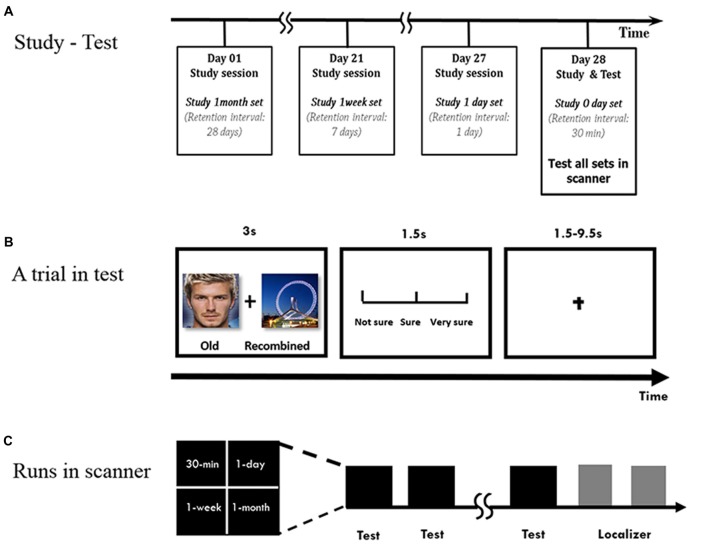
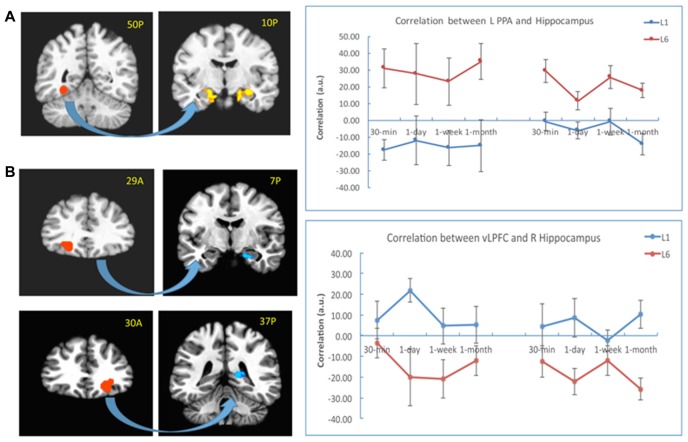
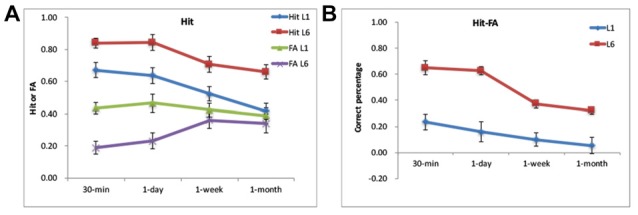
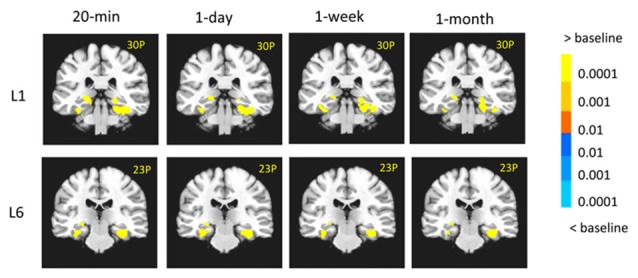
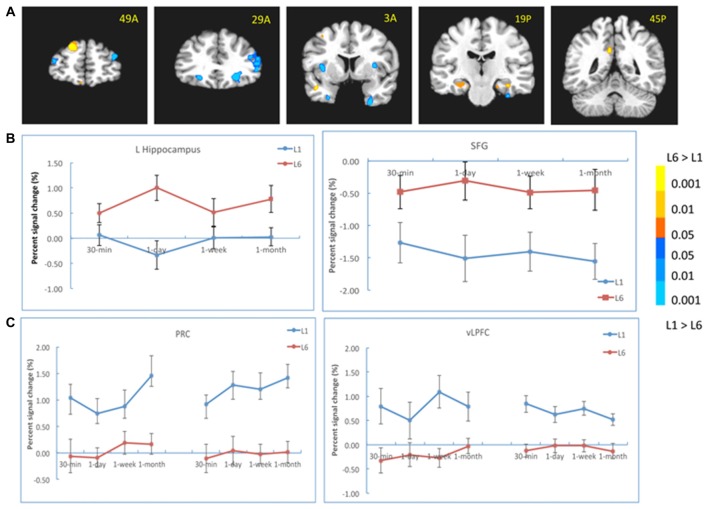
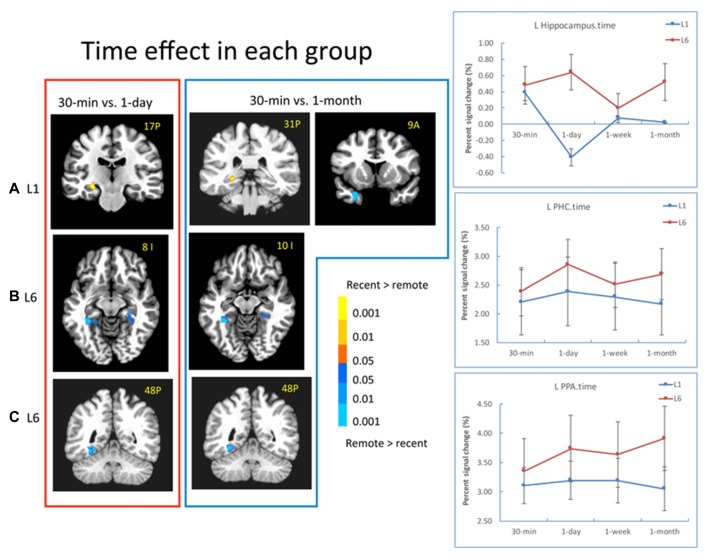
When stimuli are learned by repetition, they are remembered better and retained for a longer time. However, current findings are lacking as to whether the medial temporal lobe (MTL) and cortical regions are involved in the learning effect when subjects retrieve associative memory, and whether their activations differentially change over time due to learning experience. To address these issues, we designed an fMRI experiment in which face-scene pairs were learned once (L1) or six times (L6). Subjects learned the pairs at four retention intervals, 30-min, 1-day, 1-week and 1-month, after which they finished an associative recognition task in the scanner. The results showed that compared to learning once, learning six times led to stronger activation in the hippocampus, but weaker activation in the perirhinal cortex (PRC) as well as anterior ventrolateral prefrontal cortex (vLPFC). In addition, the hippocampal activation was positively correlated with that of the parahippocampal place area (PPA) and negatively correlated with that of the vLPFC when the L6 group was compared to the L1 group. The hippocampal activation decreased over time after L1 but remained stable after L6. These results clarified how the hippocampus and cortical regions interacted to support associative memory after different learning experiences.
当通过重复学习刺激时,它们会被更好地记住并保留更长时间。然而,关于当受试者检索联想记忆时内侧颞叶(MTL)和皮质区域是否参与学习效应,以及它们的激活是否会因学习经验而随时间发生不同变化,目前尚无相关研究结果。为了解决这些问题,我们设计了一项功能磁共振成像(fMRI)实验,其中面部 - 场景对被学习一次(L1)或六次(L6)。受试者在四个保持间隔(30分钟、1天、1周和1个月)学习这些配对,之后在扫描仪中完成一项联想识别任务。结果表明,与学习一次相比,学习六次会导致海马体激活增强,但嗅周皮质(PRC)以及前额叶腹外侧前部皮质(vLPFC)的激活减弱。此外,当将L6组与L1组进行比较时,海马体激活与海马旁回区域(PPA)的激活呈正相关,与vLPFC的激活呈负相关。L1后海马体激活随时间下降,但L6后保持稳定。这些结果阐明了在不同学习经验后海马体和皮质区域如何相互作用以支持联想记忆。