Wilson Laurence O W, O'Brien Aidan R, Bauer Denis C
Commonwealth Scientific and Industrial Research Organisation, Sydney, NSW, Australia.
Department of Immunology and Infectious Disease, John Curtin School of Medical Research, Acton, ACT, Australia.
Front Pharmacol. 2018 Jul 12;9:749. doi: 10.3389/fphar.2018.00749. eCollection 2018.
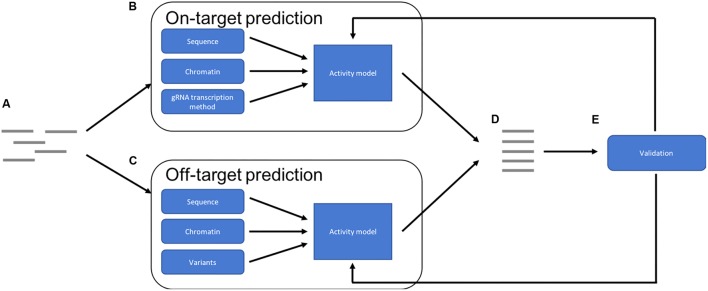
Recent years have seen the development of computational tools to assist researchers in performing CRISPR-Cas9 experiment optimally. More specifically, these tools aim to maximize on-target activity (guide efficiency) while also minimizing potential off-target effects (guide specificity) by analyzing the features of the target site. Nonetheless, currently available tools cannot robustly predict experimental success as prediction accuracy depends on the approximations of the underlying model and how closely the experimental setup matches the data the model was trained on. Here, we present an overview of the available computational tools, their current limitations and future considerations. We discuss new trends around personalized health by taking genomic variants into account when predicting target sites as well as discussing other governing factors that can improve prediction accuracy.
近年来,已开发出多种计算工具,以协助研究人员优化进行CRISPR-Cas9实验。更具体地说,这些工具旨在通过分析靶位点的特征,最大化靶向活性(引导效率),同时最小化潜在的脱靶效应(引导特异性)。尽管如此,目前可用的工具无法可靠地预测实验成功与否,因为预测准确性取决于基础模型的近似程度,以及实验设置与模型训练所依据的数据的匹配程度。在此,我们概述了可用的计算工具、它们目前的局限性以及未来需要考虑的因素。我们讨论了围绕个性化健康的新趋势,即在预测靶位点时考虑基因组变异,以及讨论其他可以提高预测准确性的控制因素。