Developmental Laboratory, Department of Psychology, Centre for Innovation in Mental Health, University of Southampton, Southampton, S017 1BJ, UK.
Autism Diagnostic Research Centre, 9-19 Rose Road, Southampton, SO14 6TE, UK.
J Autism Dev Disord. 2020 May;50(5):1470-1478. doi: 10.1007/s10803-018-3693-8.
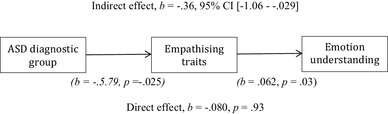
This study explored the social-cognitive profile of 173 adults referred for an autism assessment. We considered key dimensional traits (autism, empathy and systemising) to understand social cognition in adults diagnosed with an autism spectrum condition compared with those who were referred for, but did not receive a diagnosis. There were no significant social cognitive differences between groups on measures of emotion recognition and social inference. Adults with a confirmed diagnosis, however, reported fewer empathising traits which were positively associated with social-cognitive understanding. Empathising partially mediated the relationship between diagnostic group and social-cognition. Lower empathising traits in individuals diagnosed in adulthood may be important in understanding challenges with social adaptability. The findings have implications for assessment and highlight the role of empathy in developing social understanding in autism.
本研究探讨了 173 名接受自闭症评估的成年人的社会认知特征。我们考虑了关键的维度特征(自闭症、同理心和系统思维),以了解与被诊断为自闭症谱系障碍的成年人相比,那些被推荐但未被诊断出患有自闭症谱系障碍的成年人的社会认知。在情绪识别和社会推理方面,两组之间没有显著的社会认知差异。然而,被确诊的成年人报告的同理心特征较少,而同理心特征与社会认知理解呈正相关。同理心在一定程度上解释了诊断组和社会认知之间的关系。在成年后被诊断出患有自闭症的个体中,同理心特征较低可能对理解社交适应性方面的挑战很重要。这些发现对评估具有启示意义,并强调了同理心在自闭症中发展社会理解的作用。