Torretti Joel, Harris Jonathan Andrew, Bucklen Brandon Seth, Moldavsky Mark, Khalil Saif El Din
Mount Nittany Medical Center, State College, PA, USA.
Musculoskeletal Education and Research Center, A Division of Globus Medical Inc., Audubon, PA, USA.
Asian Spine J. 2018 Aug;12(4):601-610. doi: 10.31616/asj.2018.12.4.601. Epub 2018 Jul 27.
In vitro cadaveric study.
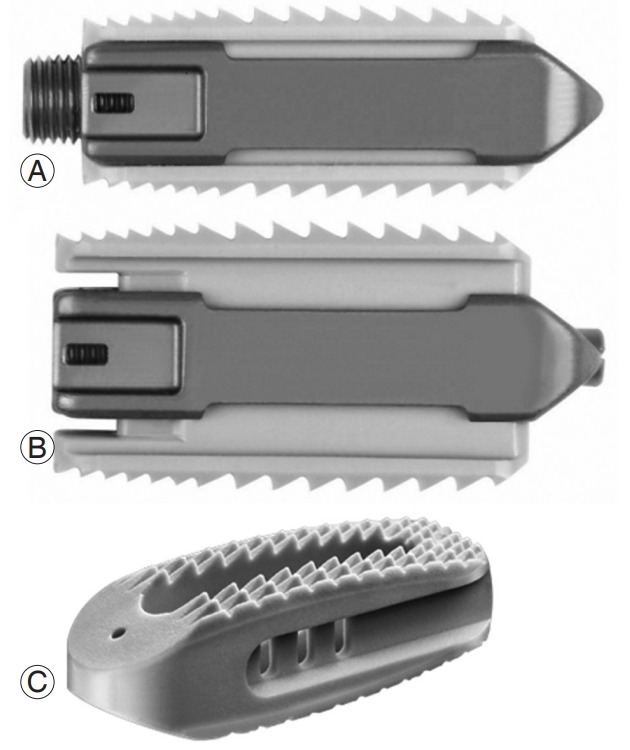
To compare biomechanical performance, trial and implant insertion, and disc distraction during implant placement, when two interbody devices, an in situ continuously expandable spacer (CES) and a traditional static spacer (SS), were used for transforaminal lumbar interbody fusion.
Severe degenerative disc diseases necessitate surgical management via large spacers to increase the disc space for implants. Next-generation interbody devices that expand in situ minimize insertion forces, optimize fit between vertebral endplates, and limit nerve root retraction. However, the literature lacks characterization of insertion forces as well as details on other parameters of expandable and static spacers.
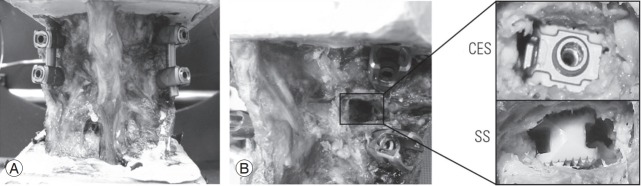
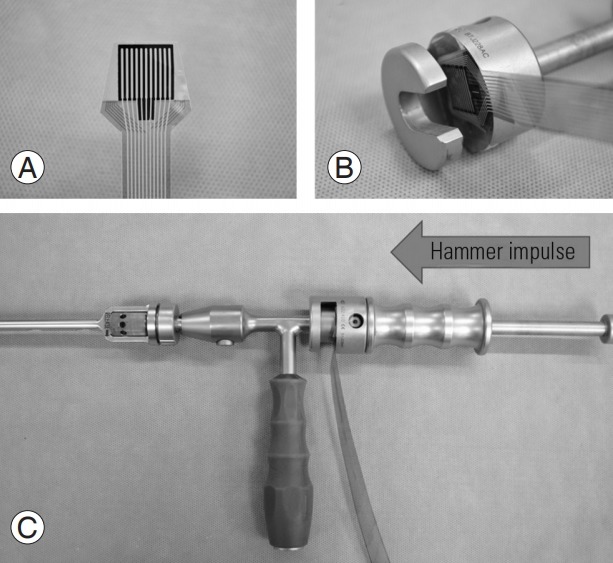
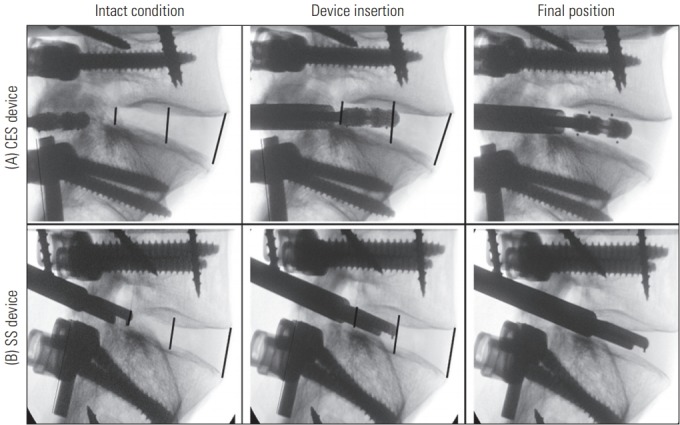
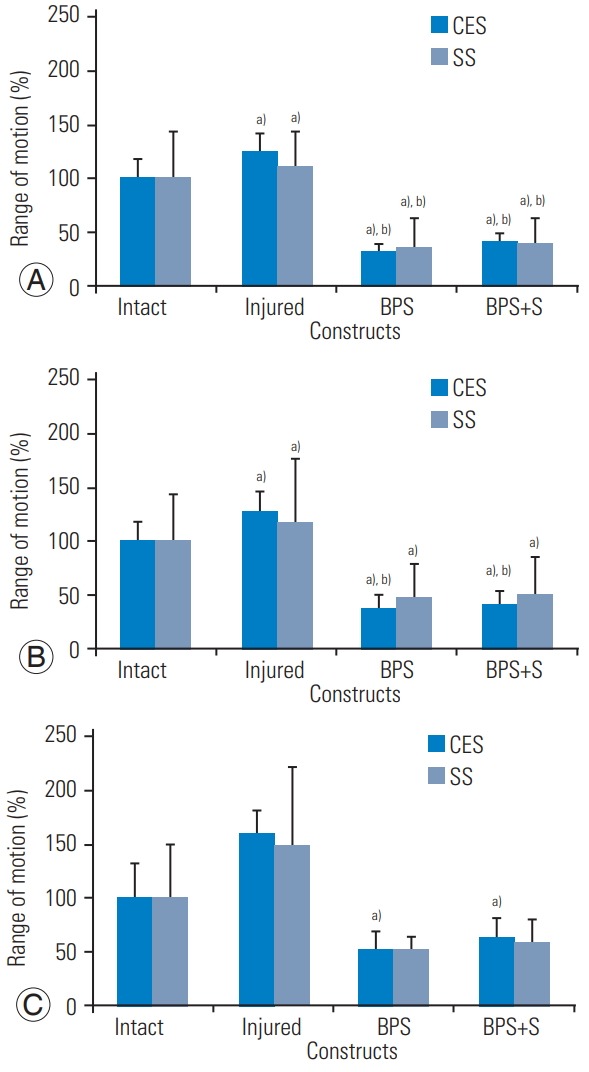
Ten cadaveric segments (L5-S1) were divided into two groups (n=5) and implanted with either CES or SS. Each specimen experienced unconstrained pure moment of ±6 Nm in flexion-extension, lateral bending, and axial rotation to assess the contribution of CES and SS implants in biomechanical performance. Radiographic analysis was performed during trial and implant insertion to measure distraction during spacer insertion at the posterior, central, and anterior disc regions. Pressure sensors measured the force of trial and implant insertion.
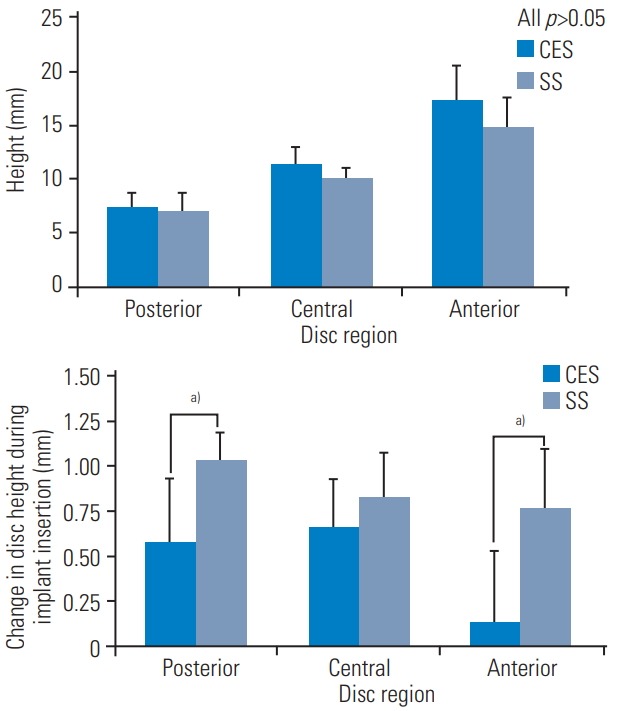
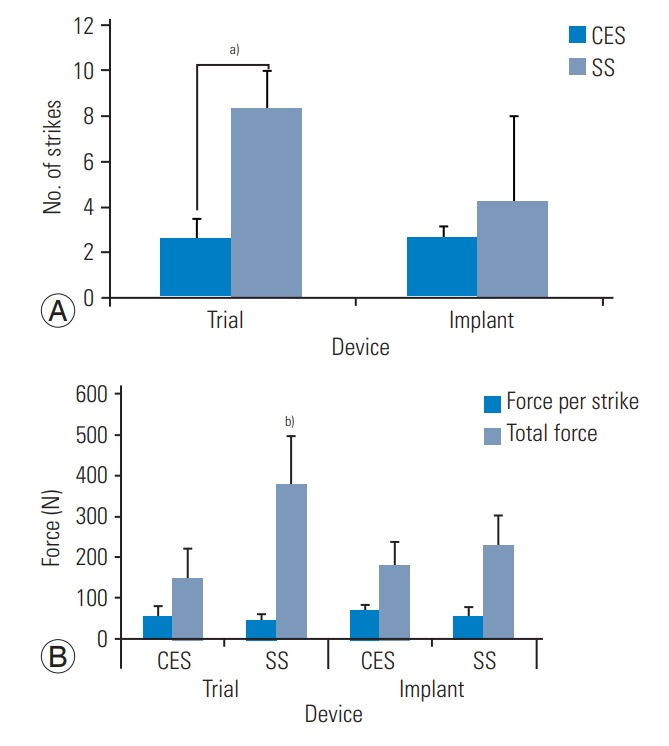
Biomechanical analysis showed no significant differences between CES and SS in all planes of motion. A total 2.6±0.9 strikes were required for expandable spacer trials insertion and 2.6±0.5 strikes for CES insertion. A total of 8.4±3.8 strikes were required to insert SS trials and 4.2±1.6 strikes for SS insertion. The total force per surgery was 330 N for CES and 635 N for SS. Fluoroscopic analysis revealed a significant reduction in distraction during implant insertion at the posterior and anterior disc regions (CES, 0.58 and 0.14 mm; SS, 1.04 and 0.78 mm, respectively).
Results from the three study arms reveal the potential use of expandable spacers. During implant insertion, CESs provided similar stability, required less insertion force, and significantly reduced over-distraction of the annulus compared with SS.
体外尸体研究。
比较在经椎间孔腰椎椎间融合术中使用两种椎间融合器(一种原位连续可扩张椎间融合器(CES)和一种传统静态椎间融合器(SS))时的生物力学性能、试模和植入物插入情况以及植入物放置过程中的椎间盘撑开情况。
严重的椎间盘退变疾病需要通过大型椎间融合器进行手术治疗,以增加植入物的椎间隙。新一代原位扩张的椎间融合器可将插入力降至最低,优化椎体终板之间的贴合度,并限制神经根牵拉。然而,文献中缺乏对插入力的描述以及关于可扩张和静态椎间融合器其他参数的详细信息。
将十个尸体节段(L5-S1)分为两组(n = 5),分别植入CES或SS。每个标本在屈伸、侧弯和轴向旋转时承受±6 Nm的无约束纯力矩,以评估CES和SS植入物在生物力学性能方面的作用。在试模和植入物插入过程中进行影像学分析,以测量椎间融合器在椎间盘后、中、前区域插入时的撑开情况。压力传感器测量试模和植入物插入的力。
生物力学分析表明,CES和SS在所有运动平面上均无显著差异。可扩张椎间融合器试模插入总共需要2.6±0.9次敲击,CES插入需要2.6±0.5次敲击。插入SS试模总共需要8.4±3.8次敲击,SS插入需要4.2±1.6次敲击。每次手术的总力CES为330 N,SS为635 N。透视分析显示,在椎间盘后、前区域植入物插入过程中撑开明显减少(CES分别为0.58和0.14 mm;SS分别为1.04和0.78 mm)。
三个研究组的结果揭示了可扩张椎间融合器的潜在用途。在植入物插入过程中,与SS相比,CES提供了相似的稳定性,所需插入力更小,并且显著减少了纤维环的过度撑开。