Chu Greg, Li Vivian, Hui Amy, Lam Christina, Chan Eva, Law Martin, Yip Lawrance, Lam Wendy
Department of Radiology, Queen Mary Hospital, Hong Kong, China.
J Med Ultrasound. 2018 Jan-Mar;26(1):42-44. doi: 10.4103/JMU.JMU_13_18. Epub 2018 Mar 28.
The objective of the study was to perform quantitative failure and fault analysis to the diagnostic ultrasound (US) scanners in a radiology department after the implementation of the predictive maintenance (PdM) method; to study the reduction trend of machine failure; to understand machine operating parameters affecting the failure; to further optimize the method to maximize the machine clinically service time.
The PdM method has been implemented to the 5 US machines since 2013. Log books were used to record machine failures and their root causes together with the time spent on repair, all of which were retrieved, categorized, and analyzed for the period between 2013 and 2016.
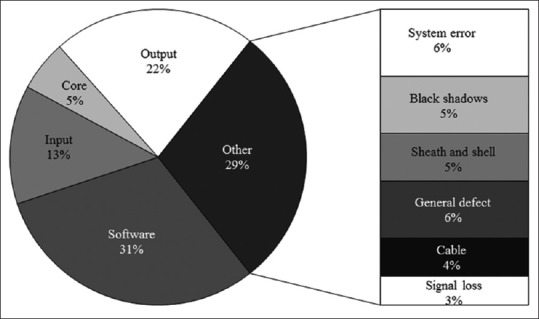
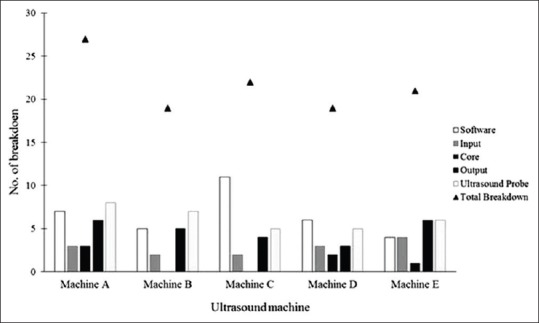
There were a total of 108 cases of failure occurred in these 5 US machines during the 4-year study period. The average number of failure per month for all these machines was 2.4. Failure analysis showed that there were 33 cases (30.5%) due to software, 44 cases (40.7%) due to hardware, and 31 cases (28.7%) due to US probe. There was a statistically significant negative correlation between the time spent on regular quality assurance (QA) by hospital physicists with the time spent on faulty parts replacement over the study period ( = 0.007). However, there was no statistically significant correlation between regular QA time and total yearly breakdown case ( = 0.12), although there has been a decreasing trend observed in the yearly total breakdown.
There has been a significant improvement on the machine failure of US machines attributed to the concerted effort of sonographers and physicists in our department to practice the PdM method, in that system component repair time has been reduced, and a decreasing trend in the number of system breakdown has been observed.
本研究的目的是在实施预测性维护(PdM)方法后,对放射科的诊断超声(US)扫描仪进行定量故障和故障分析;研究机器故障的减少趋势;了解影响故障的机器操作参数;进一步优化该方法以最大限度地延长机器的临床服务时间。
自2013年以来,PdM方法已应用于5台超声机器。使用日志记录机器故障及其根本原因以及维修所花费的时间,在2013年至2016年期间对所有这些记录进行检索、分类和分析。
在为期4年的研究期间,这5台超声机器共发生108例故障。所有这些机器每月的平均故障数为2.4次。故障分析表明,33例(30.5%)是由于软件故障,44例(40.7%)是由于硬件故障,31例(28.7%)是由于超声探头故障。在研究期间,医院物理学家花在定期质量保证(QA)上的时间与花在更换故障部件上的时间之间存在统计学上显著的负相关( = 0.007)。然而,定期QA时间与年度总故障病例数之间没有统计学上显著的相关性( = 0.12),尽管年度总故障数呈下降趋势。
由于我们科室的超声检查人员和物理学家共同努力实施PdM方法,超声机器的机器故障有了显著改善,系统部件维修时间减少,系统故障数量呈下降趋势。