Yu Fei, Li Hai, Zhou Xiaoqing, Tang XiaoLin, Galvin Iii John J, Fu Qian-Jie, Yuan Wei
Department of Otolaryngology, Southwest Hospital, Third Military Medical University, Chongqing, China.
House Ear Institute, Los Angeles, CA, United States.
Front Hum Neurosci. 2018 Jul 17;12:287. doi: 10.3389/fnhum.2018.00287. eCollection 2018.
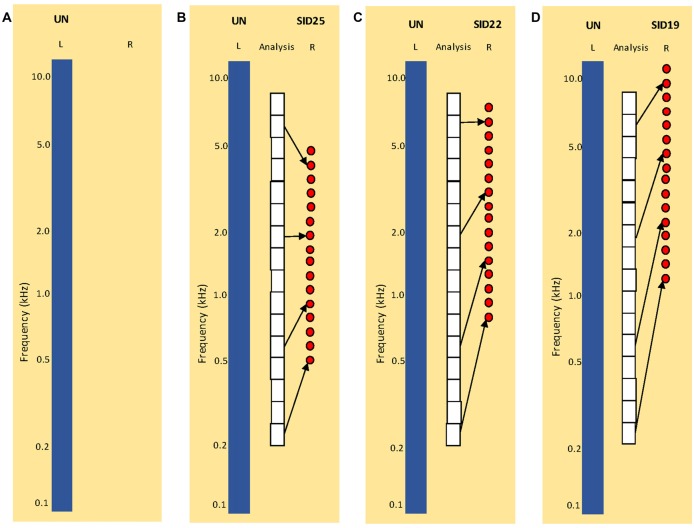
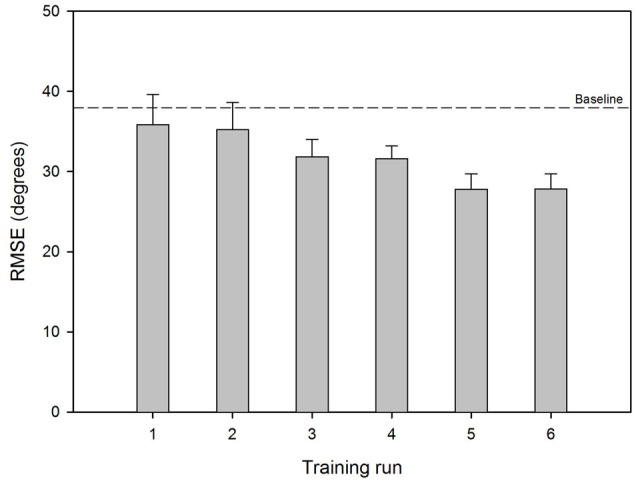
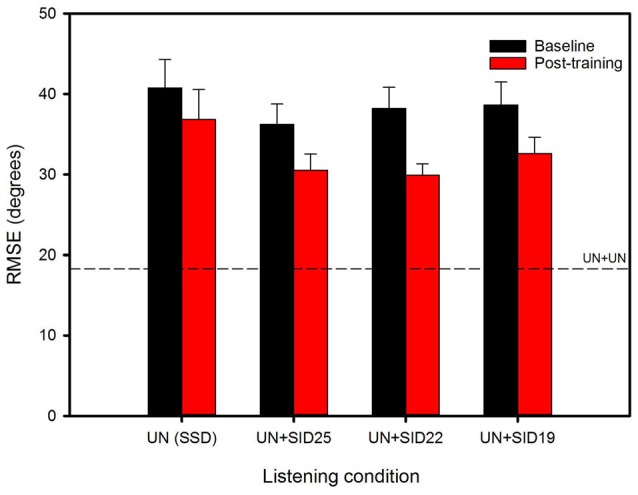
While cochlear implantation has benefitted many patients with single-sided deafness (SSD), there is great variability in cochlear implant (CI) outcomes and binaural performance remains poorer than that of normal-hearing (NH) listeners. Differences in sound quality across ears-temporal fine structure (TFS) information with acoustic hearing vs. coarse spectro-temporal envelope information with electric hearing-may limit integration of acoustic and electric patterns. Binaural performance may also be limited by inter-aural mismatch between the acoustic input frequency and the place of stimulation in the cochlea. SSD CI patients must learn to accommodate these differences between acoustic and electric stimulation to maximize binaural performance. It is possible that training may increase and/or accelerate accommodation and further improve binaural performance. In this study, we evaluated lateralization training in NH subjects listening to broad simulations of SSD CI signal processing. A 16-channel vocoder was used to simulate the coarse spectro-temporal cues available with electric hearing; the degree of inter-aural mismatch was varied by adjusting the simulated insertion depth (SID) to be 25 mm (SID25), 22 mm (SID22) and 19 mm (SID19) from the base of the cochlea. Lateralization was measured using headphones and head-related transfer functions (HRTFs). Baseline lateralization was measured for unprocessed speech (UN) delivered to the left ear to simulate SSD and for binaural performance with the acoustic ear combined with the 16-channel vocoders (UN+SID25, UN+SID22 and UN+SID19). After completing baseline measurements, subjects completed six lateralization training exercises with the UN+SID22 condition, after which performance was re-measured for all baseline conditions. Post-training performance was significantly better than baseline for all conditions ( < 0.05 in all cases), with no significant difference in training benefits among conditions. Given that there was no significant difference between the SSD and the SSD CI conditions before or after training, the results suggest that NH listeners were unable to integrate TFS and coarse spectro-temporal cues across ears for lateralization, and that inter-aural mismatch played a secondary role at best. While lateralization training may benefit SSD CI patients, the training may largely improve spectral analysis with the acoustic ear alone, rather than improve integration of acoustic and electric hearing.
虽然人工耳蜗植入使许多单侧耳聋(SSD)患者受益,但人工耳蜗(CI)的效果存在很大差异,双耳性能仍比听力正常(NH)的听者差。双耳声音质量的差异——声学听力的颞部精细结构(TFS)信息与电听觉的粗略频谱-时间包络信息——可能会限制声学和电模式的整合。双耳性能也可能受到声学输入频率与耳蜗内刺激部位之间的双耳不匹配的限制。SSD CI患者必须学会适应声学和电刺激之间的这些差异,以最大限度地提高双耳性能。训练有可能增加和/或加速适应过程,并进一步改善双耳性能。在本研究中,我们评估了NH受试者在聆听SSD CI信号处理的广泛模拟时的定位训练。使用16通道声码器模拟电听觉可用的粗略频谱-时间线索;通过将模拟插入深度(SID)调整为距耳蜗底部25毫米(SID25)、22毫米(SID22)和19毫米(SID19)来改变双耳不匹配程度。使用耳机和头部相关传递函数(HRTF)测量定位。测量了传递到左耳以模拟SSD的未处理语音(UN)的基线定位,以及声学耳与16通道声码器组合(UN + SID25、UN + SID22和UN + SID19)的双耳性能。在完成基线测量后,受试者在UN + SID22条件下完成了六项定位训练练习,之后对所有基线条件重新测量性能。所有条件下训练后的性能均显著优于基线(所有情况下P < 0.05),各条件之间的训练益处无显著差异。鉴于训练前后SSD和SSD CI条件之间无显著差异,结果表明NH听者无法整合双耳的TFS和粗略频谱-时间线索进行定位,并且双耳不匹配充其量只起次要作用。虽然定位训练可能使SSD CI患者受益,但训练可能主要是单独改善声学耳的频谱分析,而不是改善声学和电听觉的整合。