School of Social Sciences, Bangor University, Wales, United Kingdom.
PLoS One. 2018 Aug 2;13(8):e0201098. doi: 10.1371/journal.pone.0201098. eCollection 2018.
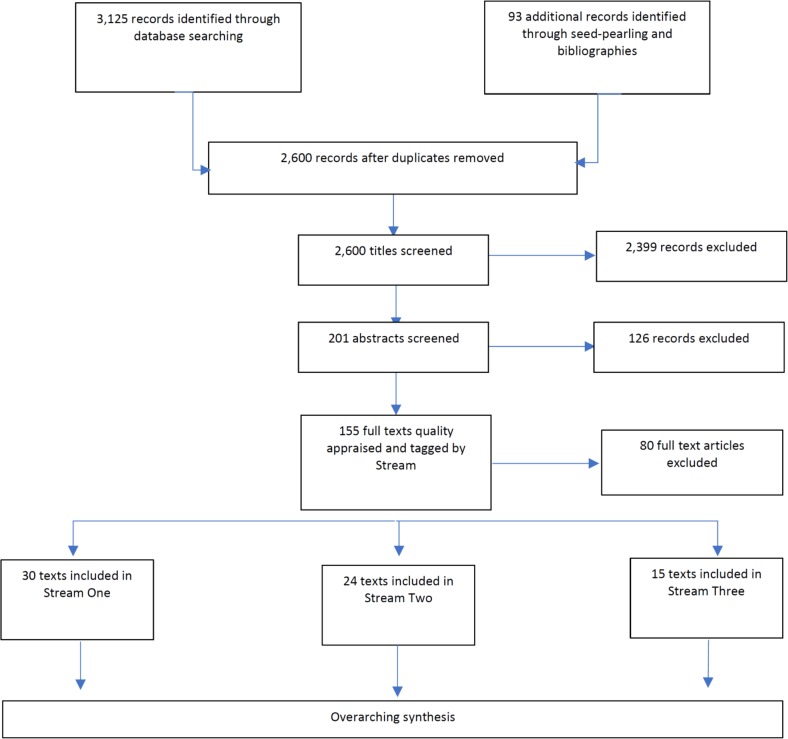
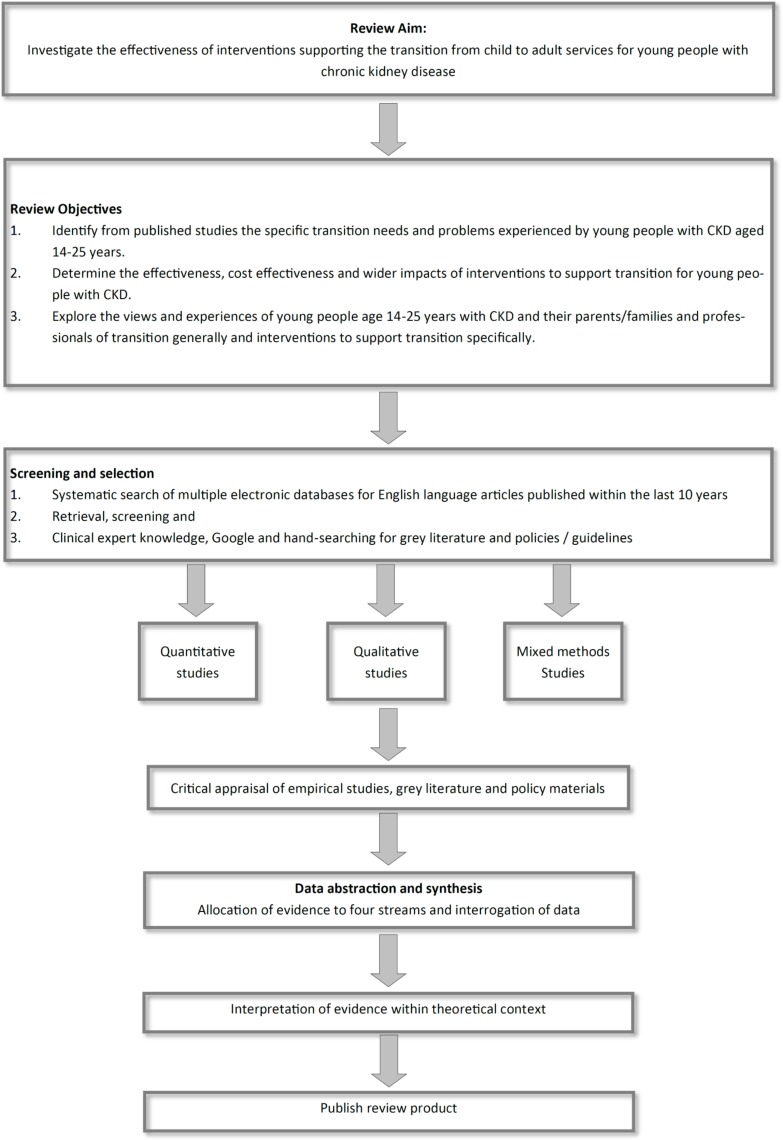
Young people age 14-25 years with chronic kidney disease have been identified as generally having poor health outcomes and are a high-risk group for kidney transplant loss due in part to poor self-management. This raises a key question as to what happens during transition from child to adult services? This paper presents a mixed-method systematic review of health and social care evidence concerning young people with chronic kidney disease transitioning from child to adult health and social care services. Quantitative and qualitative evidence were synthesised in streams followed by an overarching synthesis. Literature searches (2000 to March 2017) were conducted using Pubmed, BioMed Central and Cochrane Library, grey literature sources ZETOC, .gov.uk, third sector organisations, NHS Evidence, SCIE, TRIP, Opengrey. Snowball searching was conducted in the databases Ovid, CINAHL, ISI Web of Science, Scopus and Google Scholar. Of 3,125 records screened, 60 texts were included. We found that while strategies to support transition contained consistent messages, they supported the principle of a health-dominated pathway. Well-being is mainly defined and measured in clinical terms and the transition process is often presented as a linear, one-dimensional conduit. Individual characteristics, along with social, familial and societal relationships are rarely considered. Evidence from young people and their families highlights transition as a zone of conflict between independence and dependency with young people feeling powerless on one hand and overwhelmed on the other. We found few novel interventions and fewer that had been evaluated. Studies were rarely conducted by allied health and social care professionals (e.g. renal social workers and psychologists) as part of multi-disciplinary renal teams. We conclude that there is a lack of good evidence to inform providers of health and social care services about how best to meet the needs of this small but vulnerable cohort.
14-25 岁患有慢性肾脏疾病的年轻人一般健康状况较差,并且由于自我管理不善,是肾脏移植丧失的高风险群体。这就提出了一个关键问题,即从儿童到成人服务过渡期间会发生什么?本文对有关从儿童到成人健康和社会保健服务过渡的慢性肾脏疾病的年轻人的健康和社会保健证据进行了混合方法系统评价。定量和定性证据分别在两个流中进行综合,然后进行总体综合。文献检索(2000 年至 2017 年 3 月)使用 Pubmed、BioMed Central 和 Cochrane Library、灰色文献来源 ZETOC、.gov.uk、第三部门组织、NHS Evidence、SCIE、TRIP、Opengrey 在 Ovid、CINAHL、ISI Web of Science、Scopus 和 Google Scholar 数据库中进行了滚雪球搜索。在筛选出的 3125 条记录中,有 60 篇文章入选。我们发现,虽然支持过渡的策略包含一致的信息,但它们支持以健康为主导的途径原则。幸福感主要以临床术语定义和衡量,过渡过程通常被描述为线性的、一维的渠道。个人特征以及社会、家庭和社会关系很少被考虑。年轻人及其家人的证据表明,过渡是一个冲突的地带,一方面是独立性和依赖性之间的冲突,另一方面是年轻人感到无能为力和不知所措。我们发现很少有新颖的干预措施,更不用说经过评估的了。很少有从事肾脏相关专业(如肾脏社会工作者和心理学家)的跨学科肾脏团队的专业人员进行研究。我们得出的结论是,缺乏良好的证据来为卫生和社会保健服务提供者提供有关如何满足这一小而脆弱群体需求的信息。