Research Department of Clinical, Educational and Health Psychology, University College London, London, UK.
Research Department of Clinical, Educational and Health Psychology, University College London, London, UK.
Clin Psychol Rev. 2018 Aug;64:13-38. doi: 10.1016/j.cpr.2018.07.005. Epub 2018 Jul 29.
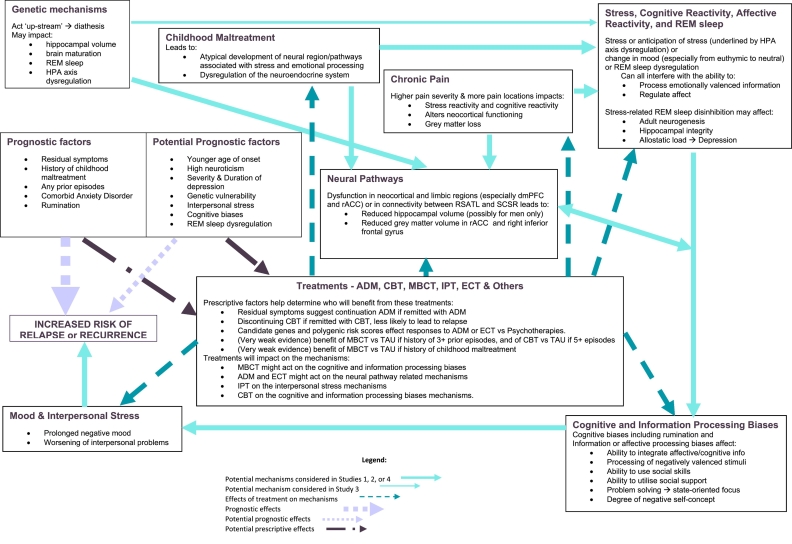
To review and synthesise prognostic indices that predict subsequent risk, prescriptive indices that moderate treatment response, and mechanisms that underlie each with respect to relapse and recurrence of depression in adults.
Childhood maltreatment, post-treatment residual symptoms, and a history of recurrence emerged as strong prognostic indicators of risk and each could be used prescriptively to indicate who benefits most from continued or prophylactic treatment. Targeting prognostic indices or their "down-stream" consequences will be particularly beneficial because each is either a cause or a consequence of the causal mechanisms underlying risk of recurrence. The cognitive and neural mechanisms that underlie the prognostic indices are likely addressed by the effects of treatments that are moderated by the prescriptive factors. For example, psychosocial interventions that target the consequences of childhood maltreatment, extending pharmacotherapy or adapting psychological therapies to deal with residual symptoms, or using cognitive or mindfulness-based therapies for those with prior histories of recurrence. Future research that focuses on understanding causal pathways that link childhood maltreatment, or cognitive diatheses, to dysfunction in the neocortical and limbic pathways that process affective information and facilitate cognitive control, might result in more enduring effects of treatments for depression.
综述和综合预测成人抑郁症复发和再发风险的预后指标、调节治疗反应的规定性指标,以及与两者相关的潜在机制。
儿童期虐待、治疗后残留症状和复发史是风险的强预后指标,每一个都可以作为预测性指标,提示谁最受益于继续或预防性治疗。针对预后指标或其“下游”后果将特别有益,因为每一个都是导致复发风险的因果机制的原因或结果。预测指标所依据的认知和神经机制可能是由受规定性因素调节的治疗效果所导致的。例如,针对儿童期虐待后果的心理社会干预,延长药物治疗或调整心理治疗以应对残留症状,或对有既往复发史的患者使用认知或正念为基础的治疗。未来的研究如果专注于理解将儿童期虐待或认知素质与处理情感信息和促进认知控制的新皮层和边缘通路功能障碍联系起来的因果途径,可能会使治疗抑郁症的效果更持久。