Department of Chemistry, Boston College, 2609 Beacon Street, Chestnut Hill, MA 02467, USA.
Department of Chemistry, Boston College, 2609 Beacon Street, Chestnut Hill, MA 02467, USA.
Cell Chem Biol. 2018 Oct 18;25(10):1304-1312.e5. doi: 10.1016/j.chembiol.2018.07.002. Epub 2018 Aug 2.
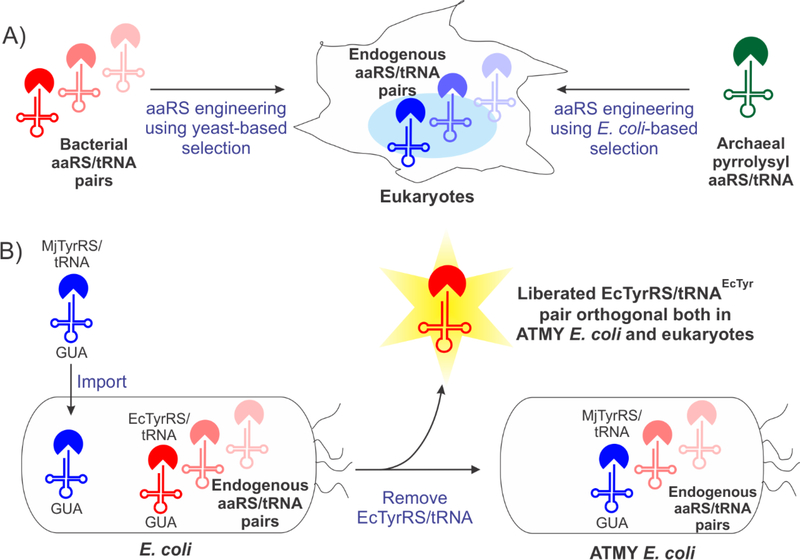
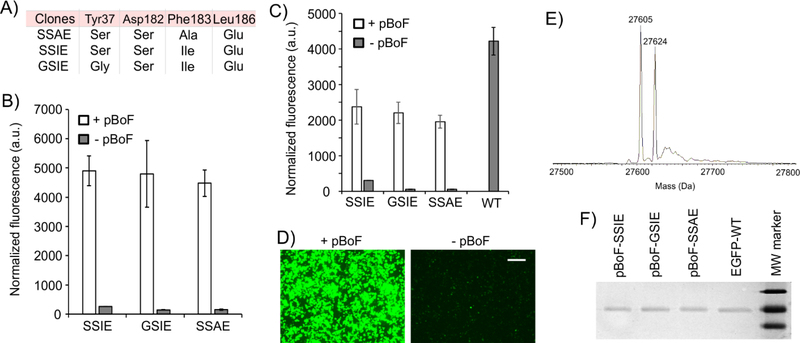
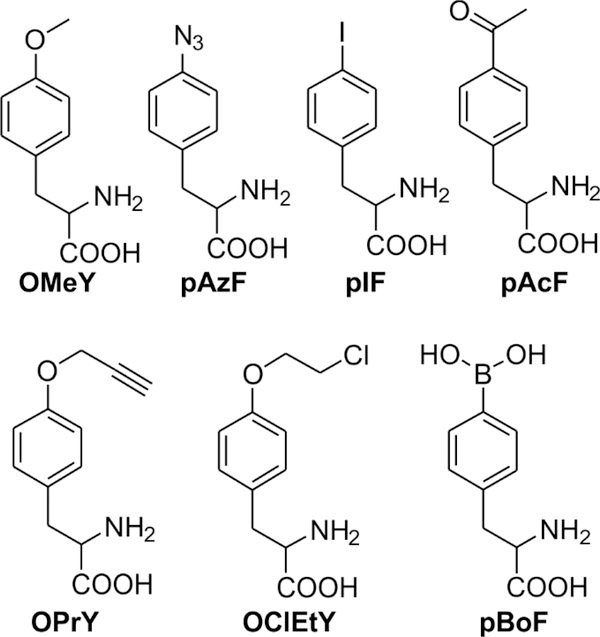
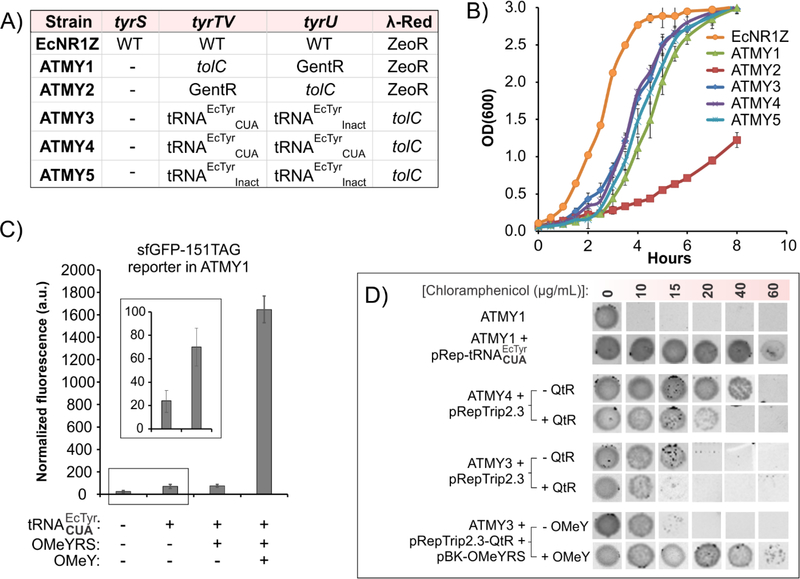
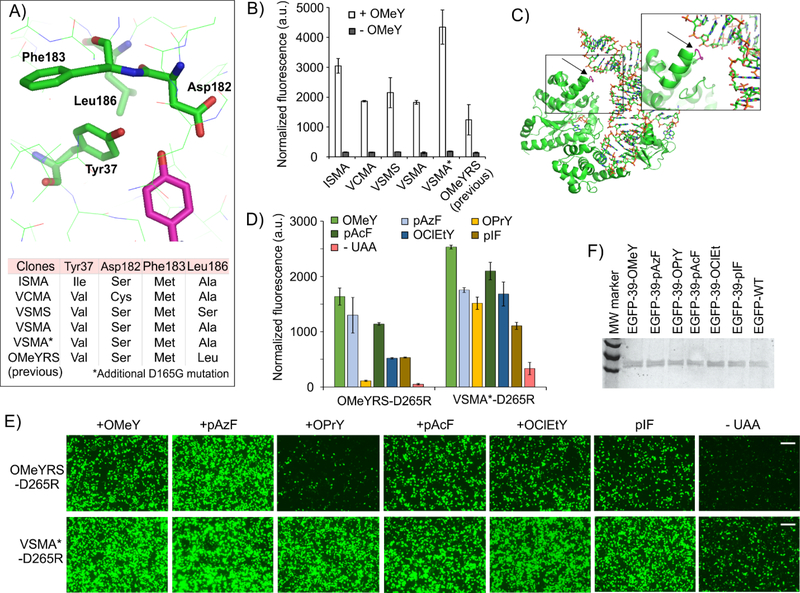
The bacteria-derived tyrosyl-tRNA synthetase (TyrRS)/tRNA pair was first used for unnatural amino acid (Uaa) mutagenesis in eukaryotic cells over 15 years ago. It provides an ideal platform to genetically encode numerous useful Uaas in eukaryotes. However, this pair has been engineered to charge only a small collection of Uaas to date. Development of Uaa-selective variants of this pair has been limited by technical challenges associated with a yeast-based directed evolution platform, which is currently required to alter its substrate specificity. Here we overcome this limitation by enabling its directed evolution in an engineered strain of E. coli (ATMY), where the endogenous TyrRS/tRNA pair has been functionally replaced with an archaeal counterpart. The facile E. coli-based selection system enabled rapid engineering of this pair to develop variants that selectively incorporate various Uaas, including p-boronophenylalanine, into proteins expressed in mammalian cells as well as in the ATMY strain of E. coli.
细菌衍生的酪氨酸-tRNA 合成酶 (TyrRS)/tRNA 对在 15 年前首次被用于真核细胞中的非天然氨基酸 (Uaa) 诱变。它为在真核生物中遗传编码大量有用的 Uaas 提供了理想的平台。然而,迄今为止,该对已被工程化为仅对一小部分 Uaas 进行充电。该对的 Uaa 选择性变体的开发受到与基于酵母的定向进化平台相关的技术挑战的限制,目前需要改变其底物特异性。在这里,我们通过在大肠杆菌 (ATMY) 的工程菌株中实现其定向进化来克服这一限制,在该菌株中,内源性 TyrRS/tRNA 对已被功能上取代为古菌对应物。简便的基于大肠杆菌的选择系统使该对的快速工程化成为可能,从而开发出选择性地将各种 Uaas(包括 p-硼代苯丙氨酸)掺入在哺乳动物细胞中表达的蛋白质以及大肠杆菌的 ATMY 菌株中的变体。