Schneider Kara L, Nyström Thomas, Widlund Per O
Department of Microbiology and Immunology, Institute of Biomedicine, Sahlgrenska Academy, University of Gothenburg, Gothenburg, Sweden.
Front Mol Neurosci. 2018 Jul 23;11:249. doi: 10.3389/fnmol.2018.00249. eCollection 2018.
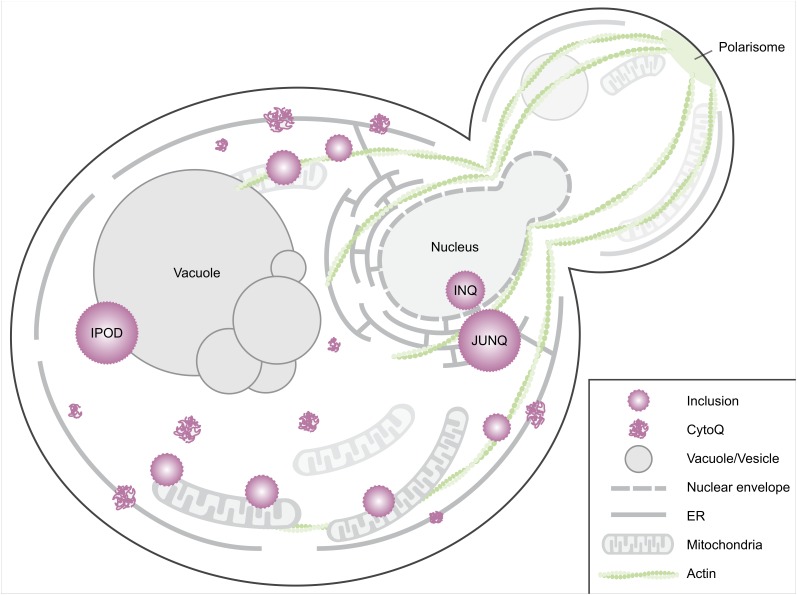
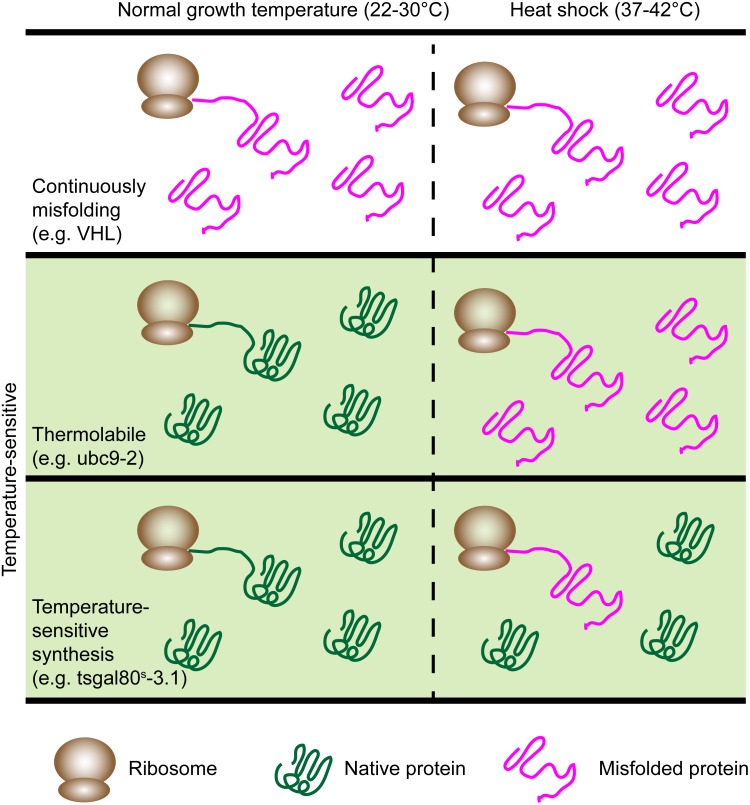
Protein quality control (PQC) is critical to maintain a functioning proteome. Misfolded or toxic proteins are either refolded or degraded by a system of temporal quality control and can also be sequestered into aggregates or inclusions by a system of spatial quality control. Breakdown of this concerted PQC network with age leads to an increased risk for the onset of disease, particularly neurological disease. has been used extensively to elucidate PQC pathways and general evolutionary conservation of the PQC machinery has led to the development of several useful models of human neurological diseases. Key to both of these types of studies has been the development of several different model misfolding proteins, which are used to challenge and monitor the PQC machinery. In this review, we summarize and compare the model misfolding proteins that have been used to specifically study spatial PQC in , as well as the misfolding proteins that have been shown to be subject to spatial quality control in models of human neurological diseases.
蛋白质质量控制(PQC)对于维持蛋白质组的正常功能至关重要。错误折叠或有毒的蛋白质可通过时间质量控制系统进行重新折叠或降解,也可通过空间质量控制系统隔离成聚集体或包涵体。随着年龄增长,这种协同的PQC网络出现故障会导致疾病发生风险增加,尤其是神经疾病。 已被广泛用于阐明PQC途径,并且PQC机制的一般进化保守性促使了几种有用的人类神经疾病模型的开发。这两类研究的关键在于开发了几种不同的模型错误折叠蛋白,用于挑战和监测PQC机制。在本综述中,我们总结并比较了用于专门研究 中空间PQC的模型错误折叠蛋白,以及在人类神经疾病模型中已被证明受到空间质量控制的错误折叠蛋白。