1 SingVaSC, Singapore Vascular Surgical Collaborative, Singapore.
2 Department of Vascular Surgery, Maastricht University Medical Center, Maastricht, the Netherlands.
J Endovasc Ther. 2018 Oct;25(5):599-607. doi: 10.1177/1526602818792854. Epub 2018 Aug 8.
To present a systematic review and meta-analysis comparing the transradial approach for aortoiliac and femoropopliteal interventions to the traditional transfemoral access.
A search of the public domain databases MEDLINE, SCOPUS, Web of Science, and Cochrane Library Databases was performed to identify studies related to the use of the transradial approach for infra-aortic procedures. Meta-analysis was used to compare the transradial to the transfemoral route in terms of procedure success, complications, procedure parameters, and hospital length of stay. Results are presented as the odds ratio (OR) and 95% confidence interval (CI).
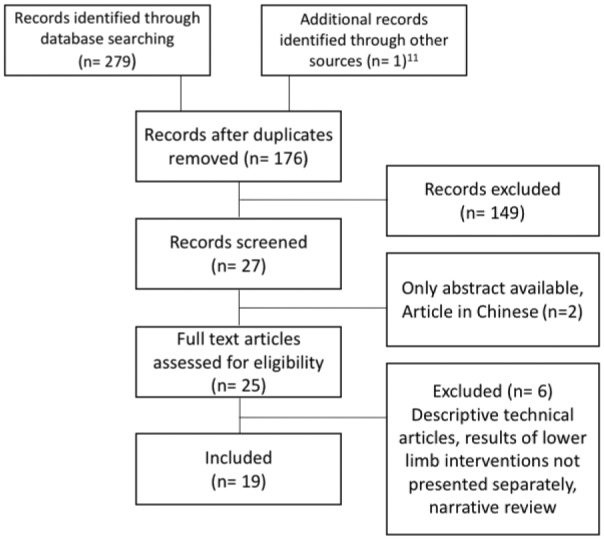
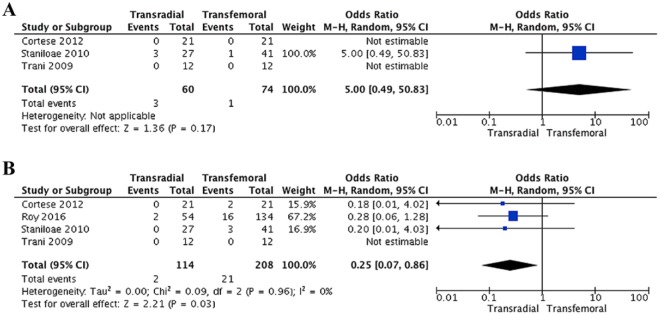
Nineteen studies containing 638 patients with transradial access for lower limb interventions were selected. Lesions were treated from the aortic bifurcation down to the popliteal artery. The mean technical success rate was 90.9%, conversion to a transfemoral approach was necessary in 9.9%, and complications were reported in 1.9%. The meta-analysis included 4 comparative studies involving 114 transradial and 208 transfemoral procedures. There was no significant advantage of either approach in terms of procedure success (OR 5.0, 95% CI 0.49 to 50.83, p=0.17), but the risk of developing a complication was significantly lower (OR 0.25, 95% CI 0.07 to 0.86, p=0.03) with the transradial approach.
Transradial access for lower limb endovascular interventions can be performed with comparable technical success and a lower overall complication profile compared to transfemoral access.
系统回顾和荟萃分析比较经桡动脉入路与传统经股动脉入路在主髂动脉和股腘动脉介入治疗中的应用。
检索公共领域数据库 MEDLINE、SCOPUS、Web of Science 和 Cochrane 图书馆数据库,以确定与经桡动脉入路用于腹主动脉下介入治疗相关的研究。荟萃分析比较了经桡动脉与经股动脉入路在手术成功率、并发症、手术参数和住院时间方面的差异。结果以比值比(OR)和 95%置信区间(CI)表示。
选择了 19 项包含 638 例经桡动脉入路下肢介入治疗的研究。病变从主动脉分叉处治疗至腘动脉。平均技术成功率为 90.9%,需要转为经股动脉入路的比例为 9.9%,并发症发生率为 1.9%。荟萃分析纳入了 4 项比较研究,共涉及 114 例经桡动脉和 208 例经股动脉手术。在手术成功率方面,两种入路均无显著优势(OR 5.0,95%CI 0.49 至 50.83,p=0.17),但经桡动脉入路发生并发症的风险显著降低(OR 0.25,95%CI 0.07 至 0.86,p=0.03)。
与经股动脉入路相比,经桡动脉入路行下肢血管腔内介入治疗可获得相当的技术成功率和更低的总体并发症发生率。