Environmental Epidemiology Unit, Lazio Regional Health Service ASL Roma 1, Rome, Italy.
Department of Public Health and Clinical Medicine, Umeå University, Umeå, Sweden.
Environ Health. 2018 Aug 8;17(1):66. doi: 10.1186/s12940-018-0411-0.
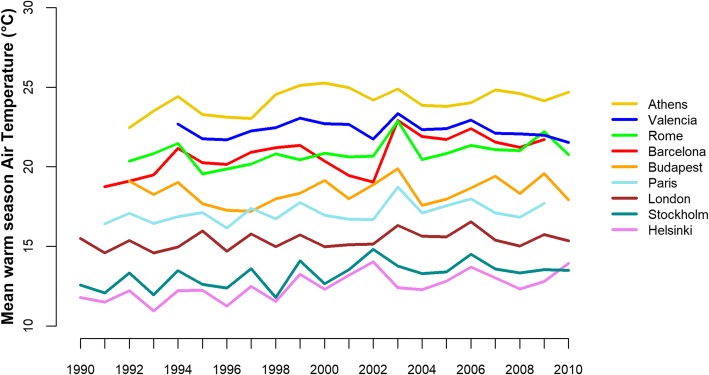
The association between heat and daily mortality and its temporal variation are well known. However, few studies have analyzed the inter-annual variations in both the risk estimates and impacts of heat. The aim is to estimate inter-annual variations in the effect of heat for a fixed temperature range, on mortality in 9 European cities included in the PHASE (Public Health Adaptation Strategies to Extreme weather events) project for the period 1990-2010. The second aim is to evaluate overall summer effects and heat-attributable deaths for each year included in the study period, considering the entire air temperature range (both mild and extreme temperatures).
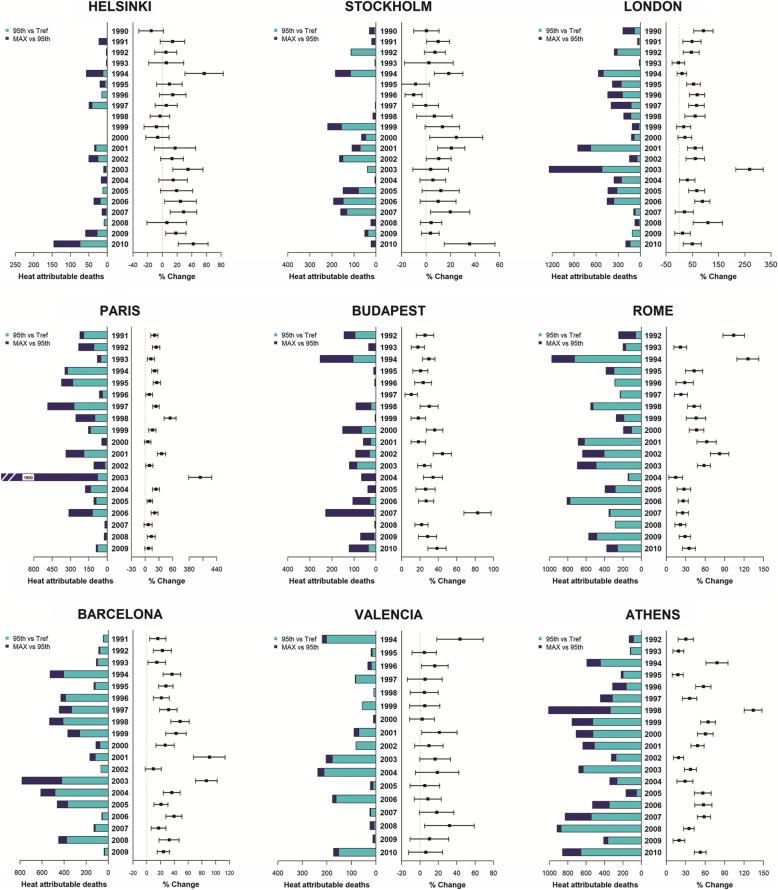
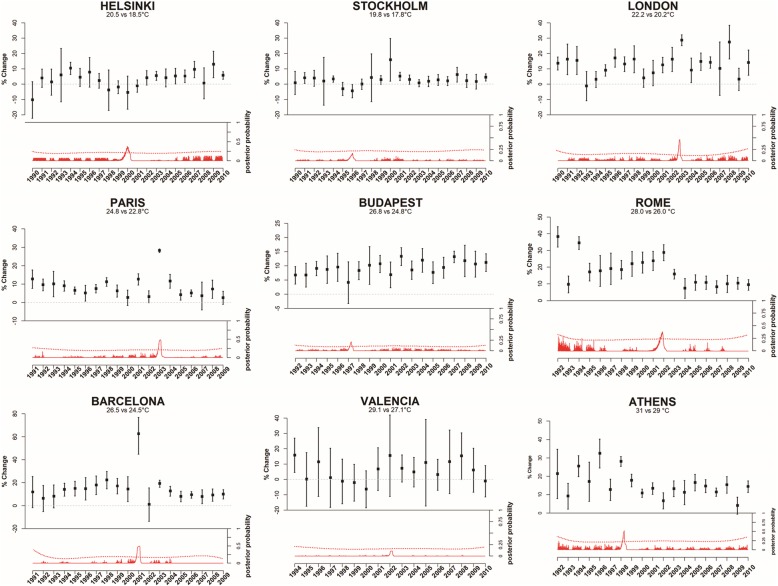
A city-specific daily time-series analysis was performed, using a generalized additive Poisson regression model, restricted to the warm season (April-September). To study the temporal variation for a fixed air temperature range, a Bayesian Change Point analysis was applied to the relative risks of mortality for a 2 °C increase over the 90th percentile of the city-specific distribution. The number of heat attributable deaths in each summer were also calculated for mild (reference to 95th percentile) and extreme heat (95th percentile to maximum value).
A decline in the effects of heat over time was observed in Athens and Rome when considering a fixed interval, while an increase in effects was observed in Helsinki. The greatest impact of heat in terms of attributable deaths was observed in the Mediterranean cities (Athens, Barcelona and Rome) for extreme air temperatures. In the other cities the impact was mostly related to extreme years with 2003 as a record breaking year in Paris (+ 1900 deaths) and London (+ 1200 deaths).
Monitoring the impact of heat over time is important to identify changes in population vulnerability and evaluate adaptation measures.
热与日死亡率之间的关联及其时间变化已广为人知。然而,很少有研究分析热的风险估计和影响的年际变化。本研究旨在估计在固定温度范围内,热量对 9 个欧洲城市(包括 PHASE 项目中的城市)死亡率的影响的年际变化,该研究时间段为 1990 年至 2010 年。第二个目的是评估整个夏季的影响和研究期间每年归因于热的死亡人数,同时考虑整个气温范围(包括温和和极端温度)。
使用广义加性泊松回归模型,针对温暖季节(4 月至 9 月)进行特定城市的每日时间序列分析。为了研究固定气温范围内的时间变化,对死亡率的相对风险进行了贝叶斯变化点分析,该分析考虑了城市特定分布的第 90 百分位数上 2°C 的升高。还计算了每个夏季归因于温和热(参考第 95 百分位数)和极端热(第 95 百分位数至最高值)的归因于热的死亡人数。
当考虑固定间隔时,在雅典和罗马观察到随着时间的推移,热效应呈下降趋势,而在赫尔辛基则观察到效应增加。在考虑极端气温时,地中海城市(雅典、巴塞罗那和罗马)归因于热的死亡人数最多。在其他城市,影响主要与极端年份有关,2003 年是巴黎(+1900 人死亡)和伦敦(+1200 人死亡)的创纪录年份。
监测热的影响随时间的变化对于识别人口脆弱性的变化和评估适应措施非常重要。