• 文献检索
  • 文档翻译
  • 深度研究
  • 学术资讯
  • Suppr Zotero 插件Zotero 插件
  • 邀请有礼
  • 套餐&价格
  • 历史记录
应用&插件
Suppr Zotero 插件Zotero 插件浏览器插件Mac 客户端Windows 客户端微信小程序
定价
高级版会员购买积分包购买API积分包
服务
文献检索文档翻译深度研究API 文档MCP 服务
关于我们
关于 Suppr公司介绍联系我们用户协议隐私条款
关注我们

Suppr 超能文献

核心技术专利:CN118964589B侵权必究
粤ICP备2023148730 号-1Suppr @ 2026

文献检索

告别复杂PubMed语法,用中文像聊天一样搜索,搜遍4000万医学文献。AI智能推荐,让科研检索更轻松。

立即免费搜索

文件翻译

保留排版,准确专业,支持PDF/Word/PPT等文件格式,支持 12+语言互译。

免费翻译文档

深度研究

AI帮你快速写综述,25分钟生成高质量综述,智能提取关键信息,辅助科研写作。

立即免费体验

密度趋势和人口统计学信号揭示了传染性癌症对袋獾的长期影响。

Density trends and demographic signals uncover the long-term impact of transmissible cancer in Tasmanian devils.

作者信息

Lazenby Billie T, Tobler Mathias W, Brown William E, Hawkins Clare E, Hocking Greg J, Hume Fiona, Huxtable Stewart, Iles Philip, Jones Menna E, Lawrence Clare, Thalmann Sam, Wise Phil, Williams Howel, Fox Samantha, Pemberton David

机构信息

Department of Primary Industries, Parks, Water and Environment, Hobart, Tas., Australia.

Institute for Conservation Research, San Diego Global Zoo, San Diego, CA, USA.

出版信息

J Appl Ecol. 2018 May;55(3):1368-1379. doi: 10.1111/1365-2664.13088. Epub 2018 Feb 5.
DOI:10.1111/1365-2664.13088
PMID:30089931
原文链接:https://pmc.ncbi.nlm.nih.gov/articles/PMC6078421/
Abstract
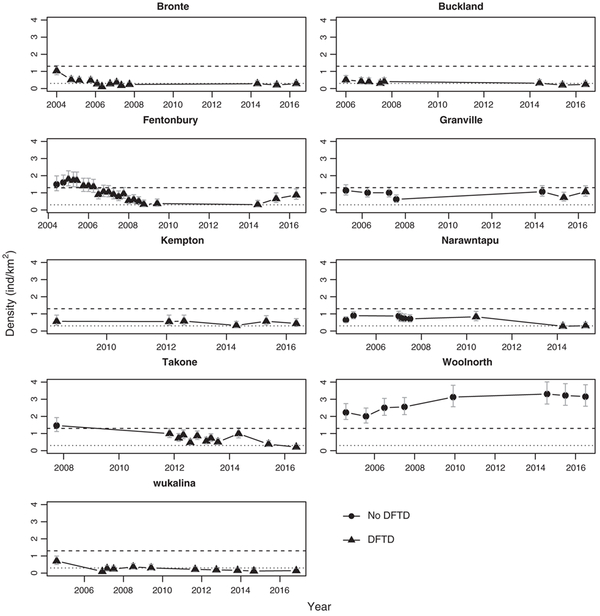
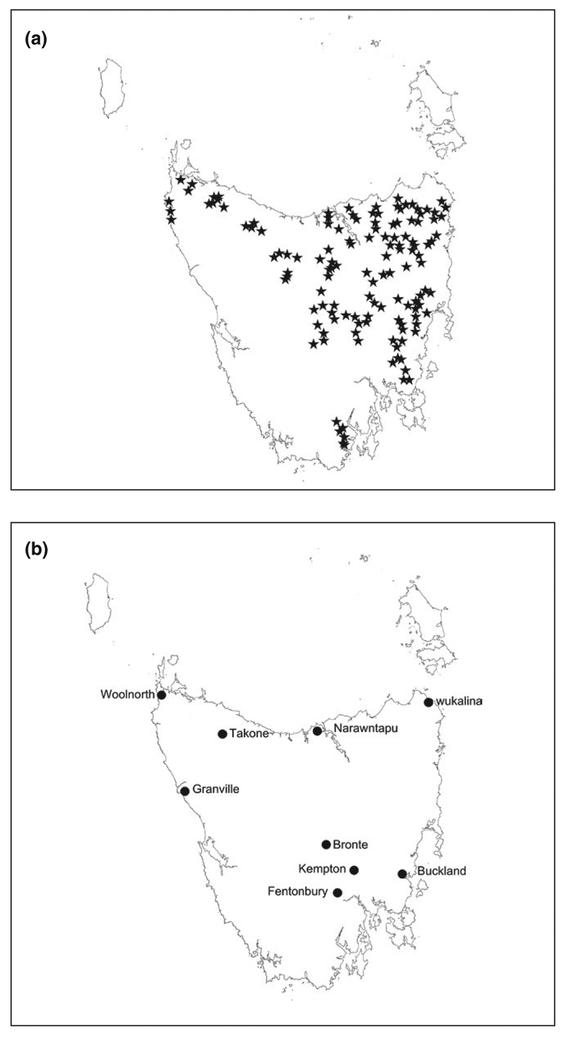
  1. Monitoring the response of wild mammal populations to threatening processes is fundamental to effective conservation management. This is especially true for infectious diseases, which may have dynamic and therefore unpredictable interactions with their host. 2. We investigate the long-term impact of a transmissible cancer, devil facial tumour disease (DFTD), on the endemic Tasmanian devil. We analyse trends in devil spot-light counts and density across the area impacted by the disease. We investigate the demographic parameters which might be driving these trends, and use spatial capture-recapture models to examine whether DFTD has affected home range size. 3. We found that devils have declined by an average of 77% in areas affected by DFTD, and that there is a congruent trend of ongoing small decline in spotlight counts and density estimates. Despite this, devils have persisted to date within each of nine monitoring sites. One site is showing as yet unexplained small increases in density 8-10 years after the emergence of DFTD. 4. We also found the prevalence of DFTD has not abated despite large declines in density and that diseased sites continue to be dominated by young devils. The long-term impact of the disease has been partially offset by increased fecundity in the form of precocial breeding in 1-year-old females, and more pouch young per female in diseased sites. The lower densities resulting from DFTD did not affect home range size. 5. Transmission of devil facial tumour disease continues despite large declines in devil density over multiple generations. Plasticity in life history traits has ameliorated the impact of devil facial tumour disease, however broad-scale trends in density show ongoing decline. In light of this, devil facial tumour disease and the impact of stochastic events on the reduced densities wrought by the disease, continue to threaten devils. In the absence of methods to manage disease in wild populations, we advocate managing the low population densities resulting from disease rather than disease per se.
摘要
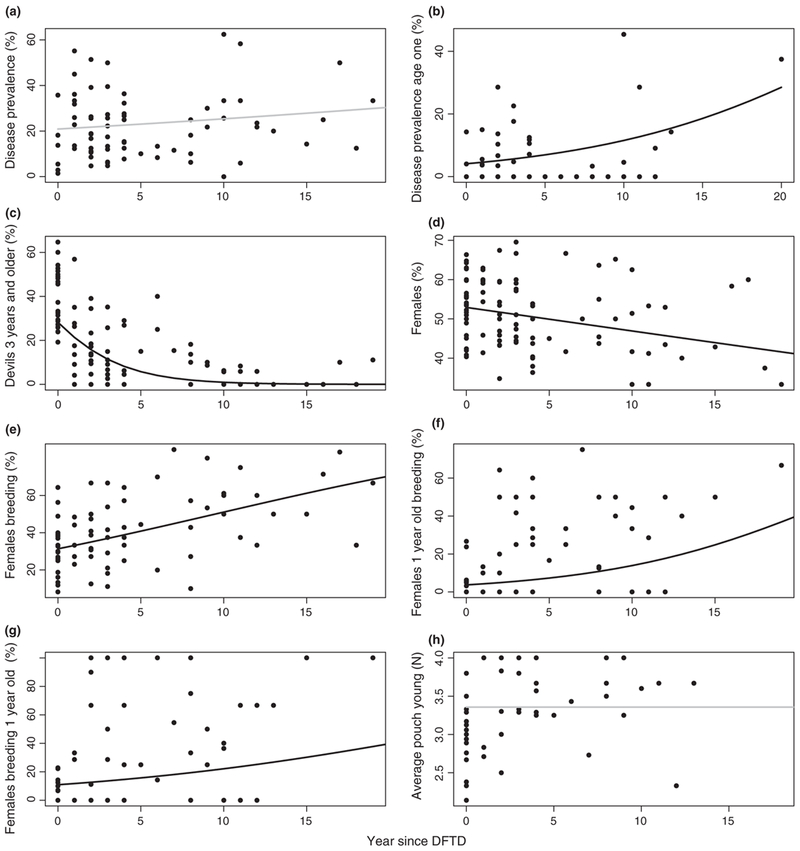
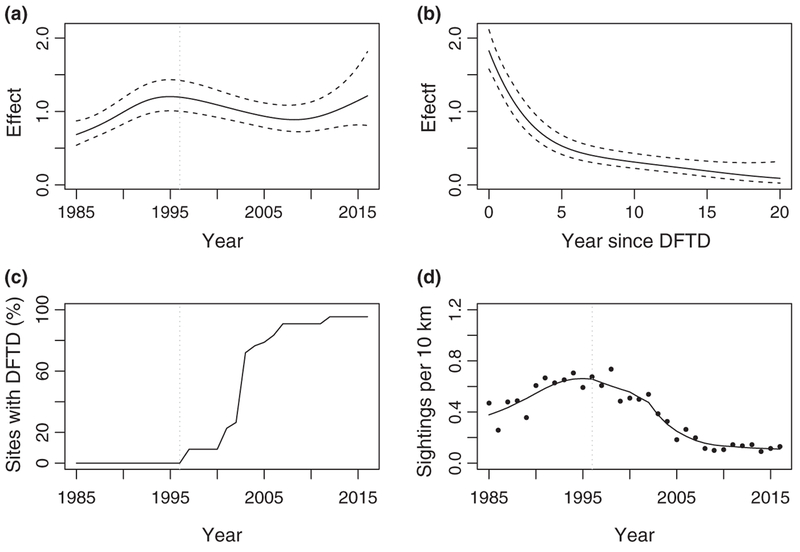
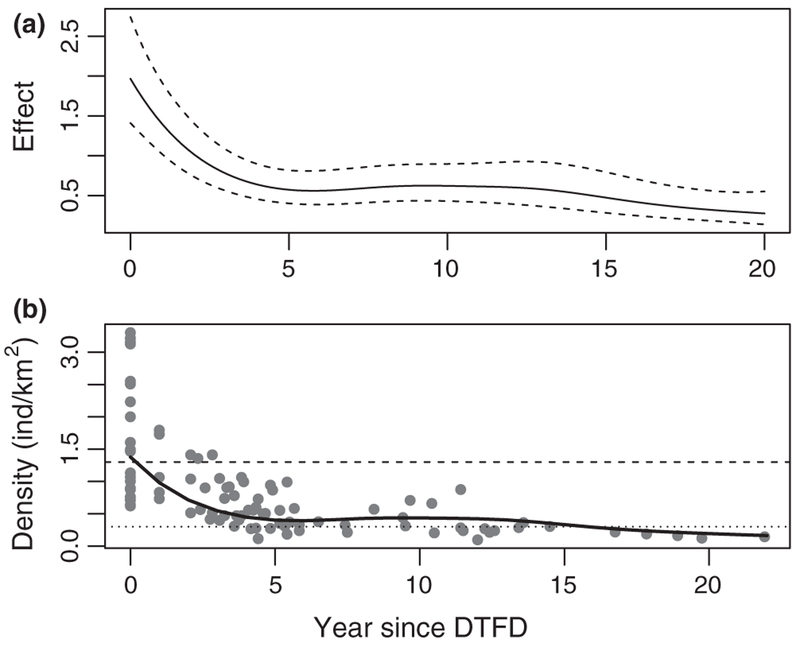
  1. 监测野生哺乳动物种群对威胁性过程的反应是有效保护管理的基础。对于传染病而言尤其如此,因为传染病与其宿主之间可能存在动态且因此不可预测的相互作用。2. 我们研究了一种可传播癌症——袋獾面部肿瘤病(DFTD)对塔斯马尼亚袋獾这一特有物种的长期影响。我们分析了受该病影响地区袋獾的 spotlight 计数和密度趋势。我们研究了可能推动这些趋势的人口统计学参数,并使用空间捕获 - 重捕模型来检验 DFTD 是否影响了家域大小。3. 我们发现,在受 DFTD 影响的地区,袋獾数量平均下降了 77%,并且 spotlight 计数和密度估计值持续出现小幅下降的一致趋势。尽管如此,在九个监测地点中的每一个,袋獾至今仍有留存。在 DFTD 出现 8 - 10 年后,有一个地点的密度出现了尚未得到解释的小幅增加。4. 我们还发现,尽管密度大幅下降,但 DFTD 的患病率并未降低,患病地区仍然以幼年袋獾为主。该疾病的长期影响已部分被 1 岁雌性袋獾早熟繁殖形式的繁殖力增加以及患病地区每只雌性袋獾育幼袋中幼崽数量增多所抵消。DFTD 导致的较低密度并未影响家域大小。5. 尽管经过多代袋獾密度大幅下降,但袋獾面部肿瘤病仍在传播。生活史特征的可塑性减轻了袋獾面部肿瘤病的影响,然而密度的总体趋势仍在持续下降。鉴于此,袋獾面部肿瘤病以及随机事件对该病导致的低密度种群的影响,继续威胁着袋獾。在缺乏管理野生种群疾病方法的情况下,我们主张管理因疾病导致的低种群密度,而非疾病本身。
https://cdn.ncbi.nlm.nih.gov/pmc/blobs/948d/6078421/839d5bbd11d8/nihms-978080-f0006.jpg
https://cdn.ncbi.nlm.nih.gov/pmc/blobs/948d/6078421/492d8d4b68bf/nihms-978080-f0001.jpg
https://cdn.ncbi.nlm.nih.gov/pmc/blobs/948d/6078421/8ff029ffc4f8/nihms-978080-f0002.jpg
https://cdn.ncbi.nlm.nih.gov/pmc/blobs/948d/6078421/4e7cbee0c00c/nihms-978080-f0003.jpg
https://cdn.ncbi.nlm.nih.gov/pmc/blobs/948d/6078421/b8eaf2f93e6e/nihms-978080-f0004.jpg
https://cdn.ncbi.nlm.nih.gov/pmc/blobs/948d/6078421/e2e484cbfd53/nihms-978080-f0005.jpg
https://cdn.ncbi.nlm.nih.gov/pmc/blobs/948d/6078421/839d5bbd11d8/nihms-978080-f0006.jpg
https://cdn.ncbi.nlm.nih.gov/pmc/blobs/948d/6078421/492d8d4b68bf/nihms-978080-f0001.jpg
https://cdn.ncbi.nlm.nih.gov/pmc/blobs/948d/6078421/8ff029ffc4f8/nihms-978080-f0002.jpg
https://cdn.ncbi.nlm.nih.gov/pmc/blobs/948d/6078421/4e7cbee0c00c/nihms-978080-f0003.jpg
https://cdn.ncbi.nlm.nih.gov/pmc/blobs/948d/6078421/b8eaf2f93e6e/nihms-978080-f0004.jpg
https://cdn.ncbi.nlm.nih.gov/pmc/blobs/948d/6078421/e2e484cbfd53/nihms-978080-f0005.jpg
https://cdn.ncbi.nlm.nih.gov/pmc/blobs/948d/6078421/839d5bbd11d8/nihms-978080-f0006.jpg

相似文献

1
Density trends and demographic signals uncover the long-term impact of transmissible cancer in Tasmanian devils.密度趋势和人口统计学信号揭示了传染性癌症对袋獾的长期影响。
J Appl Ecol. 2018 May;55(3):1368-1379. doi: 10.1111/1365-2664.13088. Epub 2018 Feb 5.
2
Season, weight, and age, but not transmissible cancer, affect tick loads in the endangered Tasmanian devil.季节、体重和年龄,但不是传染性癌症,影响濒危塔斯马尼亚恶魔身上的蜱虫数量。
Infect Genet Evol. 2022 Mar;98:105221. doi: 10.1016/j.meegid.2022.105221. Epub 2022 Jan 20.
3
Isotopic niche variation in Tasmanian devils with progression of devil facial tumor disease.袋獾面部肿瘤疾病进展过程中袋獾的同位素生态位变化
Ecol Evol. 2021 Jun 6;11(12):8038-8053. doi: 10.1002/ece3.7636. eCollection 2021 Jun.
4
Coevolution promotes the coexistence of Tasmanian devils and a fatal, transmissible cancer.协同进化促进了袋獾与一种致命的可传播癌症的共存。
Evolution. 2024 Dec 22;79(1):100-118. doi: 10.1093/evolut/qpae143.
5
Curse of the devil: molecular insights into the emergence of transmissible cancers in the Tasmanian devil (Sarcophilus harrisii).恶魔之咒:塔斯马尼亚恶魔(Sarcophilus harrisii)中可传播癌症出现的分子解析。
Cell Mol Life Sci. 2020 Jul;77(13):2507-2525. doi: 10.1007/s00018-019-03435-4. Epub 2020 Jan 3.
6
Demonstration of immune responses against devil facial tumour disease in wild Tasmanian devils.野生塔斯马尼亚袋獾对袋獾面部肿瘤病免疫反应的证明。
Biol Lett. 2016 Oct;12(10). doi: 10.1098/rsbl.2016.0553.
7
Conserving adaptive potential: lessons from Tasmanian devils and their transmissible cancer.保护适应潜力:袋獾及其传染性癌症带来的启示
Conserv Genet. 2019 Feb;20(1):81-87. doi: 10.1007/s10592-019-01157-5. Epub 2019 Feb 14.
8
Evidence for induction of humoral and cytotoxic immune responses against devil facial tumor disease cells in Tasmanian devils (Sarcophilus harrisii) immunized with killed cell preparations.用灭活细胞制剂免疫的袋獾(袋獾属哈里斯袋獾)中诱导出针对袋獾面部肿瘤病细胞的体液免疫和细胞毒性免疫反应的证据。
Vaccine. 2015 Jun 12;33(26):3016-25. doi: 10.1016/j.vaccine.2015.01.039. Epub 2015 Feb 20.
9
Comparative landscape genetics reveals differential effects of environment on host and pathogen genetic structure in Tasmanian devils (Sarcophilus harrisii) and their transmissible tumour.比较景观遗传学揭示了环境对塔斯马尼亚袋獾(Sarcophilus harrisii)及其传染性肿瘤宿主和病原体遗传结构的不同影响。
Mol Ecol. 2020 Sep;29(17):3217-3233. doi: 10.1111/mec.15558. Epub 2020 Aug 2.
10
Trophic cascades following the disease-induced decline of an apex predator, the Tasmanian devil.疾病导致顶级捕食者袋獾数量减少后出现的营养级联效应。
Conserv Biol. 2014 Feb;28(1):63-75. doi: 10.1111/cobi.12152. Epub 2013 Sep 11.

引用本文的文献

1
No Evidence for Distinct Transcriptomic Subgroups of Devil Facial Tumor Disease (DFTD).无证据表明袋獾面部肿瘤病(DFTD)存在不同的转录组亚群。
Evol Appl. 2025 Apr 1;18(4):e70091. doi: 10.1111/eva.70091. eCollection 2025 Apr.
2
Land use influences the faecal glucocorticoid metabolites of multiple species across trophic levels.土地利用影响多个营养级物种的粪便糖皮质激素代谢物。
Conserv Physiol. 2025 Jan 20;13(1):coae091. doi: 10.1093/conphys/coae091. eCollection 2025.
3
When Do Tumours Develop? Neoplastic Processes Across Different Timescales: Age, Season and Round the Circadian Clock.

本文引用的文献

1
Infection of the fittest: devil facial tumour disease has greatest effect on individuals with highest reproductive output.适者感染:袋獾面部肿瘤病对繁殖能力最强的个体影响最大。
Ecol Lett. 2017 Jun;20(6):770-778. doi: 10.1111/ele.12776. Epub 2017 May 10.
2
Rapid evolutionary response to a transmissible cancer in Tasmanian devils.塔斯马尼亚恶魔传染性癌症的快速进化反应。
Nat Commun. 2016 Aug 30;7:12684. doi: 10.1038/ncomms12684.
3
A second transmissible cancer in Tasmanian devils.袋獾身上的第二种可传播癌症。
肿瘤何时发生?不同时间尺度下的肿瘤形成过程:年龄、季节与昼夜节律
Evol Appl. 2024 Oct 22;17(10):e70024. doi: 10.1111/eva.70024. eCollection 2024 Oct.
4
Invasion and Amplification of Endogenous Retroviruses in Dasyuridae Marsupial Genomes.袋鼬科有袋类基因组中内源性逆转录病毒的入侵和扩增。
Mol Biol Evol. 2024 Aug 2;41(8). doi: 10.1093/molbev/msae160.
5
The Known and Unknown: Investigating the Carcinogenic Potential of Plastic Additives.已知与未知:探究塑料添加剂的致癌潜能。
Environ Sci Technol. 2024 Jun 18;58(24):10445-10457. doi: 10.1021/acs.est.3c06840. Epub 2024 Jun 3.
6
No evidence that a transmissible cancer has shifted from emergence to endemism in Tasmanian devils.没有证据表明可传播的癌症在袋獾中已从出现转变为地方病。
R Soc Open Sci. 2024 Apr 17;11(4):231875. doi: 10.1098/rsos.231875. eCollection 2024 Apr.
7
Human habitat modification, not apex scavenger decline, drives isotopic niche variation in a carnivore community.人类生境改变而非顶级掠食者减少导致了食肉动物群落的同位素生态位变异。
Oecologia. 2024 Apr;204(4):943-957. doi: 10.1007/s00442-024-05544-9. Epub 2024 Apr 15.
8
Complex associations between cancer progression and immune gene expression reveals early influence of transmissible cancer on Tasmanian devils.癌症进展与免疫基因表达之间的复杂关联揭示了传染性癌症对塔斯马尼亚恶魔的早期影响。
Front Immunol. 2024 Mar 7;15:1286352. doi: 10.3389/fimmu.2024.1286352. eCollection 2024.
9
Intergenomic signatures of coevolution between Tasmanian devils and an infectious cancer.袋獾与一种传染性癌症之间协同进化的基因组间特征
Proc Natl Acad Sci U S A. 2024 Mar 19;121(12):e2307780121. doi: 10.1073/pnas.2307780121. Epub 2024 Mar 11.
10
Is a blunt sword pointless? Tooth wear impacts puncture performance in Tasmanian devil canines.钝剑是否无用?牙齿磨损会影响袋獾犬齿的刺穿性能。
J Exp Biol. 2024 Feb 1;227(3). doi: 10.1242/jeb.246925. Epub 2024 Jan 31.
Proc Natl Acad Sci U S A. 2016 Jan 12;113(2):374-9. doi: 10.1073/pnas.1519691113. Epub 2015 Dec 28.
4
Transmissible cancer in Tasmanian devils: localized lineage replacement and host population response.袋獾的可传播癌症:局部谱系替代与宿主种群反应
Proc Biol Sci. 2015 Sep 7;282(1814). doi: 10.1098/rspb.2015.1468.
5
Evidence for induction of humoral and cytotoxic immune responses against devil facial tumor disease cells in Tasmanian devils (Sarcophilus harrisii) immunized with killed cell preparations.用灭活细胞制剂免疫的袋獾(袋獾属哈里斯袋獾)中诱导出针对袋獾面部肿瘤病细胞的体液免疫和细胞毒性免疫反应的证据。
Vaccine. 2015 Jun 12;33(26):3016-25. doi: 10.1016/j.vaccine.2015.01.039. Epub 2015 Feb 20.
6
Anthropogenic selection enhances cancer evolution in Tasmanian devil tumours.人为选择增强了塔斯马尼亚恶魔肿瘤中的癌症进化。
Evol Appl. 2014 Feb;7(2):260-5. doi: 10.1111/eva.12117. Epub 2013 Nov 6.
7
Evolution of a contagious cancer: epigenetic variation in Devil Facial Tumour Disease.传染性癌症的进化:恶魔面部肿瘤疾病中的表观遗传变异。
Proc Biol Sci. 2013 Jan 7;280(1750):20121720. doi: 10.1098/rspb.2012.1720. Epub 2012 Nov 7.
8
Disease and the dynamics of extinction.疾病与物种灭绝动力学。
Philos Trans R Soc Lond B Biol Sci. 2012 Oct 19;367(1604):2828-39. doi: 10.1098/rstb.2012.0224.
9
Biting injuries and transmission of Tasmanian devil facial tumour disease.噬咬伤与袋獾面部肿瘤疾病的传播。
J Anim Ecol. 2013 Jan;82(1):182-90. doi: 10.1111/j.1365-2656.2012.02025.x. Epub 2012 Sep 3.
10
The effects of season and devil facial tumour disease on the reproductive physiology of the male Tasmanian devil (Sarcophilus harrisii).季节和袋獾面部肿瘤病对雄性袋獾(袋獾属哈里斯袋獾)生殖生理学的影响。
Reprod Fertil Dev. 2012;24(7):999-1007. doi: 10.1071/RD11134.