Bell Olivia, Jones Menna E, Cunningham Calum X, Ruiz-Aravena Manuel, Hamilton David G, Comte Sebastien, Hamede Rodrigo K, Bearhop Stuart, McDonald Robbie A
Environment and Sustainability Institute University of Exeter Penryn UK.
School of Natural Sciences University of Tasmania Hobart Tasmania Australia.
Ecol Evol. 2021 Jun 6;11(12):8038-8053. doi: 10.1002/ece3.7636. eCollection 2021 Jun.
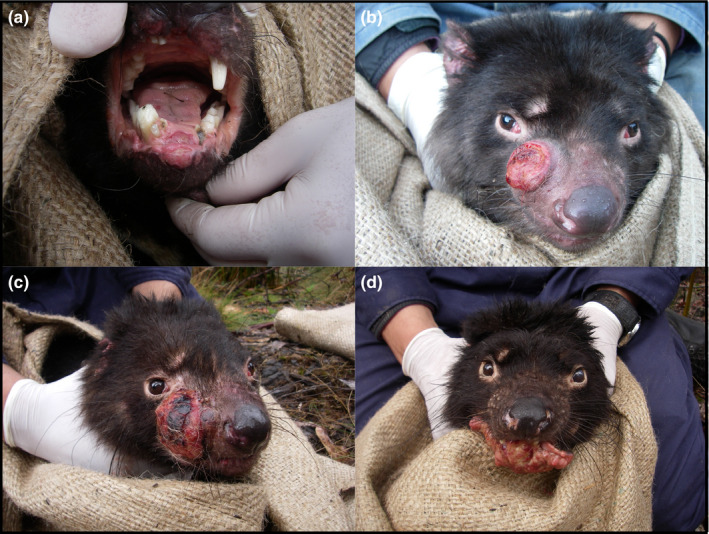
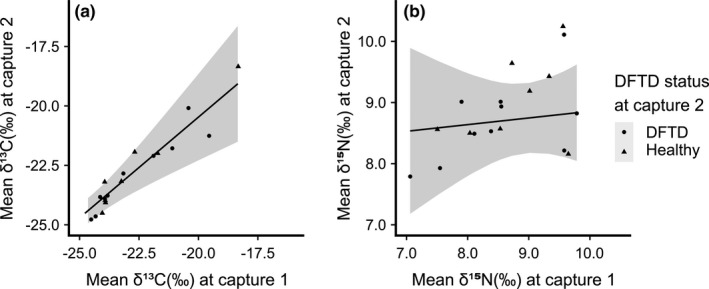
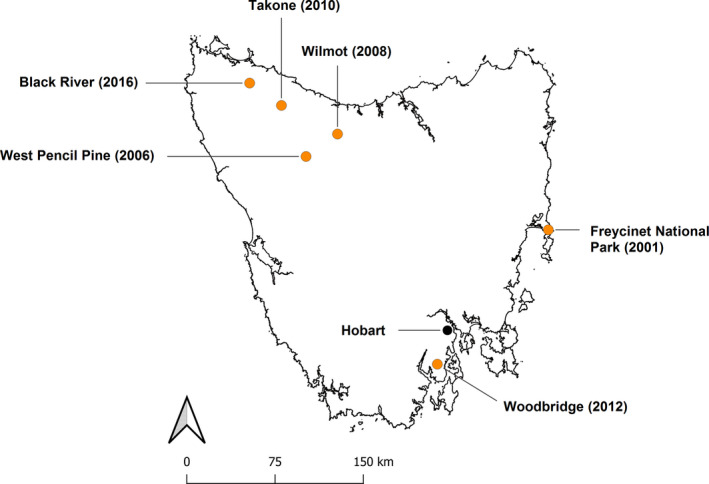
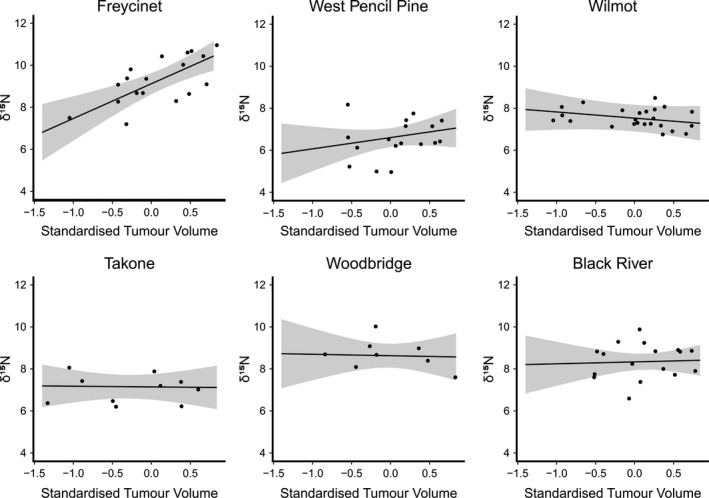
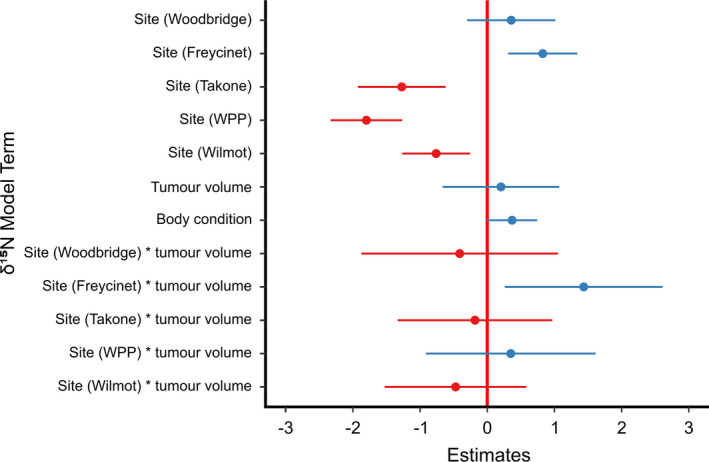
Devil facial tumor disease (DFTD) is a transmissible cancer affecting Tasmanian devils . The disease has caused severe population declines and is associated with demographic and behavioral changes, including earlier breeding, younger age structures, and reduced dispersal and social interactions. Devils are generally solitary, but social encounters are commonplace when feeding upon large carcasses. DFTD tumors can disfigure the jaw and mouth and so diseased individuals might alter their diets to enable ingestion of alternative foods, to avoid conspecific interactions, or to reduce competition. Using stable isotope analysis (δC and δN) of whiskers, we tested whether DFTD progression, measured as tumor volume, affected the isotope ratios and isotopic niches of 94 infected Tasmanian devils from six sites in Tasmania, comprising four eucalypt plantations, an area of smallholdings and a national park. Then, using tissue from 10 devils sampled before and after detection of tumors and 8 devils where no tumors were detected, we examined whether mean and standard deviation of δC and δN of the same individuals changed between healthy and diseased states. δC and δN values were generally not related to tumor volume in infected devils, though at one site, Freycinet National Park, δN values increased significantly as tumor volume increased. Infection with DFTD was not associated with significant changes in the mean or standard deviation of δC and δN values in individual devils sampled before and after detection of tumors. Our analysis suggests that devils tend to maintain their isotopic niche in the face of DFTD infection and progression, except where ecological conditions facilitate a shift in diets and feeding behaviors, demonstrating that ecological context, alongside disease severity, can modulate the behavioral responses of Tasmanian devils to DFTD.
袋獾面部肿瘤病(DFTD)是一种影响袋獾的传染性癌症。这种疾病已导致袋獾数量严重下降,并与人口结构和行为变化有关,包括繁殖提前、年龄结构年轻化、扩散和社交互动减少。袋獾通常独居,但在啃食大型尸体时,社交互动很常见。DFTD肿瘤会使袋獾的颌骨和嘴巴变形,因此患病个体可能会改变饮食,以便摄取其他食物,避免同种个体间的互动,或减少竞争。我们通过对袋獾胡须进行稳定同位素分析(δC和δN),测试了以肿瘤体积衡量的DFTD病情发展是否会影响来自塔斯马尼亚六个地点的94只受感染袋獾的同位素比率和同位素生态位,这六个地点包括四个桉树林种植园、一个小农场区域和一个国家公园。然后,我们使用10只在检测到肿瘤前后取样的袋獾以及8只未检测到肿瘤的袋獾的组织,研究了同一个体在健康和患病状态下δC和δN的平均值和标准差是否发生变化。在受感染的袋獾中,δC和δN值通常与肿瘤体积无关,不过在弗雷西内特国家公园这一地点,δN值随着肿瘤体积的增加而显著增加。在检测到肿瘤前后取样的个体袋獾中,感染DFTD与δC和δN值的平均值或标准差的显著变化无关。我们的分析表明,除了生态条件有利于饮食和觅食行为发生转变的情况外,袋獾在面对DFTD感染和病情发展时往往会维持其同位素生态位,这表明生态环境与疾病严重程度一起,可以调节袋獾对DFTD的行为反应。