Walsemann Katrina M, Ailshire Jennifer A
University of South Carolina, Columbia, SC, USA.
University of Southern California, Los Angeles, CA, USA.
Res Aging. 2011 May;33(3):286-311. doi: 10.1177/0164027511399104. Epub 2011 Apr 5.
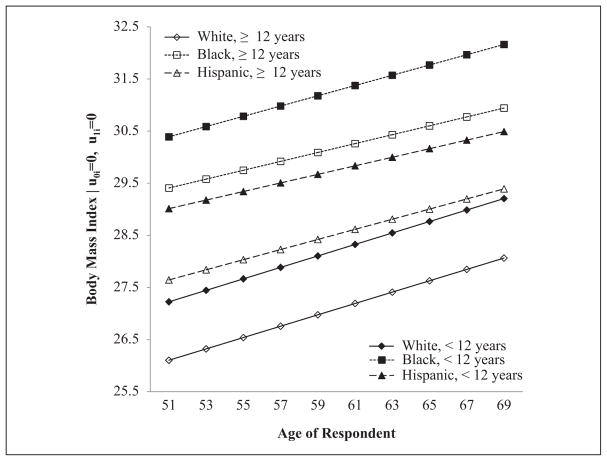
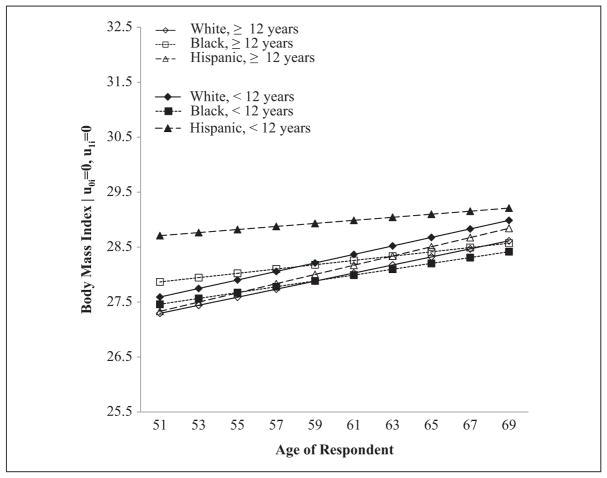
Previous research has produced inconsistent results on whether education and ethnic disparities in body mass index (BMI) persist, widen, or diminish over time. The authors investigate how education and ethnicity, independently and conditionally, influence BMI trajectories during the transition to older adulthood. Employing random coefficient modeling, the authors analyzed eight biennial waves of data (1992-2006) from the Health and Retirement Study, a nationally representative longitudinal study of individuals born between 1931 and 1941. After adjusting for health behaviors and health status, education and ethnic disparities in BMI persisted for most groups, but narrowed between high-educated White men and both low-educated Hispanic men and high-educated Black men. As such, the findings generally support the persistent inequality interpretation. Therefore, even though interventions targeted at earlier points in the life course may be effective in reducing BMI disparities in later life, social and health policies directed at reducing obesity among older adults is also warranted.
先前的研究对于体重指数(BMI)方面的教育和种族差异是否会随着时间持续存在、扩大或缩小,得出了不一致的结果。作者们调查了在步入老年期的过渡阶段,教育和种族如何独立地以及在有条件的情况下影响BMI轨迹。作者们采用随机系数模型,分析了来自健康与退休研究(一项针对1931年至1941年出生个体的具有全国代表性的纵向研究)的八次两年期数据(1992年至2006年)。在对健康行为和健康状况进行调整后,大多数群体中BMI的教育和种族差异仍然存在,但在高学历白人男性与低学历西班牙裔男性和高学历黑人男性之间的差异缩小了。因此,这些发现总体上支持持续不平等的解释。所以,尽管针对生命历程中早期阶段的干预措施可能在减少后期生活中的BMI差异方面有效,但也有必要制定旨在减少老年人肥胖的社会和健康政策。