• 文献检索
  • 文档翻译
  • 深度研究
  • 学术资讯
  • Suppr Zotero 插件Zotero 插件
  • 邀请有礼
  • 套餐&价格
  • 历史记录
应用&插件
Suppr Zotero 插件Zotero 插件浏览器插件Mac 客户端Windows 客户端微信小程序
定价
高级版会员购买积分包购买API积分包
服务
文献检索文档翻译深度研究API 文档MCP 服务
关于我们
关于 Suppr公司介绍联系我们用户协议隐私条款
关注我们

Suppr 超能文献

核心技术专利:CN118964589B侵权必究
粤ICP备2023148730 号-1Suppr @ 2026

文献检索

告别复杂PubMed语法,用中文像聊天一样搜索,搜遍4000万医学文献。AI智能推荐,让科研检索更轻松。

立即免费搜索

文件翻译

保留排版,准确专业,支持PDF/Word/PPT等文件格式,支持 12+语言互译。

免费翻译文档

深度研究

AI帮你快速写综述,25分钟生成高质量综述,智能提取关键信息,辅助科研写作。

立即免费体验

基于特征学习的传感器图像去雾算法。

A Sensor Image Dehazing Algorithm Based on Feature Learning.

机构信息

College of Aeronautics Engineering, Air Force Engineering University, Xi'an 710038, China.

出版信息

Sensors (Basel). 2018 Aug 9;18(8):2606. doi: 10.3390/s18082606.

DOI:10.3390/s18082606
PMID:30096891
原文链接:https://pmc.ncbi.nlm.nih.gov/articles/PMC6111301/
Abstract

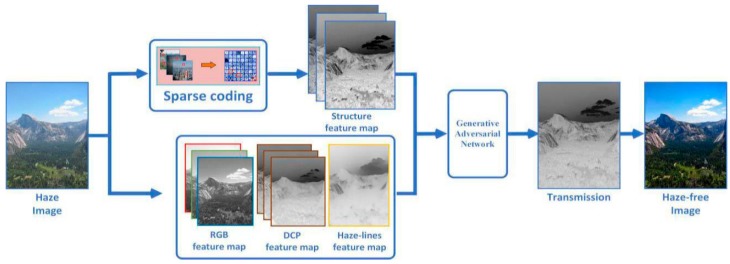
To solve the problems of color distortion and structure blurring in images acquired by sensors during bad weather, an image dehazing algorithm based on feature learning is put forward to improve the quality of sensor images. First, we extracted the multiscale structure features of the haze images by sparse coding and the various haze-related color features simultaneously. Then, the generative adversarial network (GAN) was used for sample training to explore the mapping relationship between different features and the scene transmission. Finally, the final haze-free image was obtained according to the degradation model. Experimental results show that the method has obvious advantages in its detail recovery and color retention. In addition, it effectively improves the quality of sensor images.

摘要

为了解决传感器在恶劣天气条件下获取的图像中存在的颜色失真和结构模糊问题,提出了一种基于特征学习的图像去雾算法,以提高传感器图像的质量。首先,通过稀疏编码和各种与雾相关的颜色特征同时提取雾图像的多尺度结构特征。然后,使用生成对抗网络(GAN)进行样本训练,以探索不同特征与场景传输之间的映射关系。最后,根据退化模型获得最终的无雾图像。实验结果表明,该方法在细节恢复和色彩保持方面具有明显的优势。此外,它有效地提高了传感器图像的质量。
https://cdn.ncbi.nlm.nih.gov/pmc/blobs/ebe5/6111301/f19957082435/sensors-18-02606-g014.jpg
https://cdn.ncbi.nlm.nih.gov/pmc/blobs/ebe5/6111301/fe997ad18478/sensors-18-02606-g001.jpg
https://cdn.ncbi.nlm.nih.gov/pmc/blobs/ebe5/6111301/fc38ee32809d/sensors-18-02606-g002.jpg
https://cdn.ncbi.nlm.nih.gov/pmc/blobs/ebe5/6111301/99610b4c5c40/sensors-18-02606-g003.jpg
https://cdn.ncbi.nlm.nih.gov/pmc/blobs/ebe5/6111301/0e76d4314b98/sensors-18-02606-g004.jpg
https://cdn.ncbi.nlm.nih.gov/pmc/blobs/ebe5/6111301/f43909fd6eb3/sensors-18-02606-g005.jpg
https://cdn.ncbi.nlm.nih.gov/pmc/blobs/ebe5/6111301/1ad83135a03d/sensors-18-02606-g006.jpg
https://cdn.ncbi.nlm.nih.gov/pmc/blobs/ebe5/6111301/40ac36a112b6/sensors-18-02606-g007.jpg
https://cdn.ncbi.nlm.nih.gov/pmc/blobs/ebe5/6111301/b41e4b5a3255/sensors-18-02606-g008.jpg
https://cdn.ncbi.nlm.nih.gov/pmc/blobs/ebe5/6111301/725e17b5a622/sensors-18-02606-g009.jpg
https://cdn.ncbi.nlm.nih.gov/pmc/blobs/ebe5/6111301/d11f731b6eb8/sensors-18-02606-g010.jpg
https://cdn.ncbi.nlm.nih.gov/pmc/blobs/ebe5/6111301/0b1741720c1d/sensors-18-02606-g011.jpg
https://cdn.ncbi.nlm.nih.gov/pmc/blobs/ebe5/6111301/9081fba742bd/sensors-18-02606-g012.jpg
https://cdn.ncbi.nlm.nih.gov/pmc/blobs/ebe5/6111301/d4dc48df9cf2/sensors-18-02606-g013.jpg
https://cdn.ncbi.nlm.nih.gov/pmc/blobs/ebe5/6111301/f19957082435/sensors-18-02606-g014.jpg
https://cdn.ncbi.nlm.nih.gov/pmc/blobs/ebe5/6111301/fe997ad18478/sensors-18-02606-g001.jpg
https://cdn.ncbi.nlm.nih.gov/pmc/blobs/ebe5/6111301/fc38ee32809d/sensors-18-02606-g002.jpg
https://cdn.ncbi.nlm.nih.gov/pmc/blobs/ebe5/6111301/99610b4c5c40/sensors-18-02606-g003.jpg
https://cdn.ncbi.nlm.nih.gov/pmc/blobs/ebe5/6111301/0e76d4314b98/sensors-18-02606-g004.jpg
https://cdn.ncbi.nlm.nih.gov/pmc/blobs/ebe5/6111301/f43909fd6eb3/sensors-18-02606-g005.jpg
https://cdn.ncbi.nlm.nih.gov/pmc/blobs/ebe5/6111301/1ad83135a03d/sensors-18-02606-g006.jpg
https://cdn.ncbi.nlm.nih.gov/pmc/blobs/ebe5/6111301/40ac36a112b6/sensors-18-02606-g007.jpg
https://cdn.ncbi.nlm.nih.gov/pmc/blobs/ebe5/6111301/b41e4b5a3255/sensors-18-02606-g008.jpg
https://cdn.ncbi.nlm.nih.gov/pmc/blobs/ebe5/6111301/725e17b5a622/sensors-18-02606-g009.jpg
https://cdn.ncbi.nlm.nih.gov/pmc/blobs/ebe5/6111301/d11f731b6eb8/sensors-18-02606-g010.jpg
https://cdn.ncbi.nlm.nih.gov/pmc/blobs/ebe5/6111301/0b1741720c1d/sensors-18-02606-g011.jpg
https://cdn.ncbi.nlm.nih.gov/pmc/blobs/ebe5/6111301/9081fba742bd/sensors-18-02606-g012.jpg
https://cdn.ncbi.nlm.nih.gov/pmc/blobs/ebe5/6111301/d4dc48df9cf2/sensors-18-02606-g013.jpg
https://cdn.ncbi.nlm.nih.gov/pmc/blobs/ebe5/6111301/f19957082435/sensors-18-02606-g014.jpg

相似文献

1
A Sensor Image Dehazing Algorithm Based on Feature Learning.基于特征学习的传感器图像去雾算法。
Sensors (Basel). 2018 Aug 9;18(8):2606. doi: 10.3390/s18082606.
2
Unsupervised Dark-Channel Attention-Guided CycleGAN for Single-Image Dehazing.用于单图像去雾的无监督暗通道注意力引导循环生成对抗网络
Sensors (Basel). 2020 Oct 23;20(21):6000. doi: 10.3390/s20216000.
3
Remote sensing image dehazing using generative adversarial network with texture and color space enhancement.基于纹理和色彩空间增强的生成对抗网络的遥感图像去雾
Sci Rep. 2024 May 29;14(1):12382. doi: 10.1038/s41598-024-63259-6.
4
Deep Dehazing Network With Latent Ensembling Architecture and Adversarial Learning.具有潜在集成架构和对抗学习的深度去雾网络
IEEE Trans Image Process. 2021;30:1354-1368. doi: 10.1109/TIP.2020.3044208. Epub 2020 Dec 23.
5
Residual Spatial and Channel Attention Networks for Single Image Dehazing.用于单图像去雾的残差空间和通道注意力网络
Sensors (Basel). 2021 Nov 27;21(23):7922. doi: 10.3390/s21237922.
6
AgriGAN: unpaired image dehazing via a cycle-consistent generative adversarial network for the agricultural plant phenotype.农业生成对抗网络(AgriGAN):通过循环一致生成对抗网络实现农业植物表型的无配对图像去雾
Sci Rep. 2024 Jul 1;14(1):14994. doi: 10.1038/s41598-024-65540-0.
7
Photo-Realistic Image Dehazing and Verifying Networks via Complementary Adversarial Learning.基于互补对抗学习的超真实图像去雾与验证网络
Sensors (Basel). 2021 Sep 15;21(18):6182. doi: 10.3390/s21186182.
8
Pixel-Wise Wasserstein Autoencoder for Highly Generative Dehazing.用于高生成性去雾的逐像素瓦瑟斯坦自动编码器
IEEE Trans Image Process. 2021;30:5452-5462. doi: 10.1109/TIP.2021.3084743. Epub 2021 Jun 9.
9
Fusion of Heterogeneous Adversarial Networks for Single Image Dehazing.用于单图像去雾的异构对抗网络融合
IEEE Trans Image Process. 2020 Feb 28. doi: 10.1109/TIP.2020.2975986.
10
Multi-Scale Attention Feature Enhancement Network for Single Image Dehazing.用于单图像去雾的多尺度注意力特征增强网络
Sensors (Basel). 2023 Sep 27;23(19):8102. doi: 10.3390/s23198102.

引用本文的文献

1
DFFNet: A Dual-Domain Feature Fusion Network for Single Remote Sensing Image Dehazing.DFFNet:一种用于单幅遥感图像去雾的双域特征融合网络。
Sensors (Basel). 2025 Aug 18;25(16):5125. doi: 10.3390/s25165125.
2
Color-Dense Illumination Adjustment Network for Removing Haze and Smoke from Fire Scenario Images.用于去除火灾场景图像中雾霾和烟雾的颜色密集光照调整网络
Sensors (Basel). 2022 Jan 25;22(3):911. doi: 10.3390/s22030911.
3
A Review of Remote Sensing Image Dehazing.遥感图像去雾综述

本文引用的文献

1
DehazeNet: An End-to-End System for Single Image Haze Removal.去雾网络:用于单幅图像去雾的端到端系统。
IEEE Trans Image Process. 2016 Nov;25(11):5187-5198. doi: 10.1109/TIP.2016.2598681.
Sensors (Basel). 2021 Jun 7;21(11):3926. doi: 10.3390/s21113926.
4
Visibility Restoration: A Systematic Review and Meta-Analysis.视敏度恢复:系统评价和荟萃分析。
Sensors (Basel). 2021 Apr 8;21(8):2625. doi: 10.3390/s21082625.
5
Adversarial Networks for Scale Feature-Attention Spectral Image Reconstruction from a Single RGB.基于单 RGB 图像的对抗网络进行尺度特征注意光谱图像重建
Sensors (Basel). 2020 Apr 24;20(8):2426. doi: 10.3390/s20082426.