Department of Public Health and Caring Sciences, Uppsala University, PO BOX 564, 75122, Uppsala, Sweden.
Department of Public Health Solutions, National Institute for Health and Welfare, PO BOX 30, 00271, Helsinki, Finland.
BMC Public Health. 2018 Aug 10;18(1):1000. doi: 10.1186/s12889-018-5885-8.
Applying the Process-Person-Context-Time (PPCT) model of the bioecological theory, this study considers whether proximal processes between the individual and the microsystem (social relationships within family, peer group and school) during adolescence are associated with heavy episodic drinking (HED), from youth to midlife, and whether the macro level context (country) plays a role in these associations.
Participants of two prospective cohort studies from Finland and Sweden, recruited in 1983/1981 at age 16 (n = 2194/1080), were followed-up until their forties using postal questionnaires. Logistic regression analysis was used to examine associations between social relationships at age 16 and HED (at least monthly intoxication or having six or more units of alcohol in one occasion) at ages 22/21, 32/30 and 42/43. Additive interactions between microsystem settings, as well as between settings and country, were also considered.
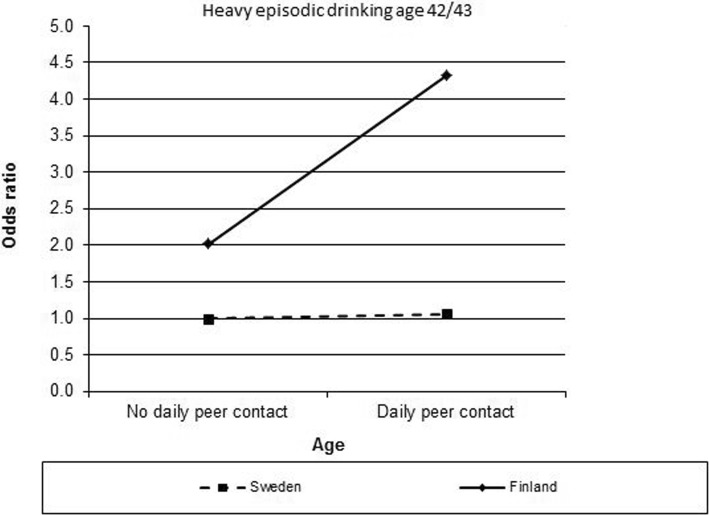
Consistent with the PPCT model, we found individual, contextual and temporal aspects to be associated with drinking habits. Higher levels of poor family relationships were associated with an increased likelihood of HED (ages 22/21 and 32/30) in both Finnish women and men and Swedish men. Higher levels of peer contact were associated with an increased likelihood of HED in both Finnish women (ages 32 and 42) and men (ages 22 and 32), and Swedish men (age 21). In contrast with the other groups, poorer relationships with classmates were associated with an increased likelihood of HED (age 30) for Swedish women only. For women, the combined effect of having both daily peer contact and living in Finland for HED at age 42/43 was statistically distinguishable from a pure additive effect.
Micro and to a lesser extent macro level contexts are associated with heavy episodic drinking well into adulthood. The most relevant processes in the adolescent microsystem occur in family and peer settings. However, long-lasting protective or risk-raising effects between different settings and later HED were not found. Promoting good relationships across different contexts during adolescence may reduce the incidence of HED in adulthood.
本研究应用生物生态理论的过程-人-环境-时间(PPCT)模型,探讨个体与微系统(家庭、同伴群体和学校内的社会关系)之间的近端过程是否与青少年期至中年期的重度间歇性饮酒(HED)相关,以及宏观环境(国家)在这些关联中是否发挥作用。
本研究使用来自芬兰和瑞典的两项前瞻性队列研究的参与者数据,这些参与者于 1983 年/1981 年在 16 岁时(n=2194/1080)入组,通过邮寄问卷进行随访直至四十多岁。使用逻辑回归分析来检验 16 岁时的社会关系与 22/21 岁、32/30 岁和 42/43 岁时的 HED(至少每月一次醉酒或一次饮酒 6 个或更多单位)之间的关联。还考虑了微系统设置以及设置与国家之间的附加交互作用。
符合 PPCT 模型,我们发现个体、环境和时间方面与饮酒习惯相关。较差的家庭关系与芬兰女性和男性以及瑞典男性发生 HED 的可能性增加有关(22/21 岁和 32/30 岁)。较高的同伴接触水平与芬兰女性(32 岁和 42 岁)和男性(22 岁和 32 岁)以及瑞典男性(21 岁)发生 HED 的可能性增加有关。与其他组不同的是,与同学的关系较差仅与瑞典女性发生 HED(30 岁)的可能性增加有关。对于女性,在芬兰时每天与同伴接触并且同时存在这两种情况与 42/43 岁时发生 HED 的纯相加效应在统计学上是可区分的。
微环境(尤其是宏观环境)与成年后重度间歇性饮酒高度相关。青少年微系统中最相关的过程发生在家庭和同伴环境中。然而,并未发现不同环境之间持久的保护或增加风险的作用以及对后期 HED 的影响。在青少年时期促进不同环境之间的良好关系可能会降低成年后 HED 的发生率。