Laboratoire Instabilité et Organisation Nucléaire, iRCM, IBFJ, DRF, CEA. 2 INSERM, U967. 3 Université Paris Diderot et Paris Saclay, UMR967, Fontenay-aux-roses, 92265, France.
Curr Genet. 2019 Feb;65(1):29-39. doi: 10.1007/s00294-018-0873-1. Epub 2018 Aug 10.
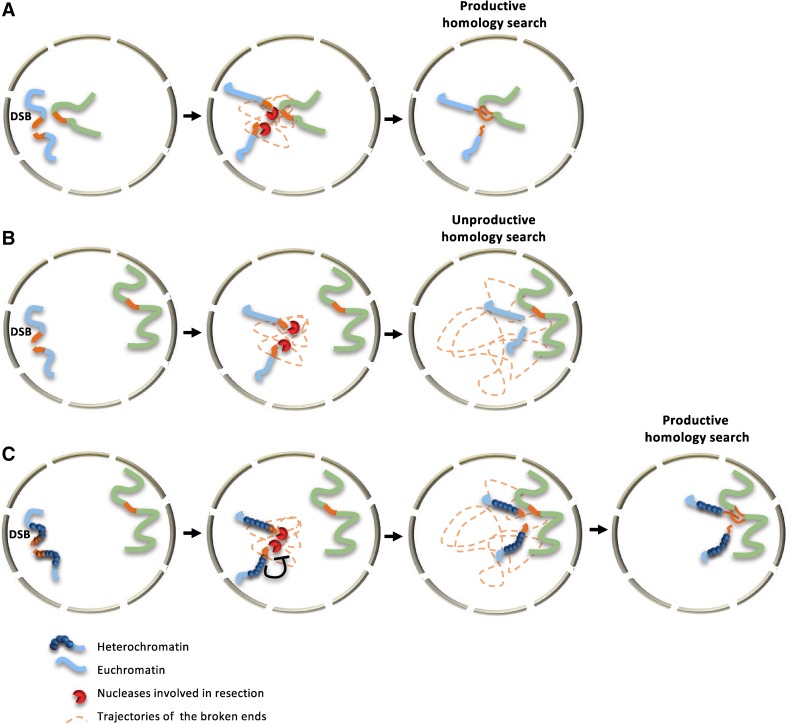
Genomic DNA is constantly exposed to damage. Among the lesion in DNA, double-strand breaks (DSB), because they disrupt the two strands of the DNA double helix, are the more dangerous. DSB are repaired through two evolutionary conserved mechanisms: Non-Homologous End Joining (NHEJ) and Homologous Recombination (HR). Whereas NHEJ simply reseals the double helix with no or minimal processing, HR necessitates the formation of a 3'ssDNA through the processing of DSB ends by the resection machinery and relies on the recognition and pairing of this 3'ssDNA tails with an intact homologous sequence. Despite years of active research on HR, the manner by which the two homologous sequences find each other in the crowded nucleus, and how this modulates HR efficiency, only recently emerges. Here, we review recent advances in our understanding of the factors limiting the search of a homologous sequence during HR.
基因组 DNA 不断受到损伤的威胁。在 DNA 损伤中,双链断裂 (DSB) 因其破坏 DNA 双螺旋的两条链而更为危险。DSB 可以通过两种进化上保守的机制进行修复:非同源末端连接 (NHEJ) 和同源重组 (HR)。NHEJ 只是简单地修复双链,几乎不进行任何处理,而 HR 则需要通过酶切作用形成 3' ssDNA,然后依赖于对该 3' ssDNA 尾与完整同源序列的识别和配对。尽管人们对 HR 进行了多年的积极研究,但对于两条同源序列在拥挤的细胞核中如何找到彼此,以及这种方式如何调节 HR 效率,直到最近才有所了解。在这里,我们回顾了最近在理解限制 HR 过程中同源序列搜索的因素方面的进展。