Phipps Jamie, Toulouze Mathias, Ducrot Cécile, Costa Rafaël, Brocas Clémentine, Dubrana Karine
UMR Stabilité Génétique Cellules Souches et Radiations, Université Paris Cité, INSERM, CEA, Fontenay-aux-Roses, France.
UMR Stabilité Génétique Cellules Souches et Radiations, Université Paris-Saclay, INSERM, CEA, Fontenay-aux-Roses, France.
Nat Cell Biol. 2025 Jan;27(1):118-129. doi: 10.1038/s41556-024-01552-2. Epub 2024 Oct 31.
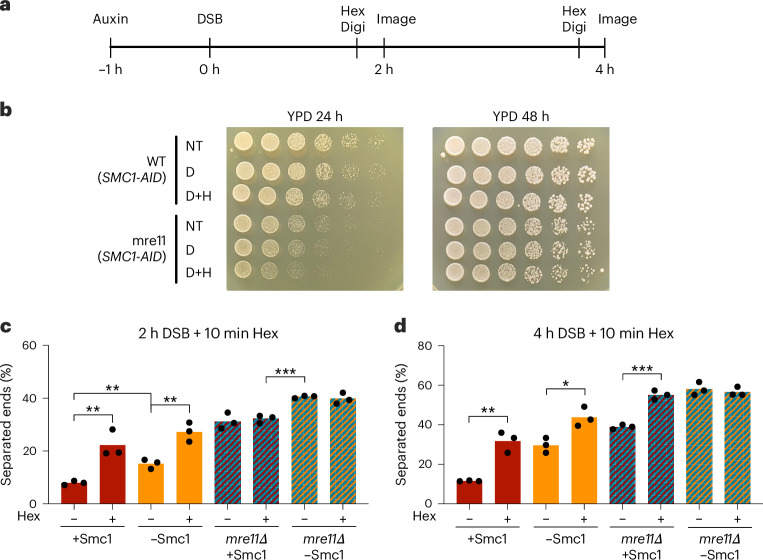
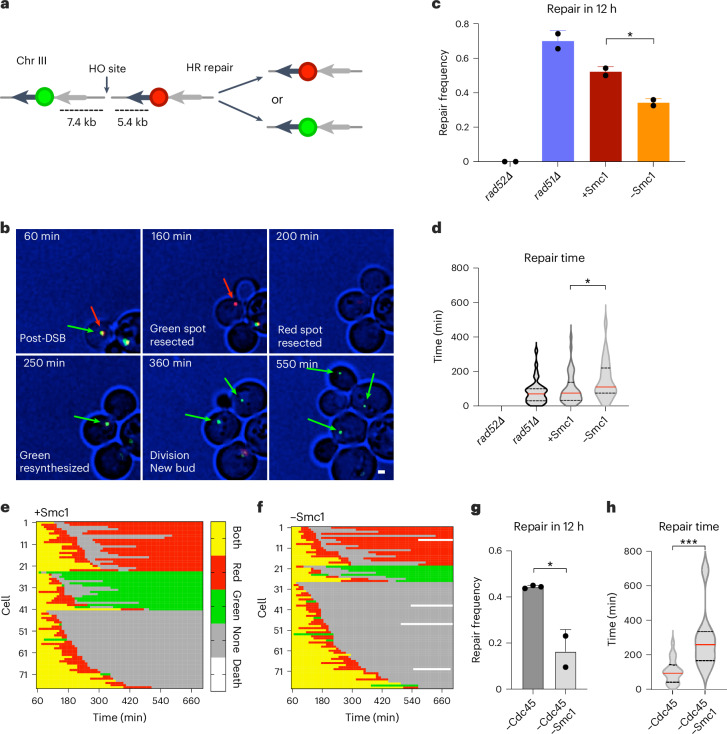
DNA double-strand breaks (DSBs) must be repaired to ensure genome stability. Crucially, DSB-ends must be kept together for timely repair. In Saccharomyces cerevisiae, two pathways mediate DSB end-tethering. One employs the Mre11-Rad50-Xrs2 (MRX) complex to physically bridge DSB-ends. Another requires the conversion of DSB-ends into single-strand DNA (ssDNA) by Exo1, but the bridging proteins are unknown. We uncover that cohesin, its loader and Smc5/6 act with Exo1 to tether DSB-ends. Remarkably, cohesin specifically impaired in oligomerization fails to tether DSB-ends, revealing a function for cohesin oligomerization. In addition to the known importance of sister chromatid cohesion, microscopy-based microfluidic experiments unveil a role for cohesin in repair by ensuring DSB end-tethering. Altogether, our findings demonstrate that oligomerization of cohesin prevents DSB end-separation and promotes DSB repair, revealing a previously undescribed mode of action and role for cohesin in safeguarding genome integrity.
DNA双链断裂(DSB)必须得到修复以确保基因组稳定性。至关重要的是,DSB末端必须保持在一起以便及时修复。在酿酒酵母中,有两条途径介导DSB末端的拴系。一条途径利用Mre11-Rad50-Xrs2(MRX)复合物在物理上连接DSB末端。另一条途径需要Exo1将DSB末端转化为单链DNA(ssDNA),但目前尚不清楚参与连接的蛋白质是什么。我们发现黏连蛋白、其加载器以及Smc5/6与Exo1共同作用来拴系DSB末端。值得注意的是,在寡聚化方面有特异性缺陷的黏连蛋白无法拴系DSB末端,这揭示了黏连蛋白寡聚化的一种功能。除了已知的姐妹染色单体黏连的重要性外,基于显微镜的微流控实验揭示了黏连蛋白通过确保DSB末端拴系在修复过程中的作用。总之,我们的研究结果表明,黏连蛋白的寡聚化可防止DSB末端分离并促进DSB修复,揭示了黏连蛋白在维护基因组完整性方面一种此前未被描述的作用方式和作用。