University of California, Berkeley and University of California, San Francisco Graduate Program in Bioengineering, CA.
Department of Epidemiology, University of Hawaii Cancer Center, Honolulu, HI.
Am J Clin Nutr. 2018 Oct 1;108(4):708-715. doi: 10.1093/ajcn/nqy158.
The 4-component (4C) model is a criterion method for human body composition that separates the body into fat, water, mineral, and protein, but requires 4 measurements with significant cost and time requirements that preclude wide clinical use. A simplified model integrating only 2 measurements-dual-energy X-ray absorptiometry (DXA) and bioelectrical impedance analysis (BIA)-and 10 min of patient time has been proposed.
We aimed to validate a rapid, simplified 4C DXA + BIA body composition model in a clinical population.
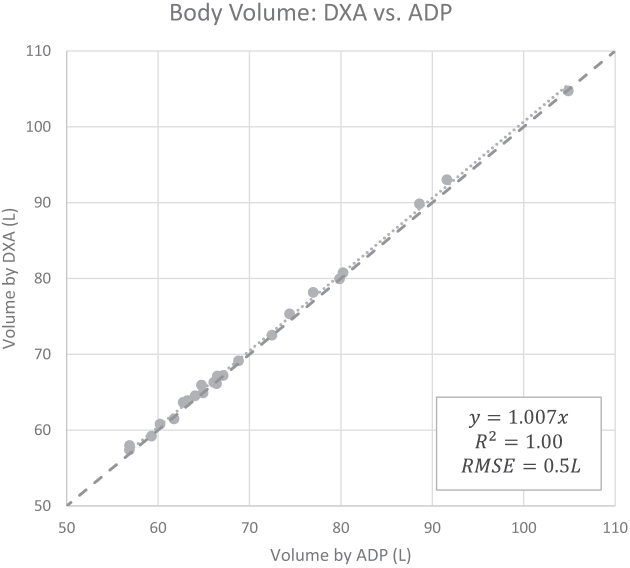
This was a cross-sectional observational study of 31 healthy adults. Participants underwent whole-body DXA, segmental BIA, air displacement plethysmography (ADP), and total body water (TBW) measurement by deuterium (D2O) dilution. 4C composition was calculated through the use of the Lohman model [DXA mineral mass, D2O TBW, ADP body volume (BV), scale weight] and the simplified model (DXA mineral mass and BV, BIA TBW, scale weight). Accuracy of percentage of fat (%Fat) and protein measurements was assessed via linear regression. Test-retest precision was calculated with the use of duplicate DXA and BIA measurements.
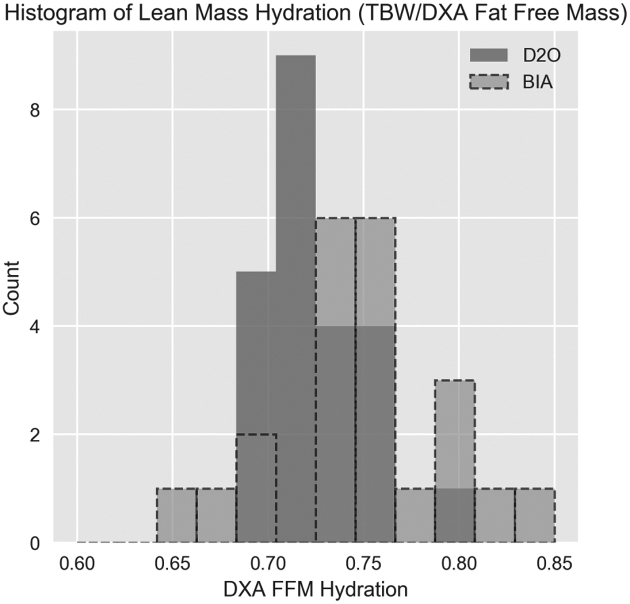
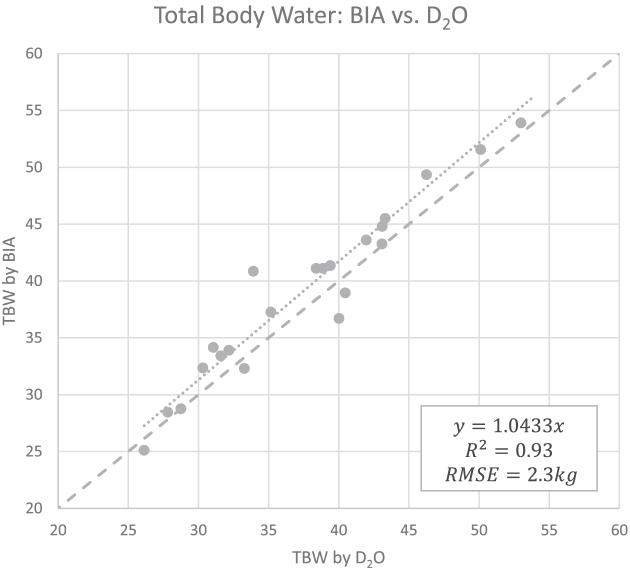
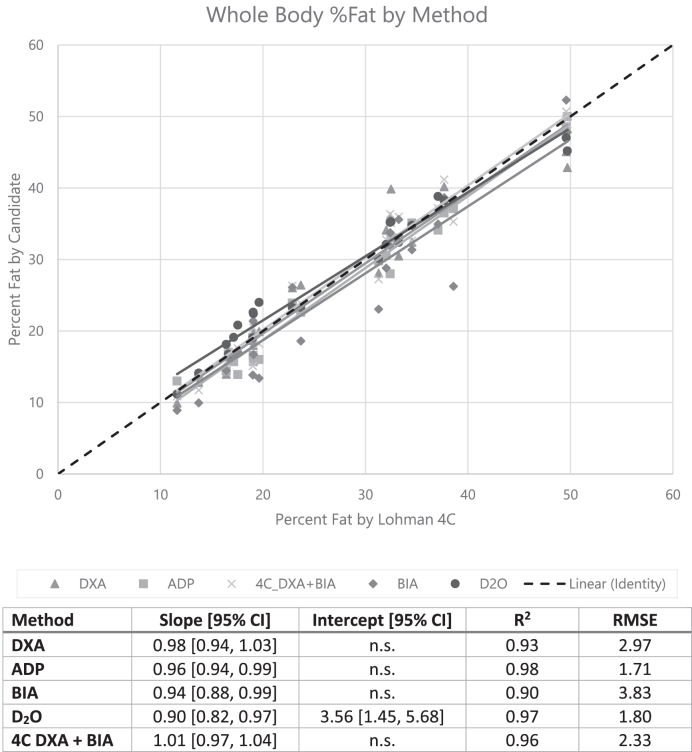
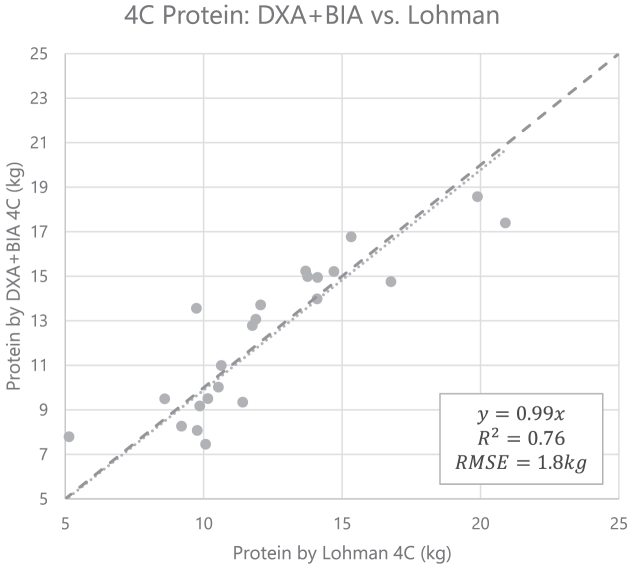
Of 31 participants, 23 were included in the analysis. TBWBIA showed good test-retest precision (%CV = 5.2 raw; 1.1 after outlier removal) and high accuracy to TBWD2O [TBWD2O = 0.956*TBWBIA, R2= 0.92, root mean squared error (RMSE) = 2.2 kg]. %Fat estimates from DXA, ADP, D2O, and BIA all showed high correlation with the Lohman model. However, only the 4C simplified model provides high accuracy for both %Fat (R2 = 0.96, RMSE = 2.33) and protein mass (R2= 0.76, RMSE = 1.8 kg). %Fat precision from 4C DXA + BIA was comparable with DXA (root mean square-SD = 0.8 and 0.6 percentage units, respectively).
This work validates a simplified 4C method that measures fat, water, mineral, and protein in a 10-min clinic visit. This model has broad clinical application to monitor many conditions including over/dehydration, malnutrition, obesity, sarcopenia, and cachexia.
4 分量(4C)模型是一种人体成分的标准方法,它将人体分为脂肪、水、矿物质和蛋白质,但需要 4 次测量,成本和时间要求高,因此无法广泛应用于临床。已经提出了一种简化模型,该模型仅整合了 2 次测量(双能 X 射线吸收法(DXA)和生物电阻抗分析(BIA))和 10 分钟的患者时间。
我们旨在验证一种快速、简化的 4C DXA+BIA 人体成分模型在临床人群中的有效性。
这是一项横断面观察性研究,共纳入 31 名健康成年人。参与者接受全身 DXA、节段 BIA、空气置换体积描记法(ADP)和全身水(TBW)通过氘(D2O)稀释测量。4C 成分通过使用 Lohman 模型[DXA 矿物质质量、D2O TBW、ADP 体体积(BV)、秤重]和简化模型(DXA 矿物质质量和 BV、BIA TBW、秤重)进行计算。通过线性回归评估脂肪百分比(%Fat)和蛋白质测量的准确性。使用重复 DXA 和 BIA 测量值计算测试-重测精度。
在 31 名参与者中,有 23 名纳入分析。TBWBIA 具有良好的测试-重测精度(%CV=5.2 原始;1.1 去除离群值后),与 TBWD2O 高度相关[TBWD2O=0.956*TBWBIA,R2=0.92,均方根误差(RMSE)=2.2kg]。DXA、ADP、D2O 和 BIA 对%Fat 的估计均与 Lohman 模型高度相关。然而,只有 4C 简化模型能同时为%Fat(R2=0.96,RMSE=2.33)和蛋白质质量(R2=0.76,RMSE=1.8kg)提供高精度。4C DXA+BIA 的%Fat 精度与 DXA 相当(均方根标准差分别为 0.8 和 0.6 个百分点)。
这项工作验证了一种简化的 4C 方法,该方法可在 10 分钟的临床就诊中测量脂肪、水、矿物质和蛋白质。该模型具有广泛的临床应用,可用于监测多种情况,包括脱水/水过多、营养不良、肥胖、肌肉减少症和恶病质。