Ho Annabell, Hancock Jeff, Miner Adam S
Department of Communication, Stanford University, Stanford, CA, USA.
Department of Psychiatry and Behavioral Sciences, Stanford University, Stanford, CA, USA.
J Commun. 2018 Aug;68(4):712-733. doi: 10.1093/joc/jqy026. Epub 2018 May 30.
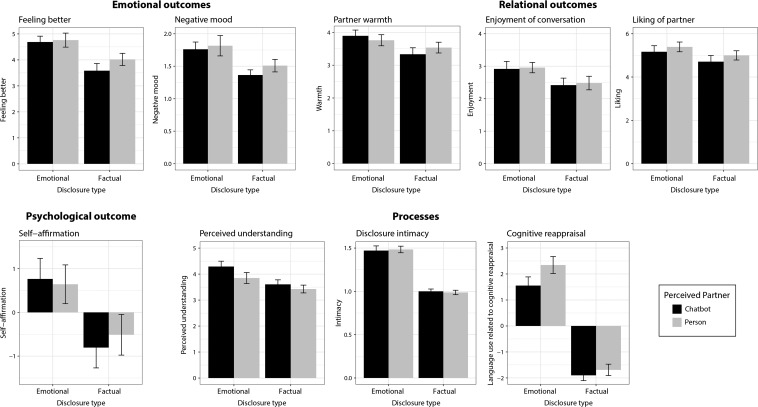
Disclosing personal information to another person has beneficial emotional, relational, and psychological outcomes. When disclosers believe they are interacting with a computer instead of another person, such as a chatbot that can simulate human-to-human conversation, outcomes may be undermined, enhanced, or equivalent. Our experiment examined downstream effects after emotional versus factual disclosures in conversations with a supposed chatbot or person. The effects of emotional disclosure were equivalent whether participants thought they were disclosing to a chatbot or to a person. This study advances current understanding of disclosure and whether its impact is altered by technology, providing support for media equivalency as a primary mechanism for the consequences of disclosing to a chatbot.
向他人透露个人信息会产生有益的情感、人际关系和心理结果。当透露者认为他们是在与计算机而非他人互动时,比如与一个能够模拟人际对话的聊天机器人互动,结果可能会受到损害、得到增强或保持不变。我们的实验研究了在与假定的聊天机器人或真人对话中,情感性披露与事实性披露后的下游效应。无论参与者认为自己是在向聊天机器人还是真人披露信息,情感性披露的效果都是相同的。这项研究推进了我们目前对披露的理解,以及其影响是否会因技术而改变,为媒体等效性作为向聊天机器人披露信息后果的主要机制提供了支持。