Department of Psychological and Behavioural Science, LSE, London, UK.
Department of Psychological Medicine, The University of Auckland, Auckland, New Zealand.
BMC Public Health. 2024 Jul 6;24(1):1802. doi: 10.1186/s12889-024-19153-x.
Loneliness is a serious public health concern. Although previous interventions have had some success in mitigating loneliness, the field is in search of novel, more effective, and more scalable solutions. Here, we focus on "relational agents", a form of software agents that are increasingly powered by artificial intelligence and large language models (LLMs). We report on a systematic review and meta-analysis to investigate the impact of relational agents on loneliness across age groups.
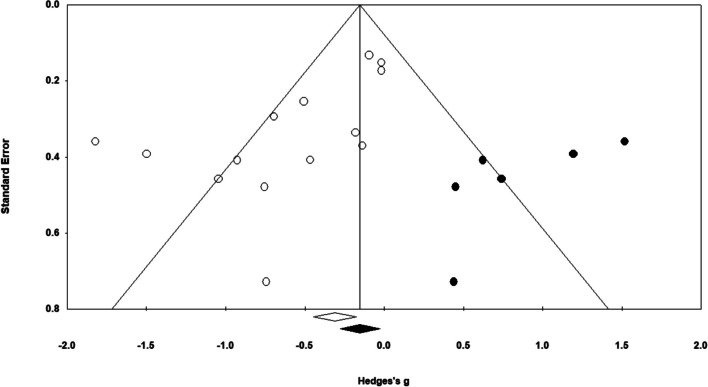
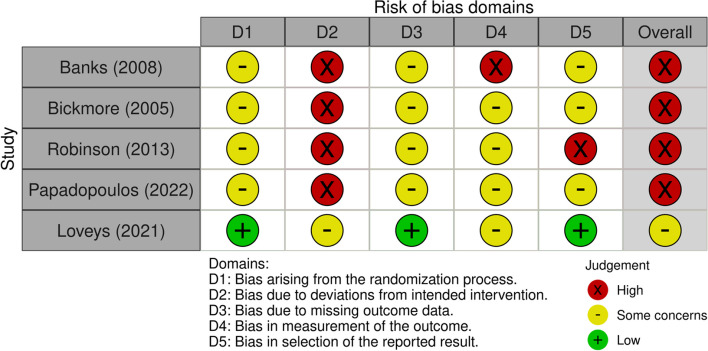
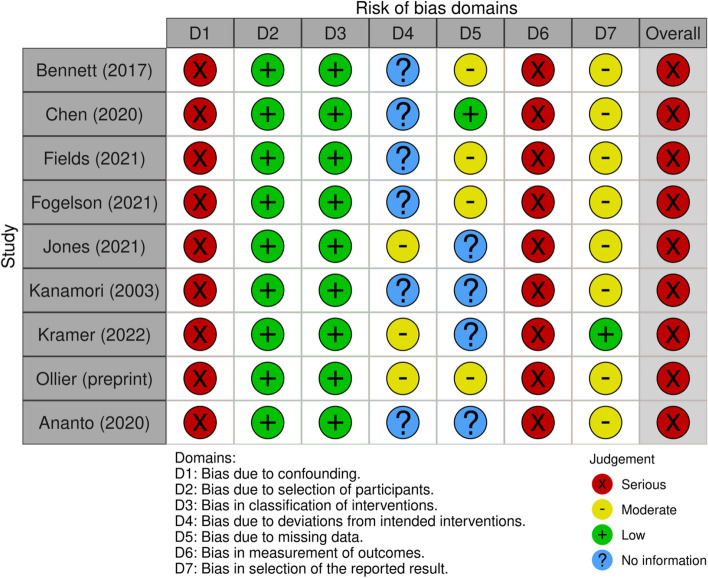
In this systematic review and meta-analysis, we searched 11 databases including Ovid MEDLINE and Embase from inception to Sep 16, 2022. We included randomised controlled trials and non-randomised studies of interventions published in English across all age groups. These loneliness interventions, typically attempt to improve social skills, social support, social interaction, and maladaptive cognitions. Peer-reviewed journal articles, books, book chapters, Master's and PhD theses, or conference papers were eligible for inclusion. Two reviewers independently screened studies, extracted data, and assessed risk of bias via the RoB 2 and ROBINS-I tools. We calculated pooled estimates of Hedge's g in a random-effects meta-analysis and conducted sensitivity and sub-group analyses. We evaluated publication bias via funnel plots, Egger's test, and a trim-and-fill algorithm.
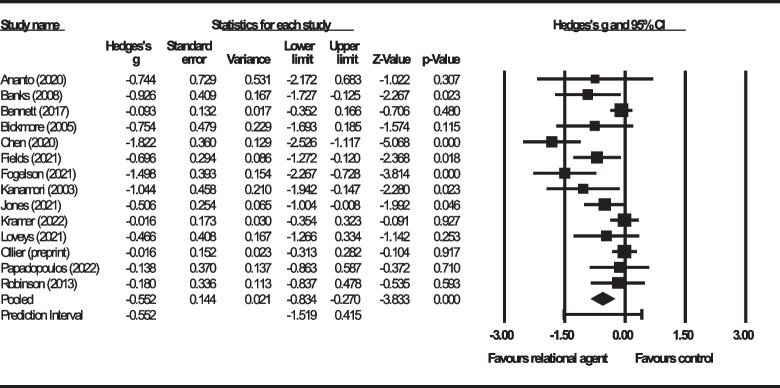
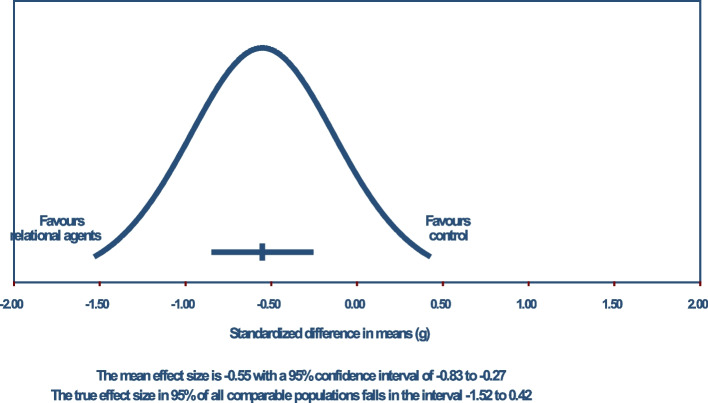
Our search identified 3,935 records of which 14 met eligibility criteria and were included in our meta-analysis. Included studies comprised 286 participants with individual study sample sizes ranging from 4 to 42 participants (x̄ = 20.43, s = 11.58, x̃ = 20). We used a Bonferroni correction with α = 0.05 / 4 = 0.0125 and applied Knapp-Hartung adjustments. Relational agents reduced loneliness significantly at an adjusted α (g = -0.552; 95% Knapp-Hartung CI, -0.877 to -0.226; P = 0.003), which corresponds to a moderate reduction in loneliness.
Our results are currently the most comprehensive of their kind and provide promising evidence for the efficacy of relational agents. Relational agents are a promising technology that can alleviate loneliness in a scalable way and that can be a meaningful complement to other approaches. The advent of LLMs should boost their efficacy, and further research is needed to explore the optimal design and use of relational agents. Future research could also address shortcomings of current results, such as small sample sizes and high risk of bias. Particularly young audiences have been overlooked in past research.
孤独是一个严重的公共卫生问题。尽管以前的干预措施在减轻孤独感方面取得了一些成功,但该领域仍在寻找新颖、更有效和更可扩展的解决方案。在这里,我们专注于“关系代理”,这是一种越来越多地由人工智能和大型语言模型 (LLM) 提供支持的软件代理形式。我们报告了一项系统评价和荟萃分析,以调查关系代理对不同年龄组孤独感的影响。
在这项系统评价和荟萃分析中,我们从 1975 年 1 月至 2022 年 9 月 16 日在 11 个数据库(包括 Ovid MEDLINE 和 Embase)中进行了搜索。我们纳入了所有年龄段的随机对照试验和非随机干预研究。这些孤独干预措施通常旨在改善社交技能、社会支持、社交互动和适应不良认知。同行评议的期刊文章、书籍、书籍章节、硕士和博士论文或会议论文均符合纳入标准。两名审查员独立筛选研究、提取数据,并通过 RoB 2 和 ROBINS-I 工具评估偏倚风险。我们在随机效应荟萃分析中计算了 Hedge 的 g 的汇总估计值,并进行了敏感性和亚组分析。我们通过漏斗图、Egger 检验和修剪和填充算法评估发表偏倚。
我们的搜索共确定了 3935 条记录,其中 14 条符合纳入标准并包含在荟萃分析中。纳入的研究包括 286 名参与者,每个研究的样本量从 4 到 42 人不等(x̄=20.43,s=11.58,x̃=20)。我们使用 Bonferroni 校正,α=0.05/4=0.0125,并应用了 Knapp-Hartung 调整。关系代理显著降低了孤独感,调整后的 α 值为(g=-0.552;95%Knapp-Hartung CI,-0.877 至-0.226;P=0.003),这对应于孤独感的中度降低。
我们的结果是目前同类研究中最全面的,为关系代理的疗效提供了有希望的证据。关系代理是一种有前途的技术,可以以可扩展的方式缓解孤独感,并且可以成为其他方法的有意义的补充。大型语言模型的出现应该会提高它们的功效,需要进一步研究来探索关系代理的最佳设计和使用。未来的研究还可以解决当前结果的缺点,例如样本量小和偏倚风险高。特别是在过去的研究中,年轻受众一直被忽视。