Punshon Tracy, Carey Anne-Marie, Ricachenevsky Felipe Klein, Meharg Andrew A
Dartmouth College, Department of Biological Sciences, Life Sciences Center, 78 College Street, Hanover, NH 03755, USA.
Center for Innovation in Medicine, Biodesign Institute, Arizona State University, Tempe, AZ 85287, USA.
Environ Exp Bot. 2018 May;149:51-58. doi: 10.1016/j.envexpbot.2018.02.007. Epub 2018 Feb 16.
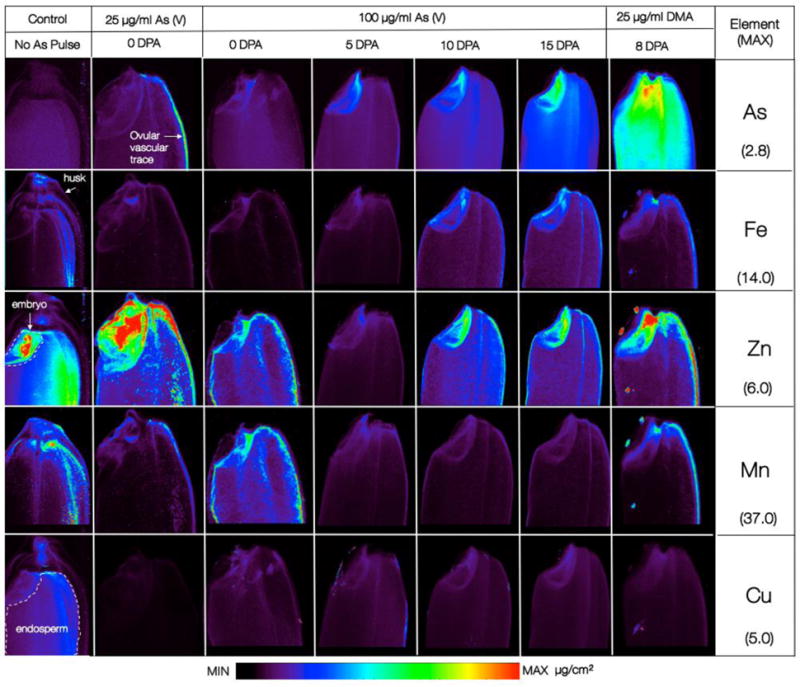
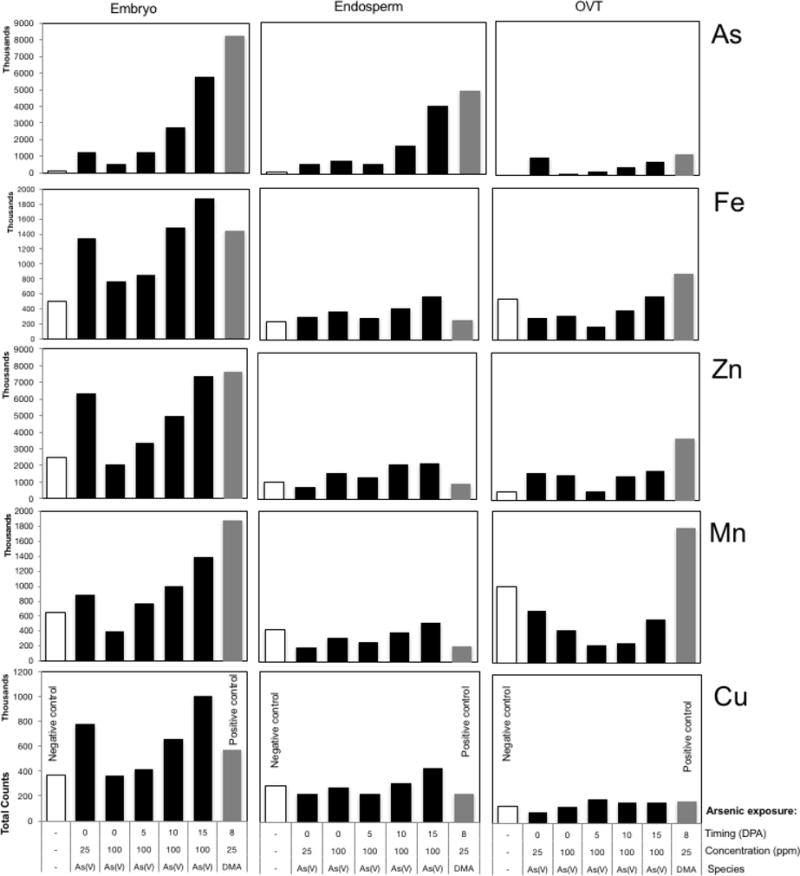
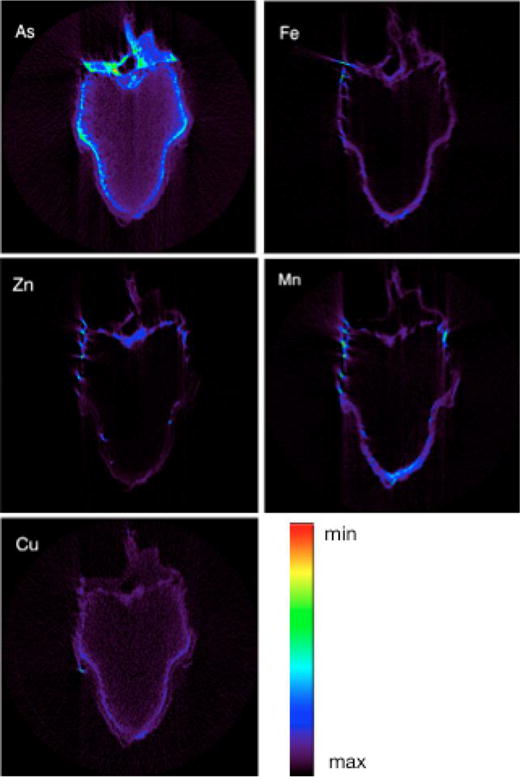
We measured the bulk grain concentrations of arsenic (As), along with rubidium (Rb) and strontium (Sr) as indicators of phloem and xylem transport respectively, in rice ( cv. ) pulsed with arsenate at two exposure levels for 5 day periods at progressively later stages of grain fill, between anthesis and maturity, through the cut flag leaf. We compared these to unexposed (negative) controls and positive controls; pulsed with dimethylarsinic acid (DMA). We collected elemental maps of As and micronutrient elements (Fe, Zn, Mn, Cu and Ni) from developing grains of rice. Exposures were either 25 or 100 μg/ml arsenate (As(V)) at various stages of grain development, compared to 25 μg/ml dimethylarsinic acid (DMA); the most efficiently transported As species identified in rice. We used the spatial distribution of arsenic in the grain to infer the presence of As transporters. By exposing grains through the flag leaf rather than via the roots, we were able to measure arsenic transport into the grain during filling under controlled conditions. Exposure to 100 μg/ml As(V) resulted in widespread As localization in both embryo and endosperm, especially in grains exposed to As at later stages of panicle development. This suggests loss of selective transport, likely to be the result of As toxicity. At 25 μg/ml As(V), As colocalized with Mn in the ovular vascular trace (OVT). Exposure to either As(V) or DMA reduced grain Fe, an effect more pronounced when exposure occurred earlier in grain development. The abundance of Cu and Zn were also reduced by As. Arsenic exposure later in grain development caused higher grain As concentrations, indicating the existence of As transporters whose efficiency increases during grain fill. We conclude that localization of As in the grain is a product of both As species and exposure concentration, and that high As(V) translocation from the flag leaf can result in high As concentrations in the endosperm.
我们在水稻(品种 )的谷粒灌浆后期,即从开花期到成熟期,通过切割旗叶,用两种暴露水平的砷酸盐对其进行为期5天的脉冲处理,测量了砷(As)的整体谷粒浓度,同时分别测量了铷(Rb)和锶(Sr)作为韧皮部和木质部运输的指标。我们将这些结果与未暴露(阴性)对照和阳性对照(用二甲基砷酸(DMA)脉冲处理)进行了比较。我们收集了水稻发育谷粒中砷和微量营养元素(铁、锌、锰、铜和镍)的元素分布图。在谷粒发育的各个阶段,暴露水平为25或100 μg/ml砷酸盐(As(V)),与之对比的是25 μg/ml二甲基砷酸(DMA),这是在水稻中鉴定出的运输效率最高的砷形态。我们利用谷粒中砷的空间分布来推断砷转运蛋白的存在。通过旗叶而非根部对谷粒进行暴露处理,我们能够在受控条件下测量灌浆期间砷向谷粒中的运输。暴露于100 μg/ml As(V)会导致砷在胚和胚乳中广泛定位,尤其是在穗发育后期暴露于砷的谷粒中。这表明选择性运输丧失,可能是砷毒性的结果。在25 μg/ml As(V)时,砷与锰在胚珠维管束迹(OVT)中共定位。暴露于As(V)或DMA都会降低谷粒中铁的含量,当在谷粒发育早期进行暴露时,这种影响更为明显。砷还会降低铜和锌的丰度。在谷粒发育后期暴露于砷会导致谷粒中砷浓度升高,表明存在砷转运蛋白,其效率在谷粒灌浆期间会增加。我们得出结论,谷粒中砷的定位是砷形态和暴露浓度共同作用的结果,并且从旗叶大量转运As(V)会导致胚乳中砷浓度升高。