Wraw Christina, Der Geoff, Gale Catharine R, Deary Ian J
Centre for Cognitive Ageing and Cognitive Epidemiology, Department of Psychology, University of Edinburgh, 7 George Square, Edinburgh, Scotland EH8 9JZ, UK.
MRC/CSO Social & Public Health Sciences Unit, 200 Renfield Street, University of Glasgow, Glasgow G2 3QB, UK.
Intelligence. 2018 Jul-Aug;69:71-86. doi: 10.1016/j.intell.2018.04.005.
We investigated the association between intelligence in youth and a range of health-related behaviours in middle age.
Participants were the 5347 men and women who responded to the National Longitudinal Survey of Youth 1979 (NLSY-79) 2012 survey. IQ was recorded with the Armed Forces Qualification Test (AFQT) when participants were aged 15 to 23 years of age. Self-reports on exercise (moderate activity, vigorous activity, and strength training), dietary, smoking, drinking, and oral health behaviours were recorded when participants were in middle age (mean age = 51.7 years). A series of regression analyses tested for an association between IQ in youth and the different health related behaviours in middle age, while adjusting for childhood socio-economic status (SES) and adult SES.
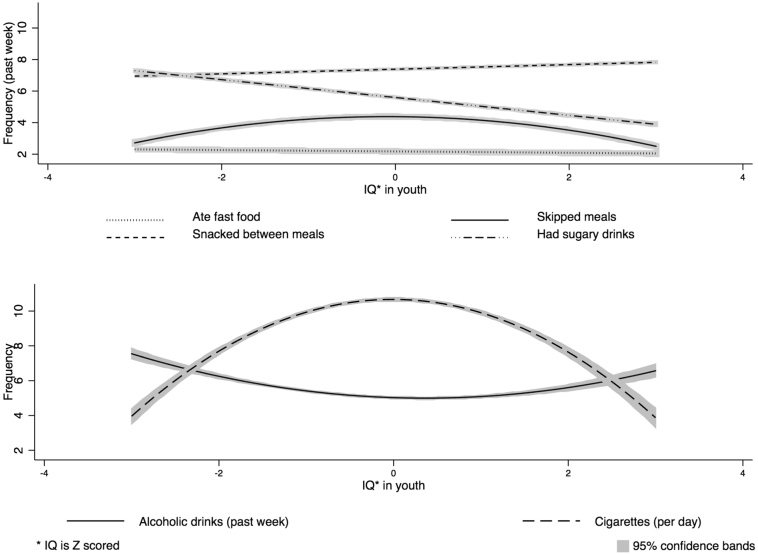
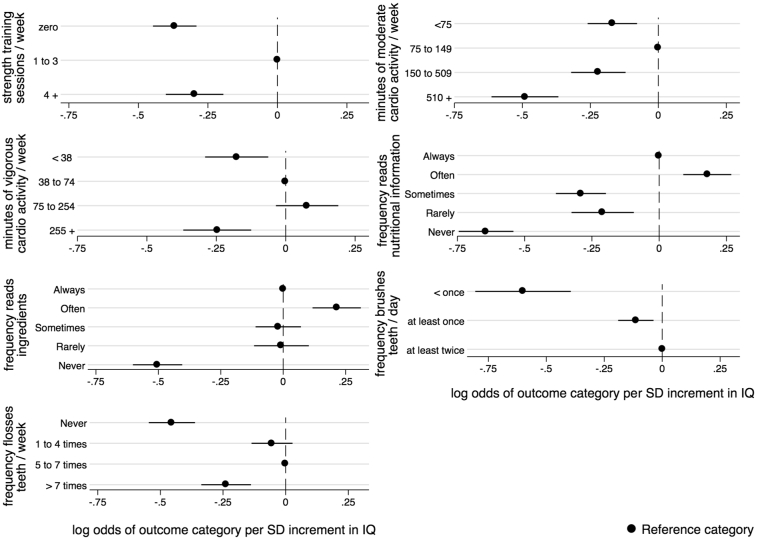
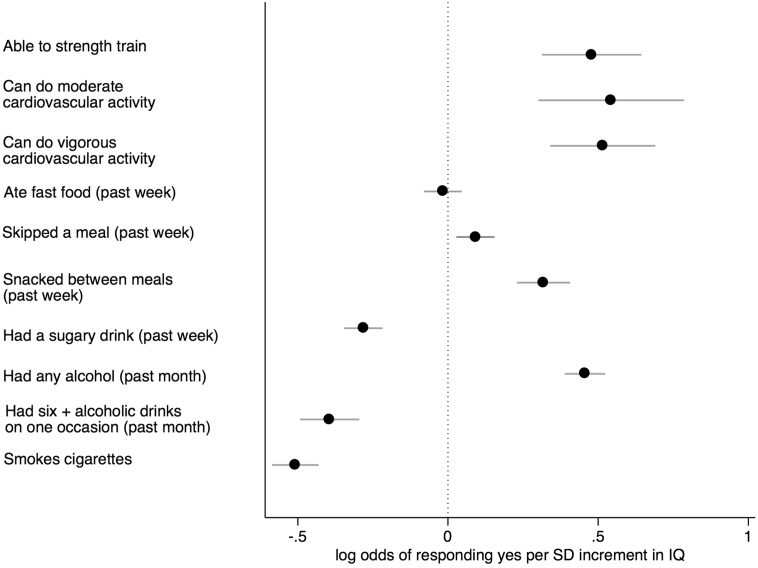
Higher IQ in youth was significantly associated with the following behaviours that are beneficial to health: being more likely to be able to do moderate cardiovascular activity (Odds Ratio, 95% CI) (1.72, 1.35 to 2.20, < .001) and strength training (1.61, 1.37 to 1.90, < .001); being less likely to have had a sugary drink in the previous week (0.75, 0.71 to 0.80, < .001); a lower likelihood of drinking alcohol heavily (0.67, 0.61 to 0.74, < .001); being less likely to smoke (0.60, 0.56 to 0.65, p < .001); being more likely to floss (1.47, 1.35 to 1.59, < .001); and being more likely to say they "often" read the nutritional information (1.20, 1.09 to 1.31, < .001) and ingredients (1.24, 1.12 to 1.36, p < .001) on food packaging compared to always reading them. Higher IQ was also linked with dietary behaviours that may or may not be linked with poorer health outcomes (i.e. being more likely to have skipped a meal (1.10, 1.03 to 1.17, = .005) and snacked between meals (1.37, 1.26 to 1.50, < .001) in the previous week). An inverted u-shaped association was also found between IQ and the number of meals skipped per week. Higher IQ was also linked with behaviours that are known to be linked with poorer health (i.e. a higher likelihood of drinking alcohol compared to being abstinent from drinking alcohol (1.58, 1.47 to 1.69, < .001)). A u-shaped association was found between IQ and the amount of alcohol consumed per week and an inverted u-shaped association was found between IQ and the number of cigarettes smoked a day. Across all outcomes, adjusting for childhood SES tended to attenuate the estimated effect size only slightly. Adjusting for adult SES led to more marked attenuation but statistical significance was maintained in most cases.
In the present study, a higher IQ in adolescence was associated with a number of healthier behaviours in middle age. In contrast to these results, a few associations were also identified between higher intelligence and behaviours that may or may not be linked with poor health (i.e. skipping meals and snacking between meals) and with behaviours that are known to be linked with poor health (i.e. drinking alcohol and the number of cigarettes smoked). To explore mechanisms of association, future studies could test for a range of health behaviours as potential mediators between IQ and morbidity or mortality in later life.
我们研究了青少年时期的智力与中年时期一系列与健康相关行为之间的关联。
参与者为5347名男性和女性,他们回应了1979年全国青少年纵向调查(NLSY - 79)2012年的调查。当参与者年龄在15至23岁时,用武装部队资格测试(AFQT)记录智商。当中年参与者(平均年龄 = 51.7岁)时,记录他们关于运动(适度活动、剧烈活动和力量训练)、饮食、吸烟、饮酒及口腔健康行为的自我报告。一系列回归分析检验了青少年时期的智商与中年时期不同健康相关行为之间的关联,同时对童年社会经济地位(SES)和成年SES进行了调整。
青少年时期较高的智商与以下对健康有益的行为显著相关:更有可能进行适度的心血管活动(优势比,95%置信区间)(1.72,1.35至2.20,<.001)和力量训练(1.61,1.37至1.90,<.001);在前一周喝含糖饮料的可能性较小(0.75,0.71至0.80,<.001);大量饮酒的可能性较低(0.67,0.61至0.74,<.001);吸烟的可能性较小(0.60,0.56至0.65,p<.001);更有可能使用牙线(1.47,1.35至1.59,<.001);与总是阅读相比,更有可能说他们“经常”阅读食品包装上的营养信息(1.20,1.09至1.31,<.001)和成分(1.24,1.12至1.36,p<.001)。较高的智商还与可能与较差健康结果相关或无关的饮食行为有关(即在前一周更有可能跳过一餐(1.10,1.03至1.17,=.005)和在两餐之间吃零食(1.37,1.26至1.50,<.001))。在智商与每周跳过的餐数之间也发现了倒U形关联。较高的智商还与已知与较差健康相关的行为有关(即与戒酒相比饮酒的可能性更高(1.58,1.47至1.69,<.001))。在智商与每周饮酒量之间发现了U形关联,在智商与每天吸烟支数之间发现了倒U形关联。在所有结果中,对童年SES进行调整往往只会使估计的效应大小略有减弱。对成年SES进行调整导致更明显的减弱,但在大多数情况下仍保持统计学显著性。
在本研究中,青少年时期较高的智商与中年时期的一些更健康行为相关。与这些结果相反,在较高智力与可能与较差健康相关或无关的行为(即跳过餐和在两餐之间吃零食)以及已知与较差健康相关的行为(即饮酒和吸烟支数)之间也发现了一些关联。为了探索关联机制,未来的研究可以测试一系列健康行为作为智商与晚年发病率或死亡率之间的潜在中介。