Krill Dana, Avidan Galia, Pertzov Yoni
Department of Psychology, Hebrew University of Jerusalem, Jerusalem, Israel.
Department of Psychology, Ben-Gurion University of the Negev, Beersheba, Israel.
Front Psychol. 2018 Jul 27;9:1319. doi: 10.3389/fpsyg.2018.01319. eCollection 2018.
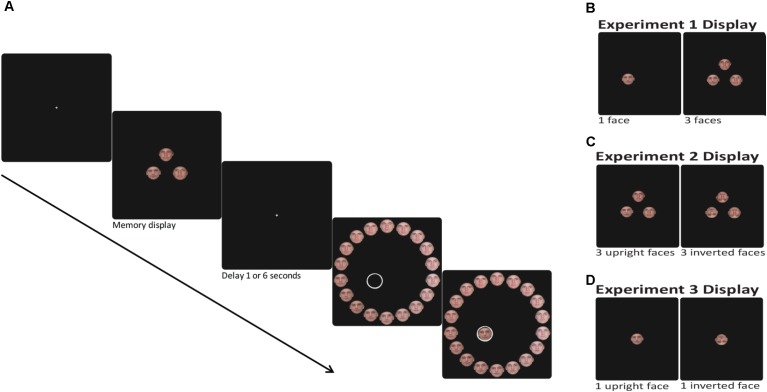
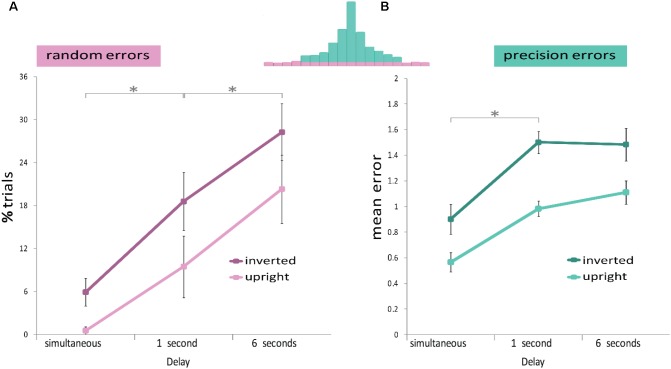
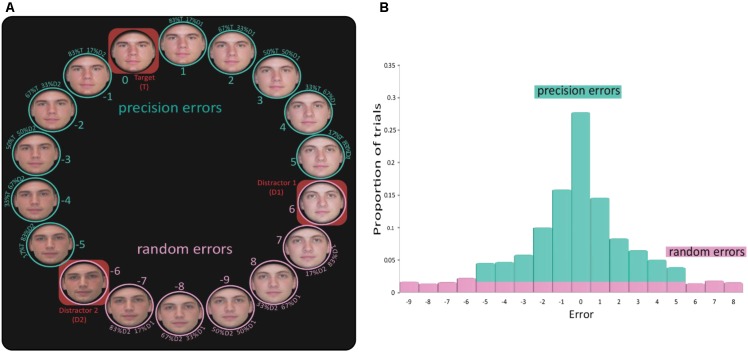
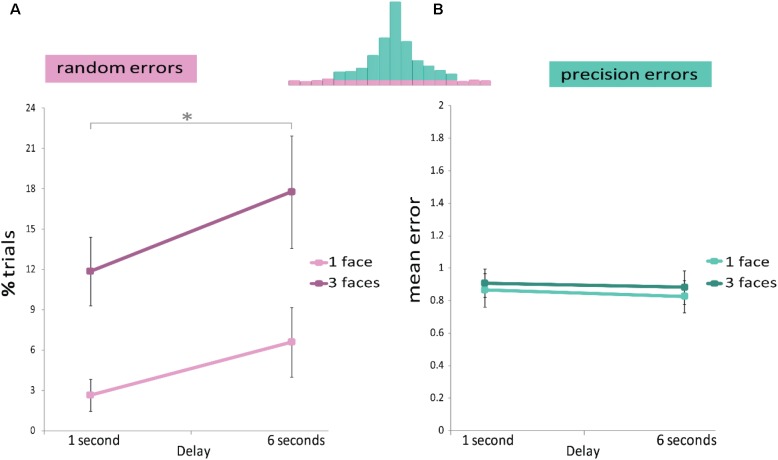
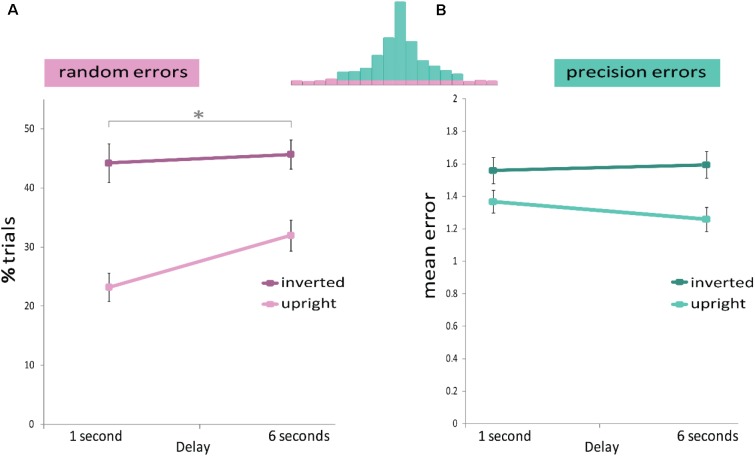
How are faces forgotten? Studies examining forgetting in visual working memory (VWM) typically use simple visual features; however, in ecological scenarios, VWM typically contains complex objects. Given their significance in everyday functioning and their visual complexity, here we investigated how upright and inverted faces are forgotten within a few seconds, focusing on the raw errors that accompany such forgetting and examining their characteristics. In three experiments we found that longer retention intervals increased the size of errors. This effect was mainly accounted for by a larger proportion of random errors - suggesting that forgetting of faces reflects decreased accessibility of the memory representations over time. On the other hand, longer retention intervals did not modulate the precision of recall - suggesting that forgetting does not affect the precision of accessible memory representation. Thus, when upright and inverted faces are forgotten there is a complete failure to access them or a complete collapse of their memory representation. In contrast to the effect of retention interval (i.e., forgetting), face inversion led to larger errors that were mainly associated with decreased precision of recall. This effect was not modulated by the duration of the retention interval, and was observed even when memory was not required in the task. Therefore, upright faces are remembered more precisely compared to inverted ones due to perceptual, rather than mnemonic processes.
面孔是如何被遗忘的?研究视觉工作记忆(VWM)中的遗忘现象的实验通常使用简单的视觉特征;然而,在现实场景中,VWM通常包含复杂的物体。鉴于面孔在日常功能中的重要性及其视觉复杂性,我们在此研究了直立和倒置的面孔在几秒钟内是如何被遗忘的,重点关注伴随这种遗忘出现的原始错误并考察其特征。在三个实验中,我们发现更长的保持间隔会增加错误的大小。这种效应主要是由更大比例的随机错误导致的——这表明面孔的遗忘反映出随着时间的推移记忆表征的可及性降低。另一方面,更长的保持间隔并未调节回忆的精度——这表明遗忘并不影响可及记忆表征的精度。因此,当直立和倒置的面孔被遗忘时,存在完全无法访问它们或其记忆表征完全崩溃的情况。与保持间隔(即遗忘)的效应相反,面孔倒置会导致更大的错误,这些错误主要与回忆精度的降低有关。这种效应不受保持间隔时长的调节,甚至在任务中不需要记忆时也会出现。因此,由于感知过程而非记忆过程,直立面孔比倒置面孔能被更精确地记住。