Department of Biochemistry and Biophysics, Texas A&M University, College Station, Texas.
Department of Biochemistry & Molecular Biology, University of Oklahoma Health Sciences Center, Oklahoma City, Oklahoma.
Wiley Interdiscip Rev RNA. 2018 Nov;9(6):e1502. doi: 10.1002/wrna.1502. Epub 2018 Aug 12.
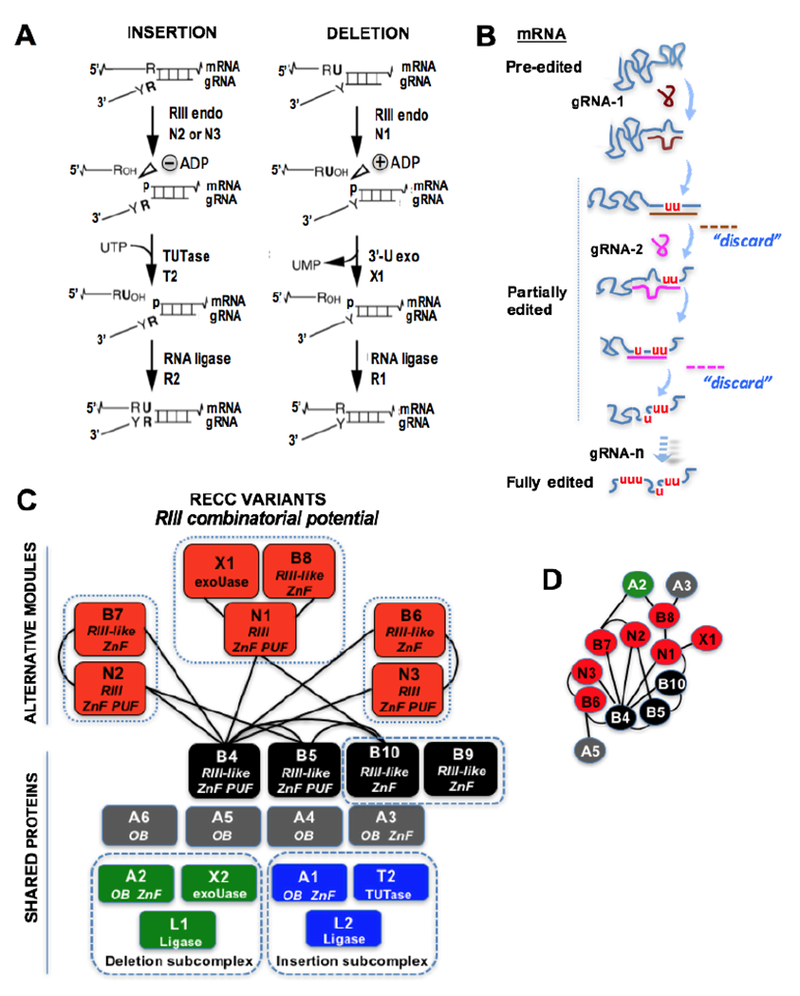
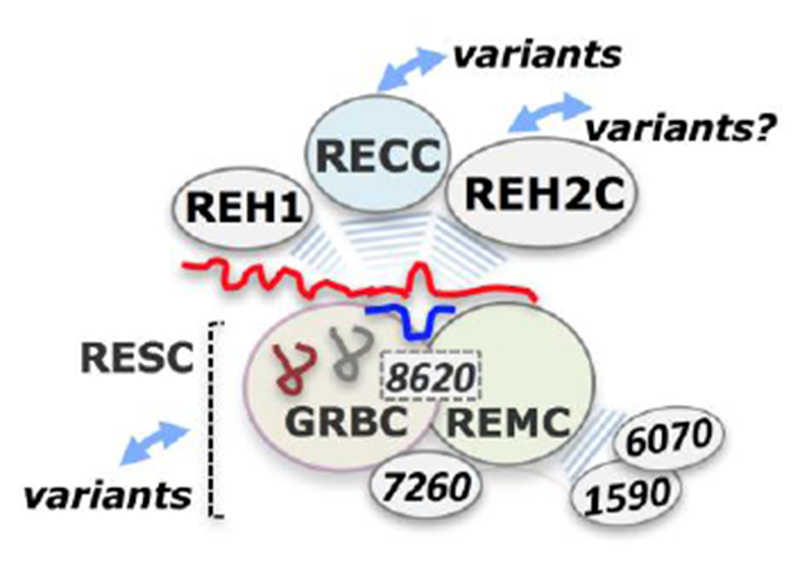
RNA editing causes massive remodeling of the mitochondrial mRNA transcriptome in trypanosomes and related kinetoplastid protozoa. This type of editing involves the specific insertion or deletion of uridylates (U) directed by small noncoding guide RNAs (gRNAs). Because U-insertion exceeds U-deletion by a factor of 10, editing increases the nascent mRNA size by up to 55%. In Trypanosoma brucei, the editing apparatus uses ~40 proteins and >1,200 gRNAs to create the functional open reading frame in 12 mRNAs. Thousands of sites are specifically recognized in the pre-edited mRNAs and a myriad of partially edited transcript intermediates accumulates in mitochondria. The control of editing is poorly understood, but past work suggests that it occurs during substrate recognition, the initiation and progression of editing, and during the life-cycle in different hosts. The growing understanding of the editing proteins offers clues about editing control. Most editing proteins reside in the "RNA-free" RNA editing core complex (RECC) and in the accessory RNA editing substrate complex (RESC) that contains gRNA. Two accessory RNA helicases are known, including one in the RNA editing helicase 2 complex (REH2C). Both the RESC and the REH2C associate with mRNA, providing a rationale for the assembly of mRNA or its mRNPs, RESC, and the RECC enzyme. Identified variants of the canonical editing complexes further complicate the model of RNA editing. We examine specific examples of complex variants, differential effects of editing proteins on the mRNAs within and between T. brucei life stages, and possible control points in RNA holo-editosomes. This article is categorized under: RNA Processing > RNA Editing and Modification RNA Interactions with Proteins and Other Molecules > RNA-Protein Complexes RNA Interactions with Proteins and Other Molecules > Protein-RNA Interactions: Functional Implications.
RNA 编辑导致原生动物和相关动基体原生动物的线粒体 mRNA 转录组发生大规模重构。这种类型的编辑涉及到由小非编码引导 RNA (gRNA) 指导的特定尿嘧啶核苷(U)的插入或缺失。由于 U 的插入量超过 U 的缺失量 10 倍,编辑使新生 mRNA 的大小增加了 55%。在布氏锥虫中,编辑装置使用约 40 种蛋白质和>1200 种 gRNA 在 12 种 mRNA 中创建功能性开放阅读框。数千个位点在编辑前的 mRNA 中被特异性识别,并且大量部分编辑的转录中间产物在线粒体中积累。编辑的控制知之甚少,但过去的工作表明,它发生在底物识别、编辑的起始和进展以及在不同宿主中的生命周期中。对编辑蛋白的不断深入理解为编辑控制提供了线索。大多数编辑蛋白存在于“无 RNA”的 RNA 编辑核心复合物 (RECC) 和包含 gRNA 的辅助 RNA 编辑底物复合物 (RESC) 中。已知有两种辅助 RNA 解旋酶,包括 RNA 编辑解旋酶 2 复合物 (REH2C) 中的一种。RESC 和 REH2C 都与 mRNA 结合,为 mRNA 或其 mRNP、RESC 和 RECC 酶的组装提供了依据。鉴定的规范编辑复合物变体进一步使 RNA 编辑模型复杂化。我们检查了特定的复杂变体示例、编辑蛋白对锥虫不同生活阶段内和之间的 mRNA 的不同影响,以及 RNA 全编辑体中的可能控制点。本文归类于:RNA 加工 > RNA 编辑和修饰 RNA 与蛋白质和其他分子的相互作用 > RNA-蛋白质复合物 RNA 与蛋白质和其他分子的相互作用 > 蛋白质-RNA 相互作用:功能意义。