Saha Bithika, Longo Rocco, Torley Peter, Saliba Anthony, Schmidtke Leigh
National Wine and Grape Industry Centre, Charles Sturt University, Wagga Wagga, NSW 2650, Australia.
School of Agricultural and Wine Sciences, Charles Sturt University, Wagga Wagga, NSW 2650, Australia.
Foods. 2018 Aug 10;7(8):127. doi: 10.3390/foods7080127.
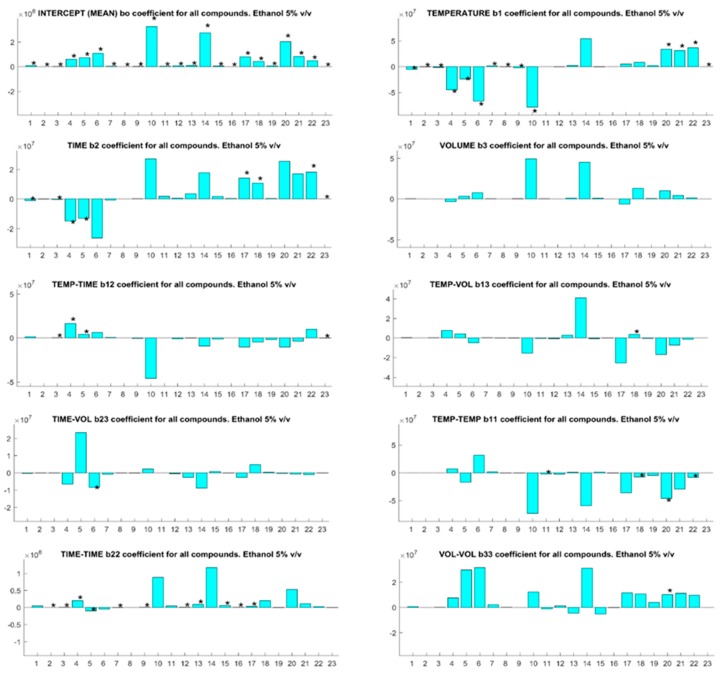
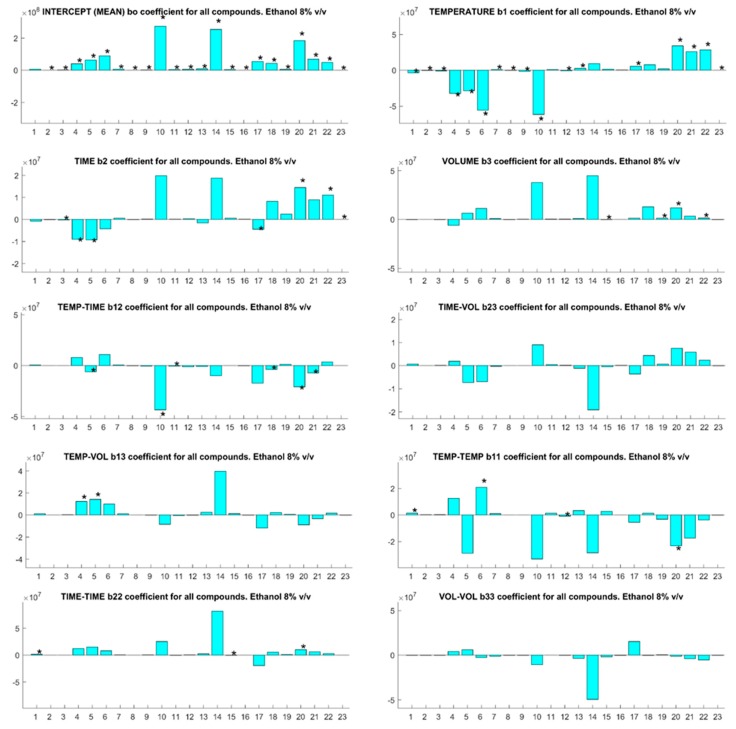
The important sampling parameters of a headspace solid-phase microextraction-gas chromatography-mass spectrometry (HS-SPME-GC-MS) procedure such as the extraction temperature, extraction time, and sample volume were optimized to quantify 23 important impact odorants in reduced alcohol red and white wines. A three-factor design of Box-Behnken experiments was used to determine the optimized sampling conditions for each analyte, and a global optimized condition at every ethanol concentration of interest determined using a desirability function that accounts for a low signal response for compounds. Shiraz and Chardonnay wines were dealcoholized from 13.7 and 12.2% / ethanol respectively, to 8 and 5% /, using a commercially available membrane-based technology. A sample set of the reduced alcohol wines were also reconstituted to their natural ethanol level to evaluate the effect of the ethanol content reduction on volatile composition. The three-factor Box-Behnken experiment ensured an accurate determination of the headspace concentration of each compound at each ethanol concentration, allowing comparisons between wines at varying ethanol levels to be made. Overall, the results showed that the main effect of extraction temperature was considered the most critical factor when studying the equilibrium of reduced alcohol wine impact odorants. The impact of ethanol reduction upon the concentration of volatile compounds clearly resulted in losses of impact odorants from the wines. The concentration of most analytes decreased with dealcoholization compared to that of the natural samples. Significant differences were also found between the reconstituted volatile composition and 5% / reduced alcohol wines, revealing that the dealcoholization effect is the result of a combination between the type of dealcoholization treatment and reduction in wine ethanol content.
对顶空固相微萃取-气相色谱-质谱联用(HS-SPME-GC-MS)方法的重要采样参数,如萃取温度、萃取时间和样品体积进行了优化,以定量测定低酒精度红葡萄酒和白葡萄酒中的23种重要特征气味物质。采用Box-Behnken实验的三因素设计来确定每种分析物的最佳采样条件,并使用考虑化合物低信号响应的合意函数确定每个目标乙醇浓度下的全局优化条件。分别使用市售的基于膜的技术将设拉子葡萄酒和霞多丽葡萄酒的酒精度从13.7%和12.2%(乙醇体积分数)降低至8%和5%(乙醇体积分数)。还将一组低酒精度葡萄酒样品恢复到其天然乙醇水平,以评估乙醇含量降低对挥发性成分的影响。三因素Box-Behnken实验确保了在每个乙醇浓度下准确测定每种化合物的顶空浓度,从而能够对不同乙醇水平的葡萄酒进行比较。总体而言,结果表明,在研究低酒精度葡萄酒特征气味物质的平衡时,萃取温度的主要影响被认为是最关键的因素。乙醇含量降低对挥发性化合物浓度的影响显然导致了葡萄酒中特征气味物质的损失。与天然样品相比,大多数分析物的浓度随着脱醇处理而降低。在恢复后的挥发性成分与5%(乙醇体积分数)低酒精度葡萄酒之间也发现了显著差异,这表明脱醇效果是脱醇处理类型和葡萄酒乙醇含量降低共同作用的结果。