Department of Medicine, The University of Chicago, Chicago, IL
Center for Health and the Social Sciences, The University of Chicago, Chicago, IL.
Diabetes Care. 2019 Mar;42(3):416-426. doi: 10.2337/dc17-1144. Epub 2018 Aug 13.
To examine for a legacy effect of early glycemic control on diabetic complications and death.
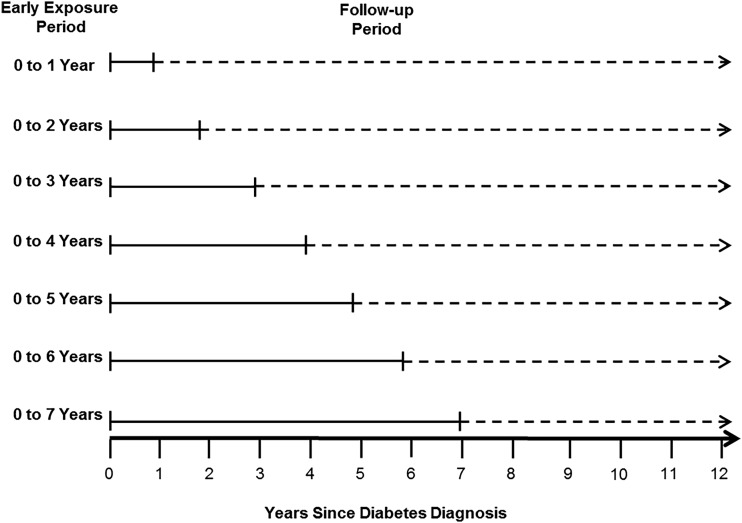
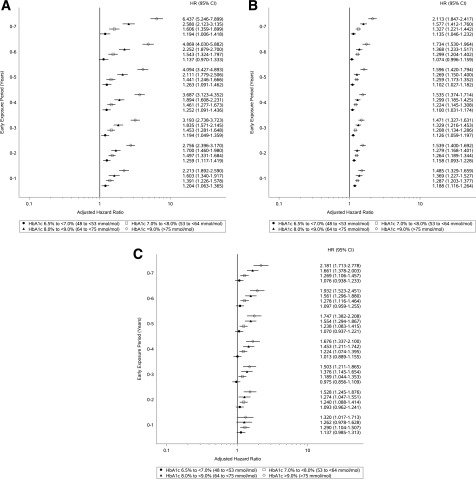
This cohort study of managed care patients with newly diagnosed type 2 diabetes and 10 years of survival (1997-2013, average follow-up 13.0 years, = 34,737) examined associations between HbA <6.5% (<48 mmol/mol), 6.5% to <7.0% (48 to <53 mmol/mol), 7.0% to <8.0% (53 to <64 mmol/mol), 8.0% to <9.0% (64 to <75 mmol/mol), or ≥9.0% (≥75 mmol/mol) for various periods of early exposure (0-1, 0-2, 0-3, 0-4, 0-5, 0-6, and 0-7 years) and incident future microvascular (end-stage renal disease, advanced eye disease, amputation) and macrovascular (stroke, heart disease/failure, vascular disease) events and death, adjusting for demographics, risk factors, comorbidities, and later HbA.
Compared with HbA <6.5% (<48 mmol/mol) for the 0-to-1-year early exposure period, HbA levels ≥6.5% (≥48 mmol/mol) were associated with increased microvascular and macrovascular events (e.g., HbA 6.5% to <7.0% [48 to <53 mmol/mol] microvascular: hazard ratio 1.204 [95% CI 1.063-1.365]), and HbA levels ≥7.0% (≥53 mmol/mol) were associated with increased mortality (e.g., HbA 7.0% to <8.0% [53 to <64 mmol/mol]: 1.290 [1.104-1.507]). Longer periods of exposure to HbA levels ≥8.0% (≥64 mmol/mol) were associated with increasing microvascular event and mortality risk.
Among patients with newly diagnosed diabetes and 10 years of survival, HbA levels ≥6.5% (≥48 mmol/mol) for the 1st year after diagnosis were associated with worse outcomes. Immediate, intensive treatment for newly diagnosed patients may be necessary to avoid irremediable long-term risk for diabetic complications and mortality.
研究早期血糖控制对糖尿病并发症和死亡的遗留效应。
本研究为队列研究,纳入了有新诊断 2 型糖尿病且生存时间达 10 年的患者(1997-2013 年,平均随访 13.0 年,n=34737),研究了 HbA1c<6.5%(<48mmol/mol)、6.5%-<7.0%(48-<53mmol/mol)、7.0%-<8.0%(53-<64mmol/mol)、8.0%-<9.0%(64-<75mmol/mol)或≥9.0%(≥75mmol/mol)在不同早期暴露时间(0-1、0-2、0-3、0-4、0-5、0-6 和 0-7 年)与未来微血管(终末期肾病、晚期眼病、截肢)和大血管(中风、心脏病/心力衰竭、血管疾病)事件及死亡的相关性,调整了人口统计学、危险因素、合并症和后期 HbA1c。
与 0-1 年早期暴露期 HbA1c<6.5%(<48mmol/mol)相比,HbA1c≥6.5%(≥48mmol/mol)与微血管和大血管事件的发生风险增加相关(如 HbA1c6.5%-<7.0%[48-<53mmol/mol]:危险比 1.204[95%CI 1.063-1.365]),HbA1c≥7.0%(≥53mmol/mol)与死亡率增加相关(如 HbA1c7.0%-<8.0%[53-<64mmol/mol]:1.290[1.104-1.507])。HbA1c 水平暴露于≥8.0%(≥64mmol/mol)的时间越长,微血管事件和死亡风险越高。
在新诊断糖尿病且生存时间达 10 年的患者中,诊断后 1 年内 HbA1c≥6.5%(≥48mmol/mol)与结局较差相关。对新诊断患者进行即时、强化治疗可能对避免糖尿病并发症和死亡率的不可挽回的长期风险是必要的。