Patel Nishma, Beeken Rebecca J, Leurent Baptiste, Omar Rumana Z, Nazareth Irwin, Morris Stephen
Department of Applied Health Research, University College London, London, UK.
Department of Behavioural Science and Health, University College London, London, UK.
BMJ Open. 2018 Aug 13;8(8):e017511. doi: 10.1136/bmjopen-2017-017511.
Ten Top Tips (10TT) is a primary care-led behavioural intervention which aims to help adults reduce and manage their weight by following 10 weight loss tips. The intervention promotes habit formation to encourage long-term behavioural changes. The aim of this study was to estimate the cost-effectiveness of 10TT in general practice from the perspective of the UK National Health Service.
An economic evaluation was conducted alongside an individually randomised controlled trial.
14 general practitioner practices in England.
All patients were aged ≥18 years, with body mass index ≥30 kg/m. A total of 537 patients were recruited; 270 received the usual care offered by their practices and 267 received the 10TT intervention.
Health service use and quality-adjusted life years (QALYs) were measured over 2 years. Analysis was conducted in terms of incremental net monetary benefits (NMBs), using non-parametric bootstrapping and multiple imputation.
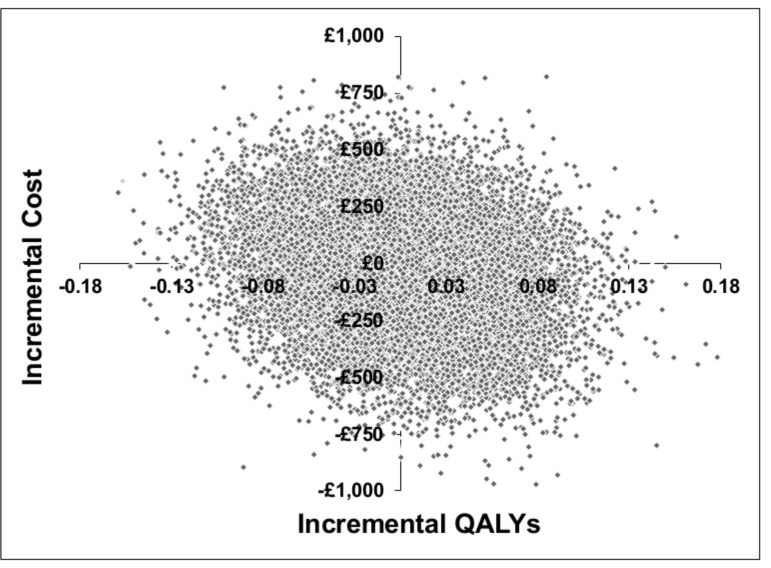
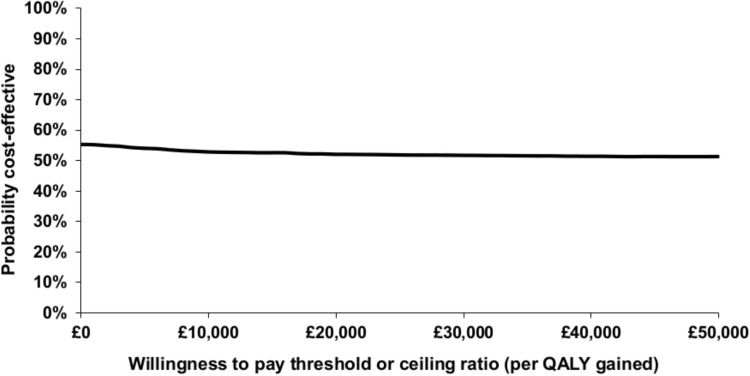
Over a 2-year time horizon, the mean costs and QALYs per patient in the 10TT group were £1889 (95% CI £1522 to £2566) and 1.51 (95% CI 1.44 to 1.58). The mean costs and QALYs for usual care were £1925 (95% CI £1599 to £2251) and 1.51 (95% CI 1.45 to 1.57), respectively. This generated a mean cost difference of -£36 (95% CI -£512 to £441) and a mean QALY difference of 0.001 (95% CI -0.080 to 0.082). The incremental NMB for 10TT versus usual care was £49 (95% CI -£1709 to £1800) at a maximum willingness to pay for a QALY of £20 000. 10TT had a 52% probability of being cost-effective at this threshold.
Costs and QALYs for 10TT were not significantly different from usual care and therefore 10TT is as cost-effective as usual care. There was no evidence to recommend nor advice against offering 10TT to obese patients in general practices based on cost-effectiveness considerations.
ISRCTN16347068; Post-results.
“十大妙招”(10TT)是一项由初级保健主导的行为干预措施,旨在帮助成年人通过遵循10条减肥妙招来减轻体重并进行管理。该干预措施促进习惯养成,以鼓励长期行为改变。本研究的目的是从英国国家医疗服务体系的角度评估10TT在全科医疗中的成本效益。
在一项个体随机对照试验的同时进行了经济评估。
英格兰的14家全科医生诊所。
所有患者年龄≥18岁,体重指数≥30kg/m²。共招募了537名患者;270名接受其诊所提供的常规护理,267名接受10TT干预。
在2年时间内测量卫生服务利用情况和质量调整生命年(QALYs)。采用非参数自举法和多重填补法,根据增量净货币效益(NMBs)进行分析。
在2年的时间范围内,10TT组每位患者的平均成本和QALYs分别为1889英镑(95%可信区间为1522英镑至2566英镑)和1.51(95%可信区间为1.44至1.58)。常规护理的平均成本和QALYs分别为1925英镑(95%可信区间为1599英镑至2251英镑)和1.51(95%可信区间为1.45至1.57)。这产生了平均成本差异-36英镑(95%可信区间为-512英镑至441英镑)和平均QALY差异0.001(95%可信区间为-0.080至0.082)。在每QALY最高支付意愿为20000英镑的情况下,10TT相对于常规护理的增量NMB为49英镑(95%可信区间为-1709英镑至1800英镑)。在这个阈值下,10TT具有成本效益的概率为52%。
10TT的成本和QALYs与常规护理没有显著差异,因此其成本效益与常规护理相当。基于成本效益考虑,没有证据表明应向全科医疗中的肥胖患者推荐或不推荐提供10TT。
ISRCTN16347068;结果公布后。