Division of Hematology and Internal Medicine, Mayo Clinic, Rochester, MN.
Blood Adv. 2018 Aug 14;2(15):1985-1997. doi: 10.1182/bloodadvances.2018021113.
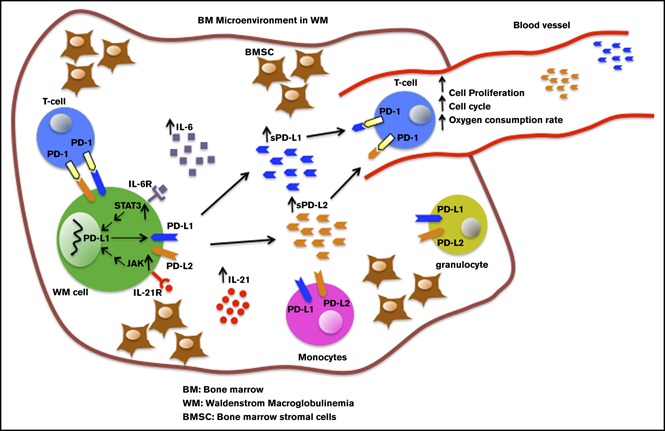
Although immune checkpoint molecules regulate the progression of certain cancers, their significance in malignant development of Waldenstrom macroglobulinemia (WM), an incurable low-grade B-cell lymphoma, remains unknown. Recently, cytokines in the bone marrow (BM) microenvironment are shown to contribute to the pathobiology of WM. Here, we investigated the impact of cytokines, including interleukin-6 (IL-6) and IL-21, on immune regulation and particularly on the programmed death-1 (PD-1) and its ligands PD-L1 and PD-L2. We showed that IL-21, interferon γ, and IL-6 significantly induced PD-L1 and PD-L2 gene expression in WM cell lines. Increased PD-L1 and PD-L2 messenger RNA was also detected in patients' BM cells. Patients' nonmalignant BM cells, including T cells and monocytes, showed increased PD-L1, but minimal or undetectable PD-L2 surface expression. There was also very modest PD-L1 and PD-L2 surface expression by malignant WM cells, suggesting that ligands are cleaved from the cell surface. Levels of soluble ligands were higher in patients' BM plasma and blood serum than controls. Furthermore, IL-21 and IL-6 increased secreted PD-L1 in the culture media of WM cell lines, implying that elevated levels of soluble PD-1 ligands are cytokine mediated. Soluble PD-1 ligands reduced T-cell proliferation, phosphorylated extracellular signal-regulated kinase and cyclin A levels, mitochondrial adenosine triphosphate production, and spare respiratory capacity. In conclusion, we identify that soluble PD-1 ligands are elevated in WM patients and, in addition to surface-bound ligands in WM BM, could regulate T-cell function. Given the capability of secreted forms to be bioactive at distant sites, soluble PD-1 ligands have the potential to promote disease progression in WM.
虽然免疫检查点分子调节某些癌症的进展,但它们在 Waldenstrom 巨球蛋白血症(WM)恶性发展中的意义尚不清楚,WM 是一种无法治愈的低级别 B 细胞淋巴瘤。最近,骨髓(BM)微环境中的细胞因子被证明有助于 WM 的病理生物学。在这里,我们研究了细胞因子(包括白细胞介素-6(IL-6)和 IL-21)对免疫调节的影响,特别是对程序性死亡-1(PD-1)及其配体 PD-L1 和 PD-L2 的影响。我们表明,IL-21、干扰素 γ 和 IL-6 可显著诱导 WM 细胞系中 PD-L1 和 PD-L2 基因的表达。在患者的 BM 细胞中也检测到 PD-L1 和 PD-L2 信使 RNA 的增加。患者的非恶性 BM 细胞,包括 T 细胞和单核细胞,表现出 PD-L1 的增加,但表面表达最小或无法检测到 PD-L2。恶性 WM 细胞表面也有轻微的 PD-L1 和 PD-L2 表达,表明配体从细胞表面被切割。患者 BM 血浆和血清中的可溶性配体水平高于对照组。此外,IL-21 和 IL-6 增加了 WM 细胞系培养物中分泌的 PD-L1,这表明可溶性 PD-1 配体水平升高是细胞因子介导的。可溶性 PD-1 配体降低了 T 细胞的增殖、磷酸化细胞外信号调节激酶和细胞周期蛋白 A 水平、线粒体三磷酸腺苷的产生和备用呼吸能力。总之,我们发现 WM 患者的可溶性 PD-1 配体水平升高,除了 WM BM 中的表面结合配体外,还可能调节 T 细胞功能。鉴于分泌形式在远处部位具有生物活性的能力,可溶性 PD-1 配体有可能促进 WM 中的疾病进展。