Electronics and Photonics Research Institute, National Institute of Advanced Industrial Science and Technology (AIST), Higashi 1-1-1, Tsukuba, Ibaraki, 305-8565, Japan.
Nat Commun. 2018 Aug 13;9(1):3234. doi: 10.1038/s41467-018-05744-x.
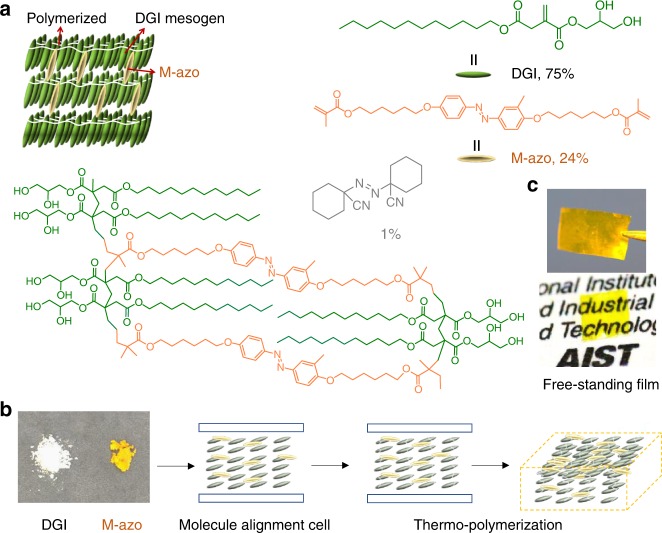
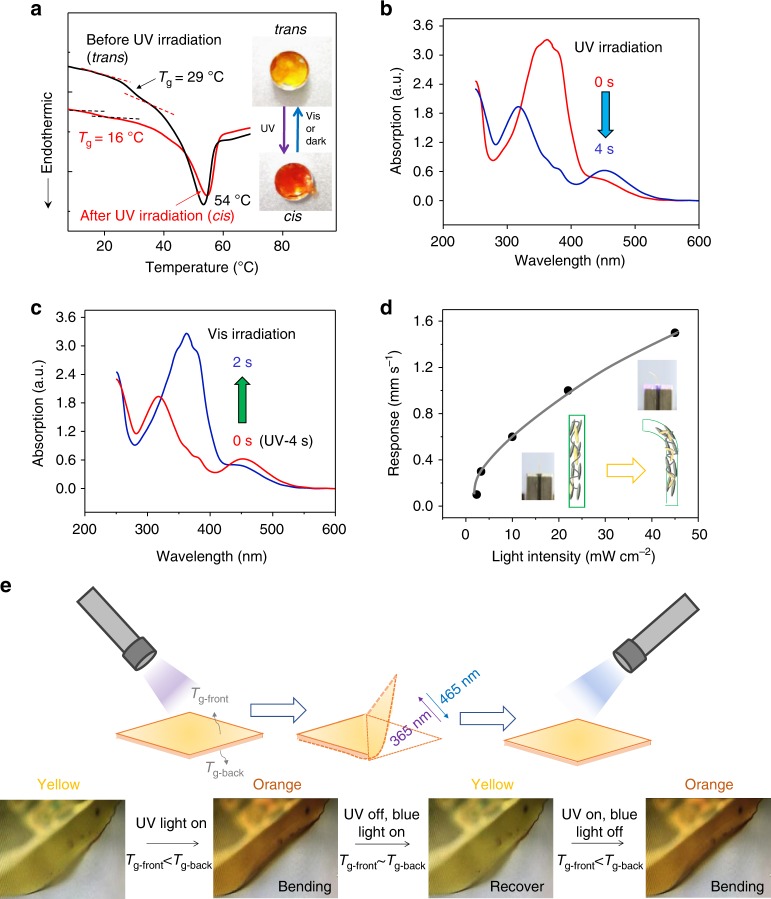
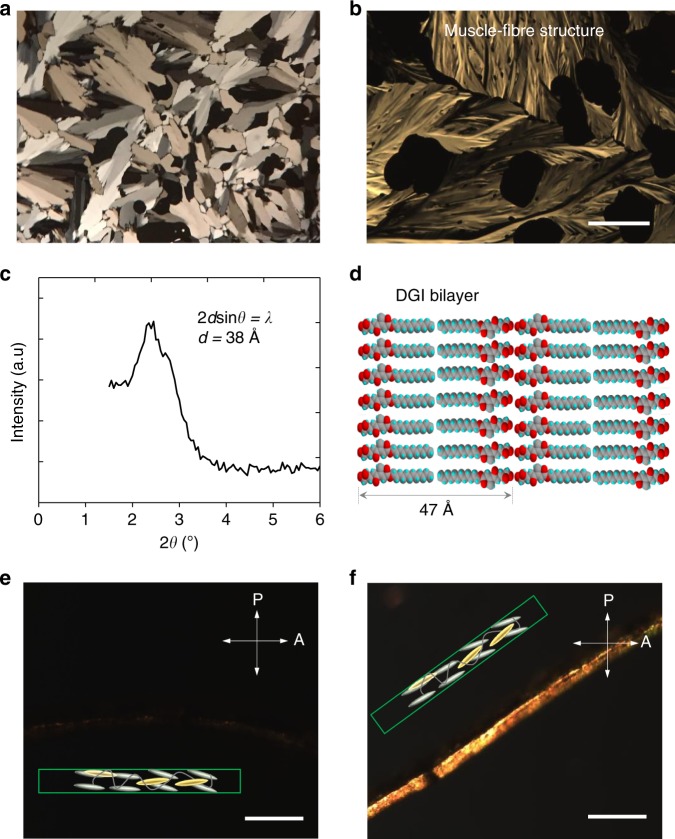
Energy conversion of light into mechanical work is of fundamental interest in applications. In particular, diligent molecular design on nanoscale, in order to achieve efficient photomechanical effects on macroscopic scale, has become one of the most interesting study topics. Here, by incorporating a "photomelting" azobenzene monomer crosslinked into liquid crystalline (LC) networks, we generate photoresponsive polymer films that exhibit reversible photoswitchable glass transition temperatures (T) at room temperature (~20 °C) and photomechanical actuations under the stimulus of UV/visible light. The trans-to-cis isomerization of azo chromophores results in a change in T of the crosslinked LC polymers. The T of the polymer network is higher than room temperature in the trans-form and lower than room temperature in the cis-form. We demonstrate the photoswitchable T contribute to the photomechanical bending and a new mechanism for photomechanical bending that attributes the process to an inhomogeneous change in T of the film is proposed.
光能转化为机械能在应用中具有重要意义。特别是,在纳米尺度上进行精心的分子设计,以在宏观尺度上实现高效的光机械效应,已成为最有趣的研究课题之一。在这里,通过将“光致熔融”偶氮苯单体交联到液晶(LC)网络中,我们生成了光响应聚合物膜,在室温(约 20°C)下表现出可逆的光控玻璃化转变温度(Tg)和在紫外/可见光刺激下的光机械致动。偶氮发色团的顺反异构导致交联 LC 聚合物的 Tg 发生变化。聚合物网络的 Tg 在反式构象下高于室温,在顺式构象下低于室温。我们证明了光致可切换 Tg 有助于光机械弯曲,并且提出了一种新的光机械弯曲机制,该机制将该过程归因于膜 Tg 的不均匀变化。