Fachbereich Physik, Universität Konstanz, D-78464, Konstanz, Germany.
Institut für Physik, Johannes Gutenberg-Universität Mainz, D-55128, Mainz, Germany.
Nat Commun. 2018 Aug 13;9(1):3232. doi: 10.1038/s41467-018-05675-7.
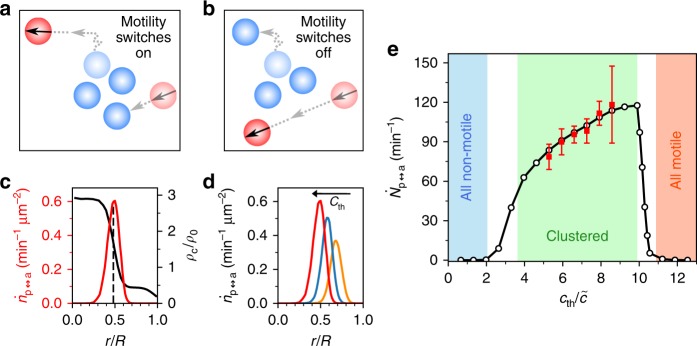
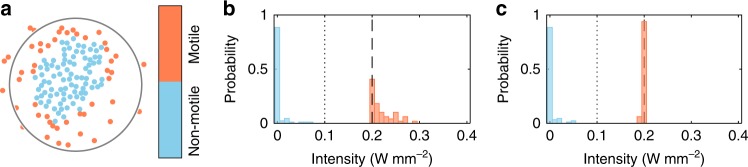
Many microorganisms regulate their behaviour according to the density of neighbours. Such quorum sensing is important for the communication and organisation within bacterial populations. In contrast to living systems, where quorum sensing is determined by biochemical processes, the behaviour of synthetic active particles can be controlled by external fields. Accordingly they allow to investigate how variations of a density-dependent particle response affect their self-organisation. Here we experimentally and numerically demonstrate this concept using a suspension of light-activated active particles whose motility is individually controlled by an external feedback-loop, realised by a particle detection algorithm and a scanning laser system. Depending on how the particles' motility varies with the density of neighbours, the system self-organises into aggregates with different size, density and shape. Since the individual particles' response to their environment is almost freely programmable, this allows for detailed insights on how communication between motile particles affects their collective properties.
许多微生物会根据邻居的密度来调节自己的行为。这种群体感应对于细菌群体内部的交流和组织非常重要。与群体感应由生化过程决定的生命系统不同,合成活性粒子的行为可以通过外部场来控制。因此,它们可以用来研究密度依赖性粒子响应的变化如何影响它们的自组织。在这里,我们使用一种由光激活的活性粒子悬浮液来实验和数值地演示这个概念,这些活性粒子的运动性通过外部反馈回路单独控制,该回路通过粒子检测算法和扫描激光系统实现。根据粒子的运动性如何随邻居密度的变化而变化,系统会自组织成具有不同大小、密度和形状的聚集体。由于个体粒子对环境的反应几乎可以自由编程,这使得我们可以深入了解运动粒子之间的通信如何影响它们的集体性质。