Ghodki Poonam S, Shalu Priyanka S, Sardesai Shalini P
Department of Anesthesia, Srimati Kashibai Navale Medical College and General Hospital, Pune, Maharashtra, India.
J Anaesthesiol Clin Pharmacol. 2018 Apr-Jun;34(2):242-246. doi: 10.4103/joacp.JOACP_172_17.
Adductor canal block (ACB) is now an established component of multimodal analgesia for knee replacement surgery and is slowly replacing femoral nerve block (FNB). It is also gaining popularity for providing pain relief in knee arthroscopies including anterior cruciate ligament reconstruction surgery (ACLR). Data is lacking from the Indian subcontinent on comparing ACB to the traditional FNB for ACLR. Hence, we conducted the present study to compare ACB and FNB in ACLR under general anesthesia.
Sixty patients were randomized to receive either ACB or FNB under ultrasound guidance. Postoperatively, quadriceps muscle strength (straight leg raise and time up and go; TUG test) and quality of analgesia (numeric rating scale; NRS and patient satisfaction score) were assessed every 6 hour, and thereafter, up to 48 hours. The time of rescue analgesia and total analgesic consumption (tramadol) were also recorded. Data was statistically analyzed and < 0.05 was considered to be significant.
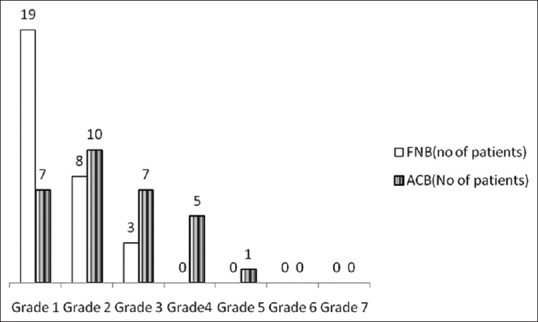
Patients receiving ACB had significantly less quadriceps weakness ( < 0.001) compared to FNB on postoperative day (POD) 1. In addition, patient satisfaction score was statistically higher ( < 0.05) in FNB on POD1. Both the above parameters were comparable on POD2. No statistically significant difference was recorded in NRS, time for rescue analgesia, and total analgesic consumption among the two groups.
ACB preserves quadriceps motor strength while providing analgesia comparable to FNB in patients undergoing ACLR. However, patient satisfaction score is better with FNB than ACB.
内收肌管阻滞(ACB)现已成为膝关节置换手术多模式镇痛的既定组成部分,并正在逐渐取代股神经阻滞(FNB)。它在包括前交叉韧带重建手术(ACLR)在内的膝关节镜检查中用于缓解疼痛也越来越受欢迎。在印度次大陆,缺乏关于ACB与传统FNB用于ACLR的比较数据。因此,我们进行了本研究,以比较全身麻醉下ACB和FNB用于ACLR的效果。
60例患者在超声引导下随机接受ACB或FNB。术后每6小时评估一次股四头肌力量(直腿抬高和计时起立行走试验;TUG试验)和镇痛质量(数字评分量表;NRS和患者满意度评分),此后直至48小时。还记录了补救性镇痛的时间和总镇痛药物消耗量(曲马多)。对数据进行统计学分析,P<0.05被认为具有统计学意义。
与FNB相比,接受ACB的患者在术后第1天股四头肌无力明显减轻(P<0.001)。此外,FNB组在术后第1天的患者满意度评分在统计学上更高(P<0.05)。上述两个参数在术后第2天相当。两组在NRS、补救性镇痛时间和总镇痛药物消耗量方面没有统计学上的显著差异。
在接受ACLR的患者中,ACB在提供与FNB相当的镇痛效果的同时,保留了股四头肌的运动力量。然而,FNB的患者满意度评分优于ACB。