Ishikuro Koji, Dougu Nobuhiro, Nukui Takamasa, Yamamoto Mamoru, Nakatsuji Yuji, Kuroda Satoshi, Matsushita Isao, Nishimaru Hiroshi, Araujo Mariana F P, Nishijo Hisao
Rehabilitation Department, Toyama University Hospital, Toyama, Japan.
System Emotional Science, Graduate School of Medicine and Pharmaceutical Sciences, University of Toyama, Toyama, Japan.
Front Aging Neurosci. 2018 Jul 30;10:231. doi: 10.3389/fnagi.2018.00231. eCollection 2018.
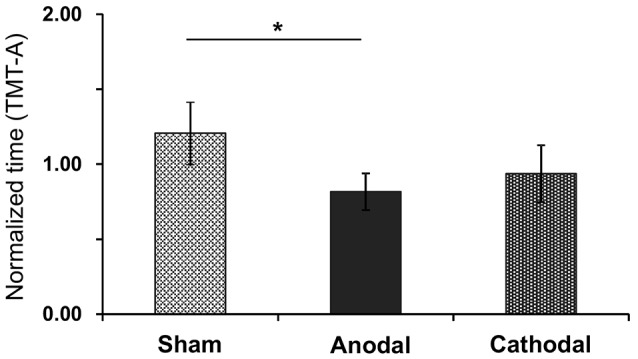
Parkinson's disease (PD) is a neurodegenerative disorder with motor and non-motor symptoms due to degeneration of dopaminergic neurons. The current pharmacological treatments induce complications associated with long-term use. However, current stimulation techniques for PD treatment, such as deep brain stimulation (DBS), are too invasive. In this context, non-invasive brain stimulation including transcranial direct current stimulation (tDCS) may be a safe and effective alternative treatment for PD. We previously reported that anodal tDCS over the frontal polar area (FPA) improved motor functions in heathy subjects. Therefore, in the present study, effects of tDCS over the FPA on motor and cognitive functions of PD patients were analyzed. Nine PD patients (3 men and 6 women) participated in this cross over study with three tDCS protocols; anodal, cathodal or sham tDCS over the FPA. Each tDCS protocol was applied for 1 week (5 times/week). Before and after each protocol, motor and cognitive functions of the patients were assessed using Unified PD Rating Scale [UPDRS (part III: motor examination)], Fugl Meyer Assessment set (FMA), Simple Test for Evaluating hand Function (STEF) and Trail Making Test A (TMT-A). The results indicated that anodal stimulation significantly decreased scores of motor disability in UPDRS-III compared with sham and cathodal stimulation, and significantly increased scores of motor functions in FMA compared with sham stimulation. Furthermore, anodal stimulation significantly decreased time to complete a motor task requiring high dexterity in STEF compared with those requiring low and medium levels of dexterity. In addition, anodal stimulation significantly decreased time to complete the TMT-A task, which requires executive functions, compared with sham stimulation. To the best of our knowledge, this is the first clinical research reporting that tDCS over the FPA successfully improved the motor and non-motor functions in PD patients. These findings suggest that tDCS over the FPA might be a useful alternative for the treatment of PD patients.
帕金森病(PD)是一种神经退行性疾病,由于多巴胺能神经元变性而出现运动和非运动症状。目前的药物治疗会引发与长期使用相关的并发症。然而,当前用于治疗帕金森病的刺激技术,如深部脑刺激(DBS),具有很强的侵入性。在此背景下,包括经颅直流电刺激(tDCS)在内的非侵入性脑刺激可能是一种安全有效的帕金森病替代治疗方法。我们之前报道过,在额极区(FPA)进行阳极tDCS可改善健康受试者的运动功能。因此,在本研究中,分析了FPA区域的tDCS对帕金森病患者运动和认知功能的影响。9名帕金森病患者(3名男性和6名女性)参与了这项交叉研究,采用了三种tDCS方案;分别是在FPA区域进行阳极、阴极或假tDCS。每种tDCS方案应用1周(每周5次)。在每个方案前后,使用统一帕金森病评定量表[UPDRS(第三部分:运动检查)]、Fugl Meyer评估量表(FMA)、手功能简易评估测试(STEF)和连线测验A(TMT-A)对患者的运动和认知功能进行评估。结果表明,与假刺激和阴极刺激相比,阳极刺激显著降低了UPDRS-III中运动残疾的评分,与假刺激相比,显著提高了FMA中运动功能的评分。此外,与需要低和中等灵巧度的运动任务相比,阳极刺激显著缩短了完成需要高灵巧度的STEF运动任务的时间。此外,与假刺激相比,阳极刺激显著缩短了完成需要执行功能的TMT-A任务的时间。据我们所知,这是第一项临床研究报告FPA区域的tDCS成功改善了帕金森病患者的运动和非运动功能。这些发现表明,FPA区域的tDCS可能是治疗帕金森病患者的一种有用替代方法。