Laboratory of Experimental Surgery, Department of General and Thoracic Surgery, Justus-Liebig-University Giessen, German Centre for Lung Research (DZL), Giessen, Germany.
Department of Anesthesiology and Intensive Care Medicine, Justus-Liebig-University Giessen, Giessen, Germany.
Front Immunol. 2018 Jul 30;9:1604. doi: 10.3389/fimmu.2018.01604. eCollection 2018.
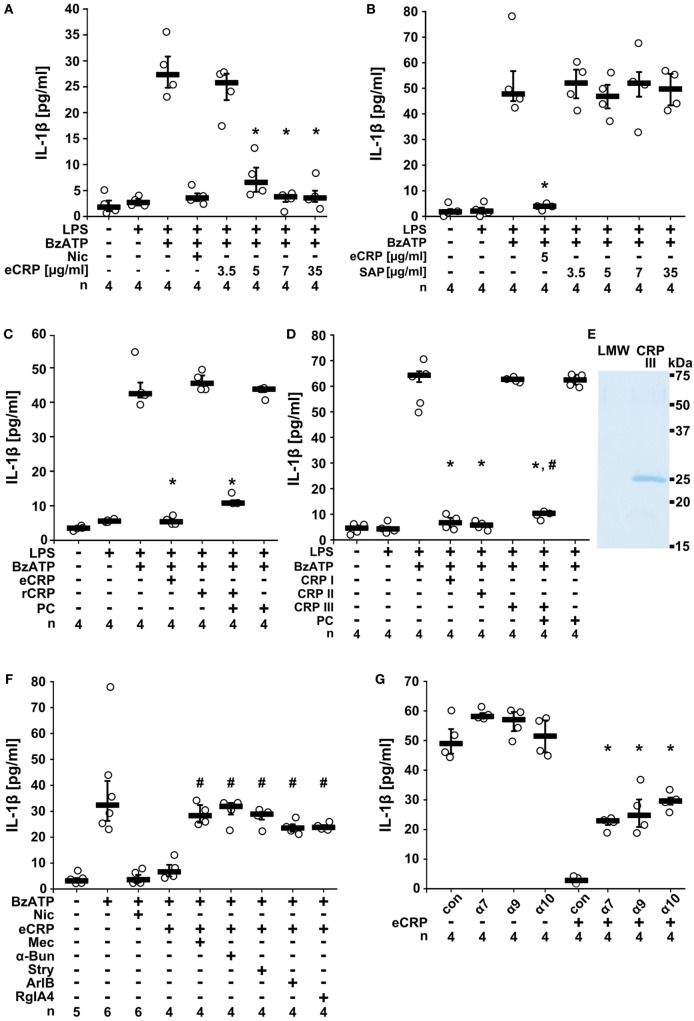
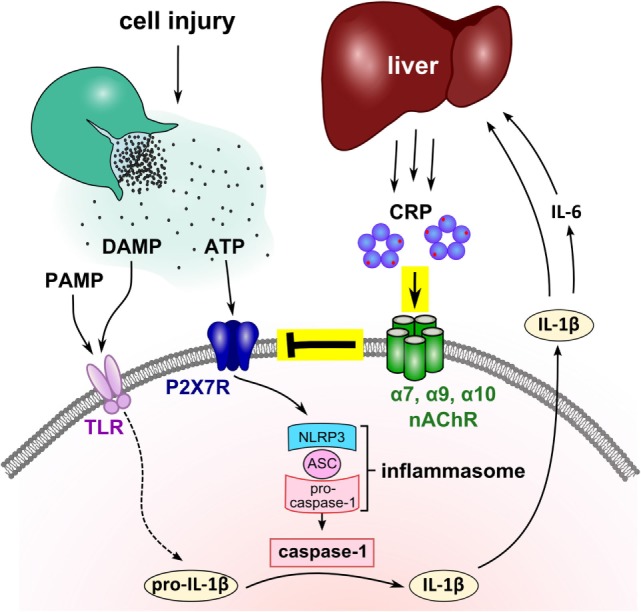
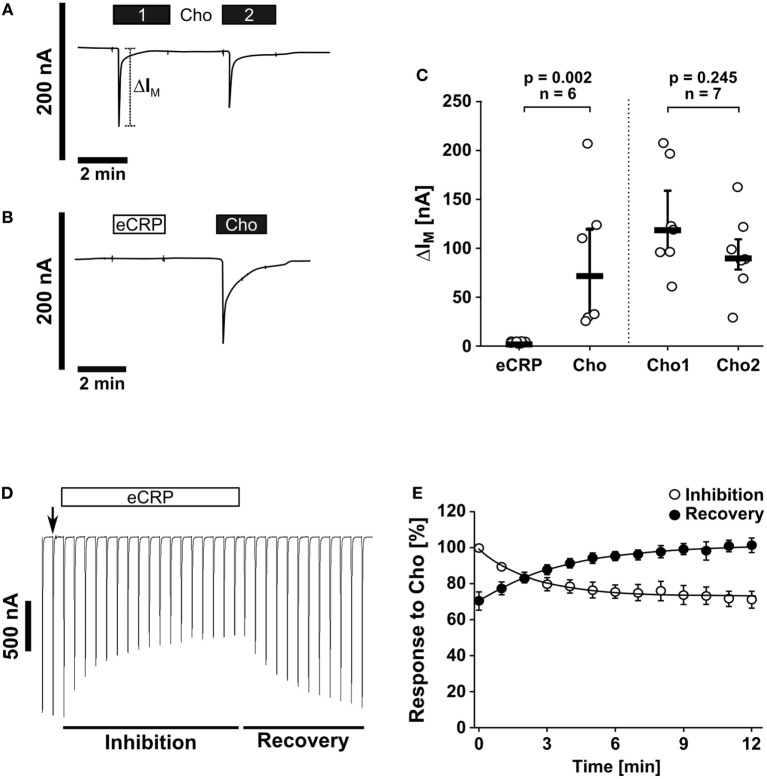
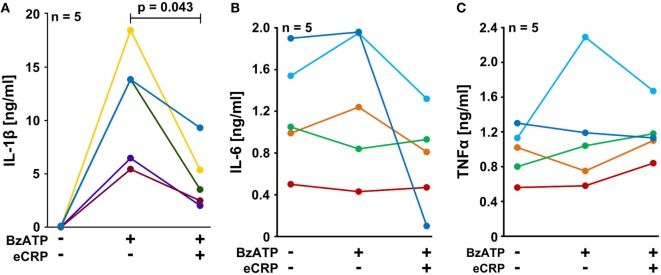
Blood levels of the acute phase reactant C-reactive protein (CRP) are frequently measured as a clinical marker for inflammation, but the biological functions of CRP are still controversial. CRP is a phosphocholine (PC)-binding pentraxin, mainly produced in the liver in response to elevated levels of interleukin-1β (IL-1β) and of the IL-1β-dependent cytokine IL-6. While both cytokines play important roles in host defense, excessive systemic IL-1β levels can cause life-threatening diseases such as trauma-associated systemic inflammation. We hypothesized that CRP acts as a negative feedback regulator of monocytic IL-1β maturation and secretion. Here, we demonstrate that CRP, in association with PC, efficiently reduces ATP-induced inflammasome activation and IL-1β release from human peripheral blood mononuclear leukocytes and monocytic U937 cells. Effective concentrations are in the range of marginally pathologic CRP levels (IC = 4.9 µg/ml). CRP elicits metabotropic functions at nicotinic acetylcholine (ACh) receptors (nAChRs) containing subunits α7, α9, and α10 and suppresses the function of ATP-sensitive P2X7 receptors in monocytic cells. Of note, CRP does not induce ion currents at conventional nAChRs, suggesting that CRP is a potent nicotinic agonist controlling innate immunity without entailing the risk of adverse effects in the nervous system. In a prospective study on multiple trauma patients, IL-1β plasma concentrations negatively correlated with preceding CRP levels, whereas inflammasome-independent cytokines IL-6, IL-18, and TNF-α positively correlated. In conclusion, PC-laden CRP is an unconventional nicotinic agonist that potently inhibits ATP-induced inflammasome activation and might protect against trauma-associated sterile inflammation.
血液中急性期反应物 C 反应蛋白(CRP)的水平常被作为炎症的临床标志物进行测量,但 CRP 的生物学功能仍存在争议。CRP 是一种磷酸胆碱(PC)结合五聚素,主要在肝脏中产生,以响应白细胞介素-1β(IL-1β)和依赖于 IL-1β 的细胞因子 IL-6 的水平升高。虽然这两种细胞因子在宿主防御中都起着重要作用,但过量的全身性 IL-1β 水平会导致危及生命的疾病,如创伤相关的全身炎症。我们假设 CRP 作为单核细胞 IL-1β 成熟和分泌的负反馈调节剂发挥作用。在这里,我们证明 CRP 与 PC 结合,可有效降低人外周血单核细胞和单核细胞 U937 细胞中 ATP 诱导的炎症小体激活和 IL-1β 的释放。有效浓度在轻度病理性 CRP 水平范围内(IC = 4.9 µg/ml)。CRP 在包含亚基 α7、α9 和 α10 的烟碱型乙酰胆碱(ACh)受体(nAChRs)上发挥代谢型功能,并抑制单核细胞中 ATP 敏感的 P2X7 受体的功能。值得注意的是,CRP 不会在常规 nAChRs 上诱导离子电流,这表明 CRP 是一种有效的烟碱激动剂,可控制先天免疫,而不会在神经系统中带来不良反应的风险。在对多发伤患者的前瞻性研究中,IL-1β 血浆浓度与之前的 CRP 水平呈负相关,而炎症小体非依赖性细胞因子 IL-6、IL-18 和 TNF-α 则呈正相关。总之,载有 PC 的 CRP 是一种非传统的烟碱激动剂,可强力抑制 ATP 诱导的炎症小体激活,并可能预防创伤相关的无菌性炎症。