Department of Physics, Novosibirsk State University, Novosibirsk, Russia.
Department of Meteorology and Oceanography, Andhra University, Visakhapatnam, India.
Sci Rep. 2018 Aug 14;8(1):12092. doi: 10.1038/s41598-018-30552-0.
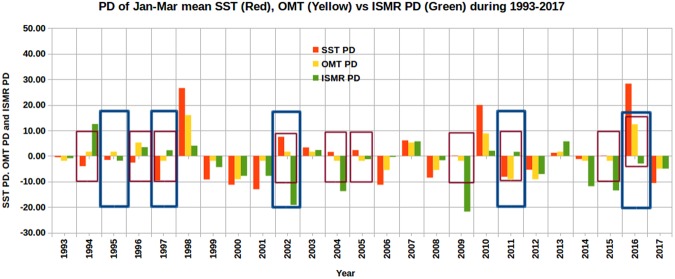
This study examines the benefit of using Ocean Mean Temperature (OMT) to aid in the prediction of the sign of Indian Summer Monsoon Rainfall (ISMR) anomalies. This is a statistical examination, rather than a process study. The thermal energy needed for maintaining and intensifying hurricanes and monsoons comes from the upper ocean, not just from the thin layer represented by sea surface temperature (SST) alone. Here, we show that the southwestern Indian OMT down to the depth of the 26 °C isotherm during January-March is a better qualitative predictor of the ISMR than SST. The success rate in predicting above- or below-average ISMR is 80% for OMT compared to 60% for SST. Other January-March mean climate indices (e.g., NINO3.4, Indian Ocean Dipole Mode Index, El Niño Southern Oscillation Modoki Index) have less predictability (52%, 48%, and 56%, respectively) than OMT percentage deviation (PD) (80%). Thus, OMT PD in the southwestern Indian Ocean provides a better qualitative prediction of ISMR by the end of March and indicates whether the ISMR will be above or below the climatological mean value.
本研究考察了利用海洋平均温度(OMT)来辅助预测印度夏季季风降雨(ISMR)异常的好处。这是一项统计研究,而不是过程研究。维持和增强飓风和季风所需的热能来自海洋上层,而不仅仅来自代表海面温度(SST)的薄层。在这里,我们表明,1 月至 3 月期间西南印度洋的 OMT 下至 26°C 等温水层,是 ISMR 的更好定性预测因子,优于 SST。与 SST 相比,预测高于或低于平均 ISMR 的成功率,OMT 为 80%,而 SST 为 60%。其他 1 月至 3 月的平均气候指数(例如,NINO3.4、印度洋偶极子模式指数、厄尔尼诺南方涛动模态指数)的可预测性(分别为 52%、48%和 56%)低于 OMT 百分比偏差(PD)(80%)。因此,西南印度洋的 OMT PD 可在 3 月底之前提供更好的 ISMR 定性预测,并表明 ISMR 是否高于或低于气候平均值。