Ouakinin Silvia R S, Barreira David P, Gois Carlos J
Faculdade de Medicina, Clínica Universitária de Psiquiatria e Psicologia Médica, Universidade de Lisboa, Lisbon, Portugal.
Serviço de Gastrenterologia e Hepatologia, Centro Hospitalar Lisboa Norte-Hospital de Santa Maria, Lisbon, Portugal.
Front Endocrinol (Lausanne). 2018 Jul 31;9:431. doi: 10.3389/fendo.2018.00431. eCollection 2018.
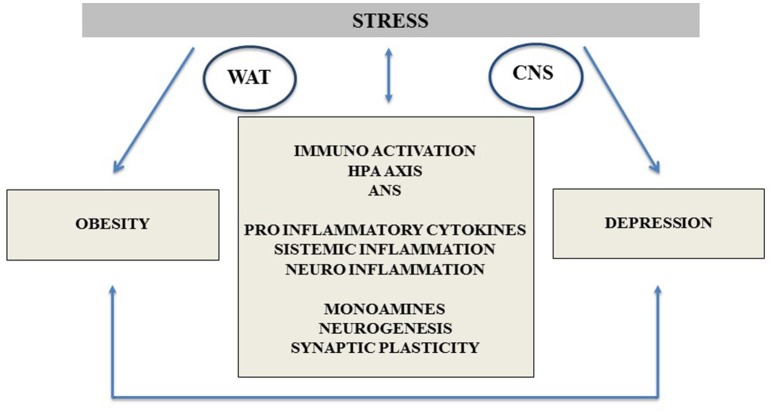
Literature on depression and obesity describes the relevance of the hypothalamic pituitary adrenal axis dysfunction, sympathetic nervous system (SNS) activation, and inflammatory processes as well as the interaction of genetic and environmental factors. Recent investigation in obesity highlights the involvement of several regulation systems, particularly in white adipose tissue. The hypothalamic pituitary adrenal axis, gonadal, growth hormone, leptin, sympathetic nervous system and adrenergic, dopaminergic, and serotoninergic central pathways, all seem interconnected and involved in obesity. From another perspective, the role of psychosocial chronic stressors, determining poor mental and physical health, is well documented. Empirical data can support biologically conceivable theories describing how perceptions of the external social environment are transduced into cellular inflammation and depression. Although in neurobiological models of depression, stress responses are associated with neuroendocrine and neuro-inflammatory processes, concerning similar pathways to those described in obesity, an integrating model is still lacking. The aim of this mini-review is to offer a reflexion on the interplay between the neuroendocrine dysfunctions related to chronic stress and the nature of the shared biologic mechanisms in the pathophysiology of both clinical entities, depression and obesity. We highlight dysfunctional answers of mind body systems that are usually activated to promote regulation and adaptation. Stress response, as a mediator between different level phenomena, may undertake the role of a plausible link between psychological and biological determinants of disease. Depression and obesity are major public health issues, urging for new insights and novel interventions and this discussion points to the need of a more in-depth approach.
关于抑郁症和肥胖症的文献描述了下丘脑 - 垂体 - 肾上腺轴功能障碍、交感神经系统(SNS)激活、炎症过程的相关性,以及遗传和环境因素的相互作用。最近对肥胖症的研究突出了几个调节系统的参与,特别是在白色脂肪组织中。下丘脑 - 垂体 - 肾上腺轴、性腺、生长激素、瘦素、交感神经系统以及肾上腺素能、多巴胺能和5-羟色胺能中枢通路,似乎都相互关联并与肥胖症有关。从另一个角度来看,心理社会慢性应激源对身心健康不佳的影响作用已得到充分证明。实证数据可以支持生物学上合理的理论,这些理论描述了对外部社会环境的认知是如何转化为细胞炎症和抑郁症的。虽然在抑郁症的神经生物学模型中,应激反应与神经内分泌和神经炎症过程相关,涉及与肥胖症中描述的类似途径,但仍缺乏一个综合模型。本综述的目的是对与慢性应激相关的神经内分泌功能障碍以及抑郁症和肥胖症这两种临床实体病理生理学中共享生物学机制的性质之间的相互作用进行反思。我们强调身心系统的功能失调反应,这些反应通常被激活以促进调节和适应。应激反应作为不同层次现象之间的中介,可能在疾病的心理和生物学决定因素之间起到合理的联系作用。抑郁症和肥胖症是主要的公共卫生问题,迫切需要新的见解和新颖的干预措施,而本讨论指出了需要更深入方法的必要性。