Millenet Sabina K, Nees Frauke, Heintz Stefan, Bach Christiane, Frank Josef, Vollstädt-Klein Sabine, Bokde Arun, Bromberg Uli, Büchel Christian, Quinlan Erin B, Desrivières Sylvane, Fröhner Juliane, Flor Herta, Frouin Vincent, Garavan Hugh, Gowland Penny, Heinz Andreas, Ittermann Bernd, Lemaire Herve, Martinot Jean-Luc, Martinot Marie-Laure P, Papadoulos Dimitri O, Paus Tomáš, Poustka Luise, Rietschel Marcella, Smolka Michael N, Walter Henrik, Whelan Rob, Schumann Gunter, Banaschewski Tobias, Hohmann Sarah
Department of Child and Adolescent Psychiatry and Psychotherapy, Central Institute of Mental Health, Medical Faculty Mannheim, Heidelberg University, Mannheim, Germany.
Department of Cognitive and Clinical Neuroscience, Central Institute of Mental Health, Medical Faculty Mannheim, Heidelberg University, Mannheim, Germany.
Front Genet. 2018 Jul 31;9:284. doi: 10.3389/fgene.2018.00284. eCollection 2018.
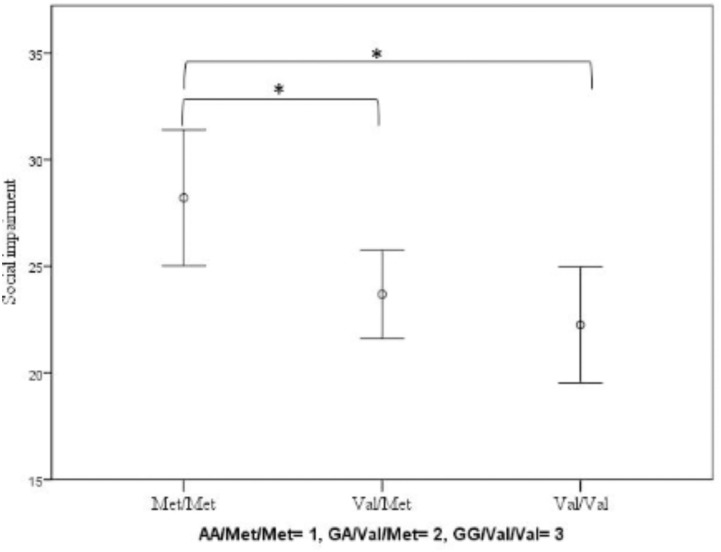
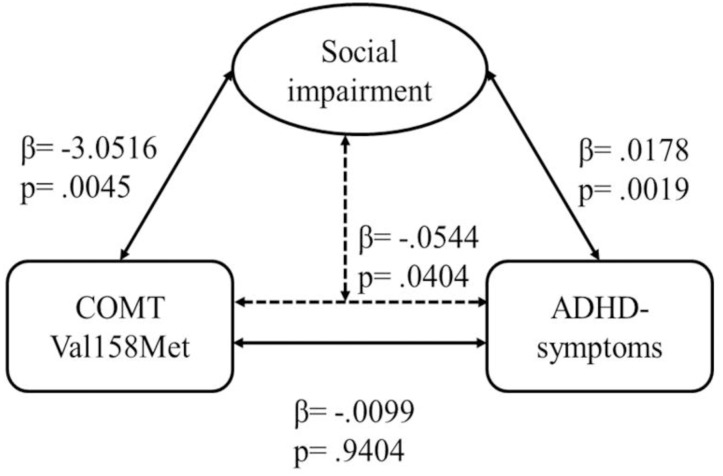
The dopaminergic system has been shown to have substantial effects on the etiology of attention-deficit hyperactivity disorder (ADHD). However, while some studies found a significant direct effect, others did not. In this context, social behavior might play an important role as a factor that is related both to the dopaminergic system and ADHD. In a large epidemiological sample of adolescents ( = 462; 16-17 years), we assessed the level of ADHD symptoms using the Strengths and Difficulties Questionnaire, social behavior using the Social Responsiveness Scale, and the allelic distribution of the dopaminergic catechol--methyltransferase () Val158Met polymorphism. We found a significant association between and social impairment, insofar as Met-allele carriers showed increased levels of social impairment. Moreover, social impairment significantly determined an association between and ADHD (explained variance: 19.09%). This effect did not significantly differ between males and females. and social impairment might interactively affect ADHD symptomatology, and could thus represent significant gene-phenotypic risk factors for ADHD symptomatology. This might have interesting implications for prevention and intervention strategies with a focus on social behavior in genetically at-risk individuals.
多巴胺能系统已被证明对注意力缺陷多动障碍(ADHD)的病因有重大影响。然而,虽然一些研究发现了显著的直接影响,但其他研究则未发现。在这种情况下,社会行为可能作为一个与多巴胺能系统和ADHD都相关的因素发挥重要作用。在一个大型青少年流行病学样本(n = 462;16 - 17岁)中,我们使用优势与困难问卷评估ADHD症状水平,使用社会反应量表评估社会行为,并评估多巴胺能儿茶酚 - O - 甲基转移酶(COMT)Val158Met多态性的等位基因分布。我们发现COMT与社会功能损害之间存在显著关联,因为携带Met等位基因者的社会功能损害水平有所增加。此外,社会功能损害显著决定了COMT与ADHD之间的关联(解释方差:19.09%)。这种效应在男性和女性之间没有显著差异。COMT和社会功能损害可能相互作用影响ADHD症状表现,因此可能是ADHD症状表现的重要基因 - 表型风险因素。这可能对以遗传易患个体的社会行为为重点的预防和干预策略具有有趣的启示。