Hannig Christian, Helbig Ralf, Hilsenbeck Julia, Werner Carsten, Hannig Matthias
Clinic of Operative and Pediatric Dentistry, Medical Faculty Carl Gustav Carus, Technische Universität Dresden, Fetscherstraße 74, 01307 Dresden, Germany.
Max Bergmann Center of Biomaterials, Leibniz-Institut für Polymerforschung Dresden e.V., Hohe Strasse 6, 01069 Dresden, Germany.
R Soc Open Sci. 2018 Jul 4;5(7):171742. doi: 10.1098/rsos.171742. eCollection 2018 Jul.
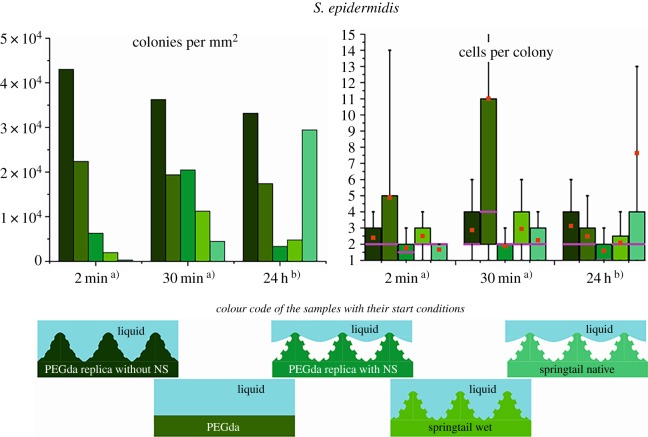
Springtails (Collembola) have a nanostructured cuticle. To evaluate and to understand anti-biofouling properties of springtail cuticles' morphology under different conditions, springtails, shed cuticles and cuticle replicates were studied after incubation with protein solutions and bacterial cultures using common models. In a second step, they were exposed to human oral environment in order to explore potential application in dentistry. , the cuticular structures were found to resist wetting by albumin solutions for up to 3 h and colonization by was inhibited. When exposed in the oral cavity, initial pellicle formation was of high heterogeneity: parts of the surface were coated by adsorbed proteins, others remained uncoated but exhibited locally attached, 'bridging', proteinaceous membranes spanning across cavities of the cuticle surface; this unique phenomenon was observed for the first time. Also the degree of bacterial colonization varied considerably. In conclusion, the springtail cuticle partially modulates bioadhesion in the oral cavity in a unique and specific manner, but it has no universal effect. Especially after longer exposure, the nanotextured surface of springtails is masked by the pellicle, resulting in subsequent bacterial colonization, and, thus, cannot effectively avoid bioadhesion in the oral cavity comprehensively. Nevertheless, the observed phenomena offer valuable information and new perspectives for the development of antifouling surfaces applicable in the oral cavity.
跳虫(弹尾目)具有纳米结构的表皮。为了评估和了解不同条件下跳虫表皮形态的抗生物污染特性,使用常见模型对跳虫、蜕下的表皮和表皮复制品在与蛋白质溶液和细菌培养物孵育后进行了研究。第二步,将它们暴露于人类口腔环境中,以探索在牙科领域的潜在应用。结果发现,表皮结构在长达3小时内可抵抗白蛋白溶液的润湿,并且抑制了细菌的定殖。当暴露于口腔中时,初始牙菌斑的形成具有高度异质性:部分表面被吸附的蛋白质覆盖,其他部分未被覆盖,但呈现出局部附着的、“桥接”的蛋白质膜,横跨表皮表面的腔隙;这种独特现象首次被观察到。细菌定殖的程度也有很大差异。总之,跳虫表皮以独特而特定的方式部分调节口腔中的生物粘附,但没有普遍效果。特别是在长时间暴露后,跳虫的纳米纹理表面被牙菌斑掩盖,导致随后的细菌定殖,因此不能全面有效地避免口腔中的生物粘附。尽管如此,观察到的现象为开发适用于口腔的防污表面提供了有价值的信息和新的视角。